As modern warfare continues to evolve, so too must the tools and technologies used by the U.S. Marine Corps.
One area of particular concern in recent years has been the threat posed by unmanned aerial systems (UAS), or drones—particularly as demonstrated in ongoing global conflicts.
At this year’s Modern Day Marine expo in Washington, D.C., Marine Corps officials emphasized the need to modernize their Amphibious Combat Vehicle (ACV) platform, with a specific eye toward integrating a counter-drone capability.
Col. Tim Hough, the Corps’ program manager for advanced amphibious assault, told attendees that lessons drawn from the war in Ukraine have brought the threat of drones into sharper focus for military planners.
Here's What They're Not Telling You About Your Retirement
“What’s kind of growing as everybody’s been watching the fight in Ukraine over the past four years is that counter-UAS threat,” Hough said.
“It’s no secret, and armored vehicles are a juicy target on the battlefield. And I don’t think the ACV would be any different.”
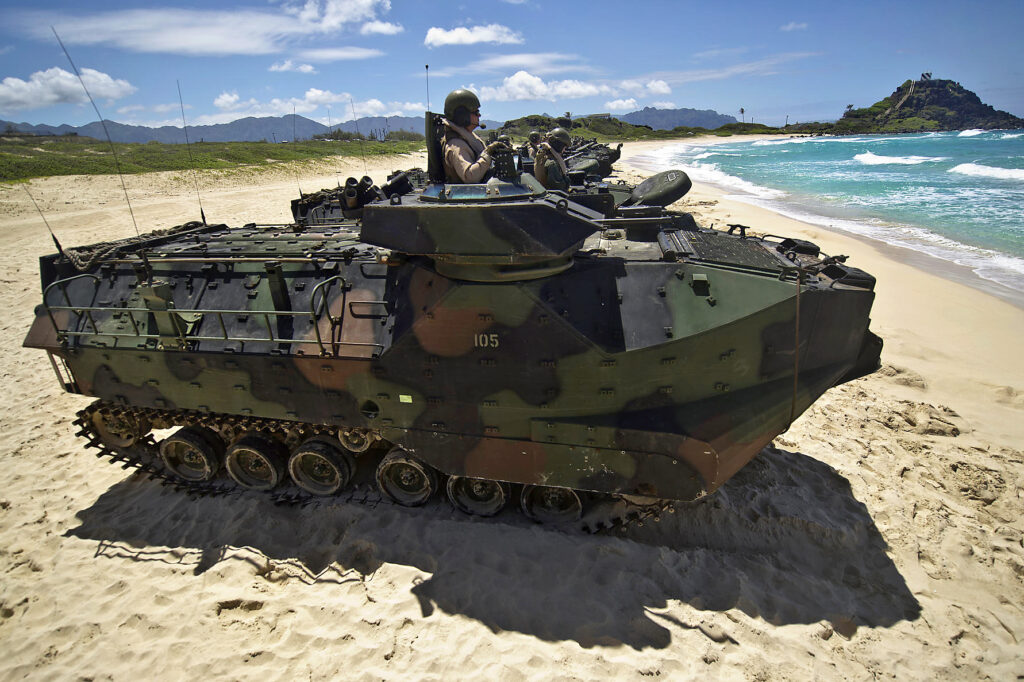
Indeed, as drones become more advanced, accessible, and lethal, the ability to detect and neutralize these threats is becoming a necessary feature of any modern combat vehicle.
This Could Be the Most Important Video Gun Owners Watch All Year
Although the exact nature of the Marine Corps’ counter-UAS integration remains undecided, Hough said the service is in the “market research” phase and carefully evaluating both needs and feasible solutions.
“Unlike any other armored platform on the battlefield, we have a unique requirement, and that’s, we’ve got to push a 72,000-pound brick through the water upwards of 12 nautical miles,” he explained.
“Every time we bolt on another capability, we’ve got to make sure we’re not getting ahead of ourselves with the amount of weight we can put on the vehicle before we start limiting that water mobility.”
Weight constraints and aquatic capabilities are crucial considerations, given that the ACV must not only function as a land-based combat platform but also retain the ability to operate in maritime environments.
This dual role makes integrating additional equipment—such as sensors, radar systems, or kinetic weapons for drone defense—a balancing act between protection, performance, and amphibious agility.
One option under discussion includes a counter-UAS radar integrated into the vehicle’s turret, though Hough was quick to note, “It’s wide open at this point.”
That open-ended approach reflects the Marine Corps’ desire to stay flexible as technologies and threats continue to develop rapidly.
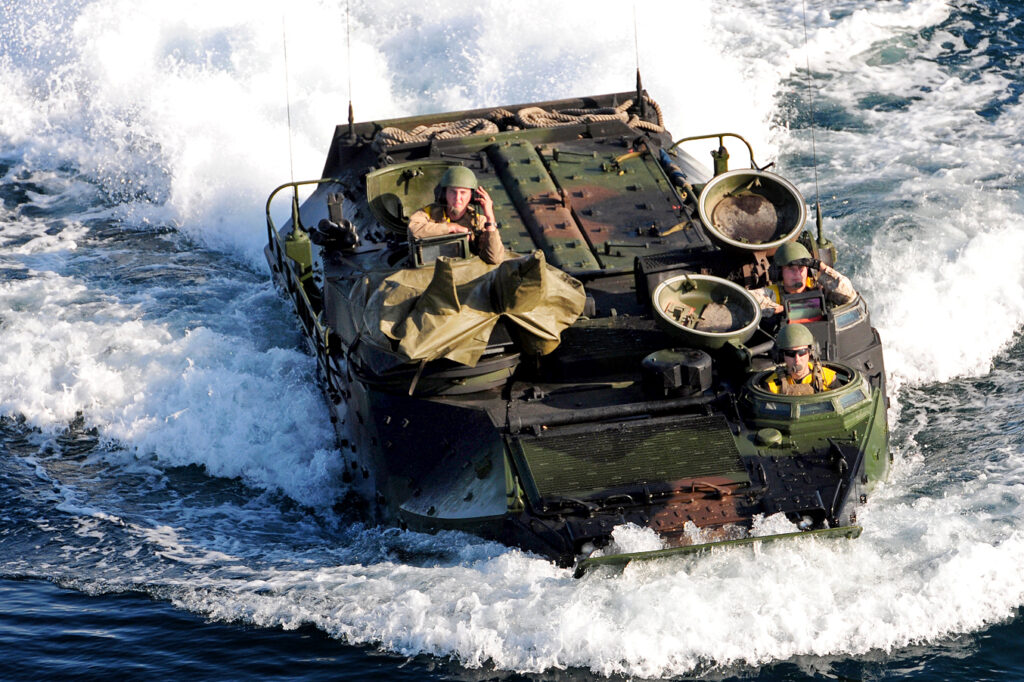
PACIFIC OCEAN (Nov. 1, 2011) An amphibious assault vehicle assigned to the 11th Marine Expeditionary Unit (11th MEU) approaches the amphibious assault ship USS Makin Island (LHD 8). Makin Island is underway for routine operations off the coast of Southern California in preparation for the ship's first operational deployment later this year. (U.S. Navy photo by Mass Communication Specialist 1st Class Douglas Bedford/Released)
The ACV program represents a significant modernization of the Marine Corps’ amphibious capabilities, replacing the decades-old Assault Amphibious Vehicle (AAV), which Hough referred to as the service’s “armored Winnebago.”
The ACV’s introduction marks the first new amphibious platform in nearly 50 years.
It has already achieved several milestones, including a successful waterborne gunnery mission using its Mk 19 40mm grenade machine guns during a Pacific deployment last year—an achievement Hough noted as a unique milestone for the Corps.
Beyond the baseline troop transport variant, the Marine Corps is in the final testing phases for multiple ACV configurations.
These include the ACV-30, which features a 30mm cannon to enable engagements with enemy armored vehicles, and a recovery variant equipped with a crane for battlefield repair missions.
The ACV-30 is expected to reach initial operational capability by 2026, with the recovery version slated for 2027.
Operational testing for the ACV-30 began earlier this year at the U.S. Army Aberdeen Test Center in Maryland and at Camp Pendleton in California.
According to Hough, the vehicle is now undergoing cyber vulnerability assessments to ensure its resilience in the face of electronic warfare and hacking attempts—an increasingly relevant concern in today’s digitized battlespace.
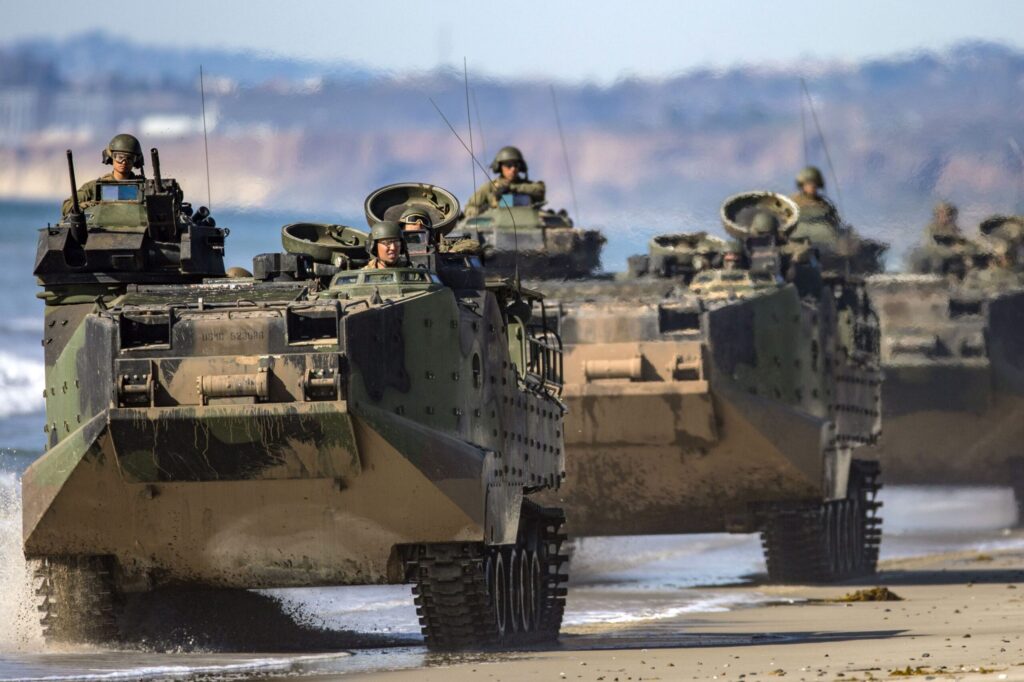
Despite a rocky start—most notably a tragic 2020 incident in which an AAV sank, claiming the lives of nine Marines and sailors—the ACV program has since rebounded and now appears to be on steadier ground.
As Hough emphasized, the focus is shifting to the future, with the Corps preparing to publish multiple market research requests later this year to explore potential enhancements.
The counter-UAS system is just one of several items on that list.
Other desired upgrades include better water maneuverability, increased vehicle responsiveness and speed, more automation to ease the driver’s workload, reduced noise for stealthier operations, and enhanced situational awareness systems.
These additions are part of a broader effort to future-proof the platform against evolving threats and mission demands.
As the Marine Corps continues to refine the ACV, the push to incorporate counter-drone systems underscores the growing complexity of modern battlefields.
What was once a straightforward amphibious personnel carrier is rapidly transforming into a modular, high-tech war machine capable of countering a wide array of threats—on land, at sea, and now, in the skies above.
The question is not if the ACV will be upgraded with counter-UAS capabilities, but how—and how soon.
Join the Discussion
COMMENTS POLICY: We have no tolerance for messages of violence, racism, vulgarity, obscenity or other such discourteous behavior. Thank you for contributing to a respectful and useful online dialogue.