In a harrowing rescue mission that tested both skill and endurance, U.S. Coast Guard rescue swimmers and an MH-60 Jayhawk helicopter crew saved four workers trapped in an industrial tank after a catastrophic roof collapse in Taholah, Washington.
The daring three-hour effort involved hoisting injured men through jagged rebar and hardening concrete, all while battling time, rotor wash, and communication limitations.
The call for help came just after the Coast Guard crew had completed a routine training flight.
By chance, they had been practicing hoists over dry land that morning. But when they returned to Coast Guard Air Station Astoria, a request for assistance arrived from local first responders.
Here's What They're Not Telling You About Your Retirement
“We got the word it might be four people trapped inside of a water tower that had potentially collapsed, and that was really all we got,” said pilot Lt. Michael Travers.
“It worked out because most of us were already in our dry suits, ready to go.”
The crew included Travers, co-pilot Lt. Michael Buhl, flight mechanic Logan Harris, and rescue swimmers Chief Benjamin Brown and Aviation Survival Technician Jon Claridge.
Brown, realizing the complexity of inland rescues, immediately recommended bringing a second swimmer. “It’s nice to have a second person on the ground,” he said.
This Could Be the Most Important Video Gun Owners Watch All Year
After a 30-minute flight to the site atop a mountain on the Olympia Peninsula, the crew arrived to find that the local fire department had no means to reach the trapped workers.
With no safe access from the ground, the Coast Guard team determined they would need to lower the rescue swimmers into the collapsed tank from 120 feet above.
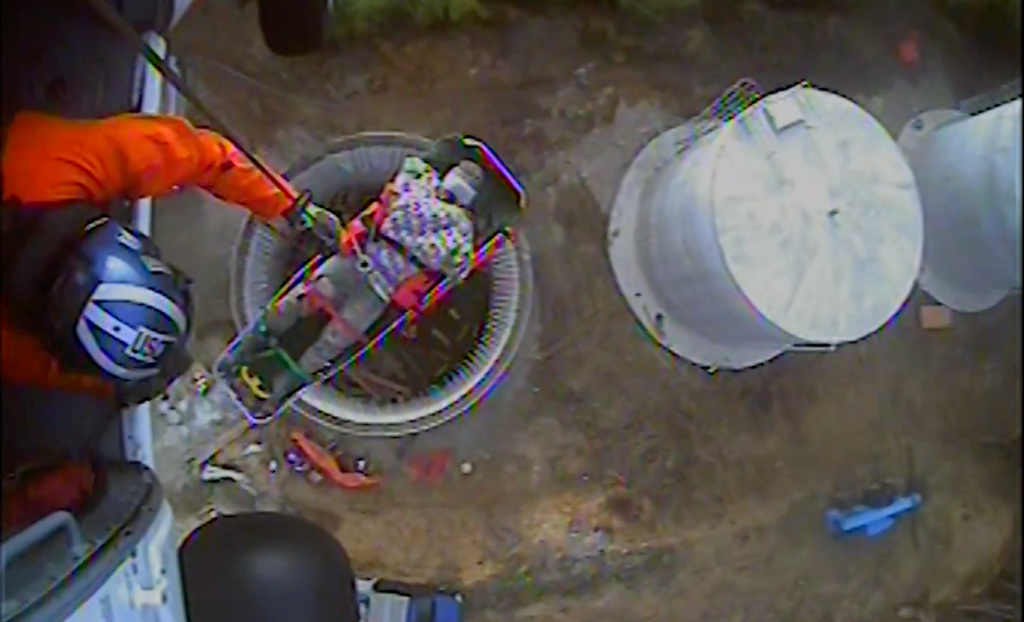
That altitude—three times higher than typical Coast Guard hoists—was necessary due to the tank’s structure. “Devices coming up and down can get impacted by the rotor wash and get a bad swing,” said Harris.
“That swing heading toward rebar is not good.”
Inside the tank, the scene was grim. The steel roof had given way during a concrete pour, sending four men and tons of debris plummeting into the 40-foot deep structure.
Two of the workers were critically injured, one of whom was stuck in a pool of uncured concrete.
“The consistency was just like mud when we initially got down there,” Brown said.
“Then as the scene went on, it started to cure and got a little harder. One of the patients was lying on his back, sort of, like, as if he had fallen in mud. So we had to kind of dig him out.”
Claridge described the challenge of freeing the man: “I was having to use my hands and dig some of that wet concrete away from his side, because we only had like six inches all around him to work. So we were just digging, like, holes to try and get space to move in.”
Despite their expertise in open-ocean rescues, the confined industrial environment was new and demanding.
The swimmers worked quickly to stabilize injuries and prepare the patients for extraction.
The team initially hoped to use a rescue basket, but all four men were too badly injured and required spinal backboards and full steel litters.
“From the height of the hoist, it’s hard to tell exactly what the swimmers are looking at down there,” Harris noted.
“So I was trying to keep [a] really close eye on their hand signals—where they need to go, where they need devices to be.”
Over the course of three hours, Harris—on just his second live rescue—executed more than a dozen hoists. Each litter had to be carefully guided past steel rods protruding from the tank’s collapsed rim.
“Navigating devices in and out of that environment was particularly tricky,” he said.
Fuel was also a concern. The helicopter had enough for five hours, but prolonged hovering cut deeply into that reserve. Worse, the tank’s metal walls interfered with radio communications.
“We had no way to communicate with them unless we were directly over the top,” Travers said. “We just went into what we call a max endurance orbit over the top and primarily operated off hand signals instead of a radio.”
One key to the mission’s success was the rapid support from local fire and EMS crews.
Ambulances were lined up just 200 yards from the tank, and every time a patient was lifted out, the helicopter landed to hand them off and receive a new backboard.
“We would not have been as successful without the help of the local EMS and fire department,” Travers emphasized.
“They really set up a pretty amazing operation on the ground for us to be able to transfer the patients quickly.”
Though the mission pushed everyone to their limits, all four workers were rescued and transported for medical treatment.
And while most of the crew were seasoned veterans, it was Harris—on just his second real-world mission—who underscored the quiet strength of the Coast Guard's training and teamwork.
“I definitely pushed the envelope for me personally,” Harris said. “But we had a solid crew that kind of kept everything together.”
Join the Discussion
COMMENTS POLICY: We have no tolerance for messages of violence, racism, vulgarity, obscenity or other such discourteous behavior. Thank you for contributing to a respectful and useful online dialogue.