The U.S. Army is poised to take a significant leap toward energy independence and resilience with the development and deployment of nuclear microreactors at military installations.
This initiative follows an executive order issued by President Donald Trump on May 23, which mandates the use of advanced nuclear technology to support national security objectives and energy requirements across both domestic and deployed military operations.
The order specifically tasks Army Secretary Daniel Driscoll with establishing a comprehensive program to integrate advanced reactor technologies—including Generation III+ reactors, small modular reactors, microreactors, and both stationary and mobile variants—into the Army’s energy strategy.
These systems are intended to provide "resilient, secure, and reliable power to critical defense facilities and other mission capability resources," according to the language of the order.
Here's What They're Not Telling You About Your Retirement
A key directive in the order sets a deadline for the operation of at least one nuclear reactor at a domestic military base by September 30, 2028.
This milestone signals a major shift in how the U.S. military powers its infrastructure, particularly amid increasing concerns over grid vulnerability, cyber threats, and logistical constraints in remote or contested environments.
Army Secretary Driscoll and Army Chief of Staff Gen. Randy George addressed the issue during testimony before the House Armed Services Committee this week. When asked by Rep. Derrick Van Orden, R-Wis., about the strategic value of microreactors, Driscoll voiced strong support for the program.
“I think microreactors can be an incredible asset as we solve against the future energy needs of the United States Army, both CONUS [continental United States], OCONUS [outside the continental U.S.] and peacetime and wartime,” Driscoll stated. “We are excited to lead that effort.”
This Could Be the Most Important Video Gun Owners Watch All Year
While no specific installations have been publicly identified as initial sites for reactor deployment, both Driscoll and George emphasized the potential of microreactors to boost energy resilience and operational independence for bases across the globe.
These compact nuclear systems are designed to supply consistent, long-duration power without reliance on external fuel supplies, offering a critical advantage in both domestic and forward-deployed scenarios.
The concept of microreactors powering military bases is not entirely new. In early 2022, the Pentagon announced “Project Pele,” an ambitious program aimed at creating a transportable nuclear microreactor capable of supporting military operations in austere environments.
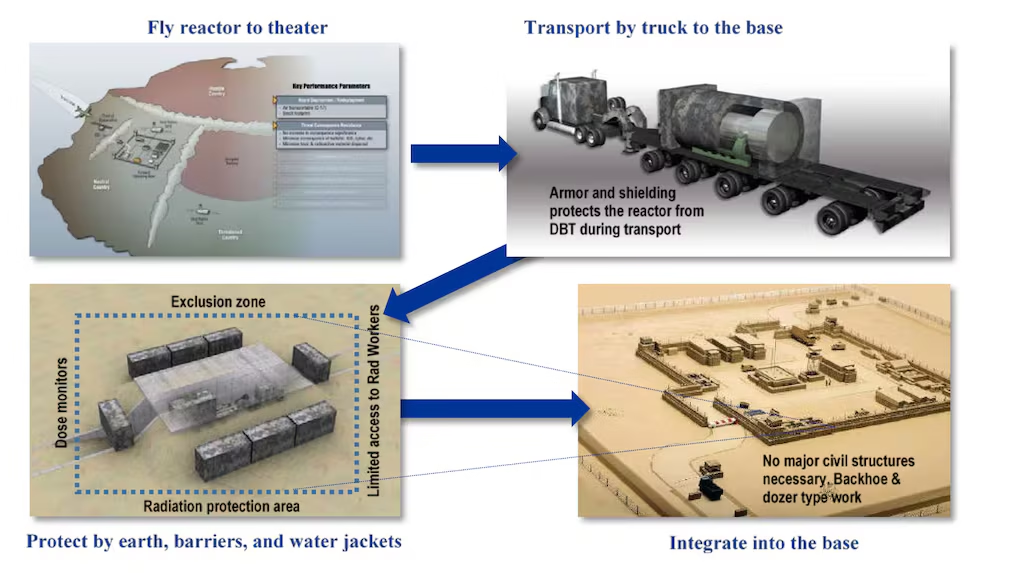
The proposed design called for a 40-ton system compact enough to fit into three to four standard 20-foot shipping containers. This modularity allows the reactor to be airlifted via C-17 cargo aircraft and rapidly deployed to remote locations.
Project Pele’s reactor is expected to deliver between one and five megawatts of electrical power, with a runtime of up to three years before needing refueling.
Such a capability would drastically reduce the military’s dependence on vulnerable fuel supply lines, especially in contested zones or areas lacking traditional infrastructure.
The name "Pele" is both symbolic and technical. In Hawaiian mythology, Pele is the goddess of fire and volcanoes, a nod to the reactor's immense energy potential. The acronym also stands for "Portable Energy for Lasting Effects," underscoring the Pentagon’s vision of long-term, deployable power solutions.
To bring the project to life, the Department of War awarded a $300 million contract in June 2022 to BWX Technologies, based in Lynchburg, Virginia.
The company is charged with designing and constructing the reactor, advancing the DoW's broader strategy to modernize energy systems in alignment with emerging threats and technological advancements.
As global adversaries target critical infrastructure and energy supply chains become increasingly contested, the ability to generate on-site, secure power is becoming an indispensable asset for national defense.
The Army’s leadership role in this initiative highlights the branch’s growing emphasis on innovation and sustainability in operational planning.
With a clear deadline set and funding already in motion, the next few years will be pivotal as the Army, in collaboration with industry partners and defense stakeholders, works to realize a future where nuclear microreactors quietly and efficiently power the nerve centers of American military might.
Join the Discussion
COMMENTS POLICY: We have no tolerance for messages of violence, racism, vulgarity, obscenity or other such discourteous behavior. Thank you for contributing to a respectful and useful online dialogue.