In a major step to bolster national security and border enforcement, the U.S. Air Force has been tasked with managing a newly established militarized zone in Texas, directly along the U.S.-Mexico border.
The Department of War designated this area a National Defense Area (NDA), stretching 250 miles across the Rio Grande River through Hidalgo and Cameron counties.
It will be overseen as an extension of Joint Base San Antonio.
This marks the third such zone declared by the Pentagon in recent months.
Here's What They're Not Telling You About Your Retirement
The first NDA was instituted in New Mexico on April 21, followed by a second in west Texas on May 1.
The latest development expands military presence and infrastructure in response to growing concerns over illegal immigration and drug trafficking across the southern border.
The Air Force, in coordination with U.S. Northern Command, will be the lead agency managing the area.
“The secretary of the Air Force and the commander of U.S. Northern Command will collaborate closely to manage the area,” the service announced in a release.
This Could Be the Most Important Video Gun Owners Watch All Year
The creation of these NDAs stems from a series of executive orders issued by President Donald Trump, aimed at securing the U.S. southern border.
The Trump administration has framed these efforts not only as a necessary response to illegal immigration but also as a critical maneuver to combat the flow of narcotics from Mexican cartels into the United States.
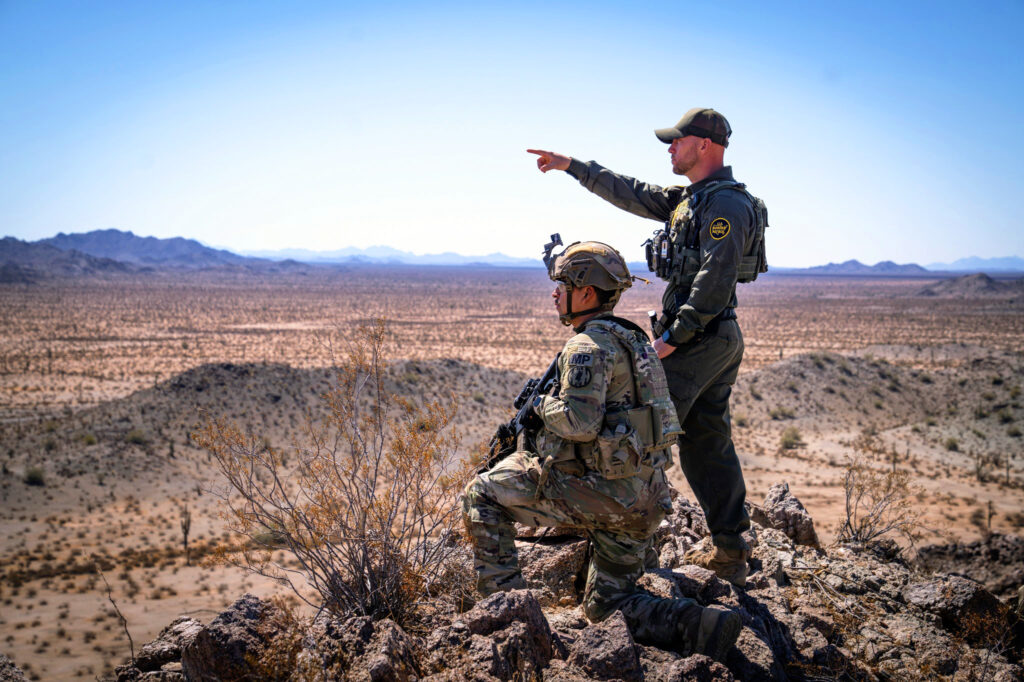
As military and law enforcement presence has intensified along the land border, drug traffickers have adapted by exploiting alternative routes — particularly via water.
This has led to the deployment of naval warships equipped with Coast Guard Law Enforcement Detachment (LEDET) teams to patrol maritime routes, perform interdictions, and close off vulnerable access points.
The effectiveness of this heightened security posture is already being seen in recent operations.
In Cameron County, near the heart of the newly established NDA, a law enforcement sweep earlier this month led to the seizure of over 100 pounds of marijuana. The area is described by officials as a “hotspot” heavily influenced by the Gulf Cartel.
In another incident, smugglers attempting to transport bundles of illegal drugs across the Rio Grande into South Texas were thwarted by coordinated interdiction efforts.
Personnel assigned to the NDA will serve under Joint Task Force-Southern Border (JTF-SB), which is responsible for the area’s overall security.
Their tasks will include installing physical barriers, posting warning signs, conducting ground patrols, and intercepting unauthorized individuals.

The military’s role is limited to temporary detainment, after which trespassers will be transferred to civilian law enforcement.
“Trespassers into military zones potentially face prosecution for two federal offenses — illegally entering the country and trespassing on U.S. military property,” officials confirmed.
The military is also leveraging advanced technology to enhance situational awareness and coverage of the expansive terrain.
Ground-based radar systems are now in use to detect movement in remote areas and alert law enforcement of suspicious activities.
These systems have proven effective in identifying increased drone activity — a tactic frequently used by narcotics traffickers to avoid detection.
To reduce logistical costs and maintain a sustained aerial presence, JTF-SB has also adopted 3-D printing technology to manufacture surveillance drones on-site.
These drones are tailored to the region’s surveillance needs and have enabled more flexible, efficient coverage.

Additionally, Stryker armored vehicles equipped with advanced camera systems and capable of navigating rough terrain have been deployed to further boost mobility and reconnaissance capabilities in hard-to-reach zones.
While the expanded military presence marks a significant escalation in border enforcement strategy, early signs suggest it is already yielding results. As of May, officials reported that overall illegal border crossings were on the decline.
The implementation of these National Defense Areas signals a determined and coordinated effort between military and law enforcement entities to reclaim control over the southern border, disrupt cartel operations, and reinforce national sovereignty.
As challenges evolve, the Pentagon’s approach — blending high-tech tools with on-the-ground tactical readiness — represents a new era of border defense.
Join the Discussion
COMMENTS POLICY: We have no tolerance for messages of violence, racism, vulgarity, obscenity or other such discourteous behavior. Thank you for contributing to a respectful and useful online dialogue.