The U.S. Navy has submitted a sweeping fiscal year 2026 budget request totaling $292.2 billion, with a significant portion aimed at bolstering shipbuilding efforts, advancing new technologies, and overhauling the nation's aging naval shipyards.
As global maritime threats evolve and China’s naval expansion accelerates, American military leaders are under mounting pressure to modernize the fleet and revitalize infrastructure that in many cases dates back over a century.
The Navy’s funding request is part of a broader $848.3 billion Department of War proposal — a decrease in real terms when adjusted for inflation.
But what sets this year's budget apart is its reliance on two separate funding bills: a $248.9 billion base budget and a $43.3 billion reconciliation package.
Here's What They're Not Telling You About Your Retirement
This bifurcated approach has raised concerns among lawmakers, who warn that crucial Navy programs could be jeopardized if reconciliation funds fail to materialize.

“Reconciliation was always meant to be just a one-time funding surge,” Sen. Susan Collins, R-Maine, said during a Senate Appropriations Subcommittee on Defense hearing.
She urged an increase in the base budget to ensure the Navy's critical needs aren't left to chance in future political negotiations.
This Could Be the Most Important Video Gun Owners Watch All Year
Among the most notable elements of the Navy’s proposal is a robust $47.4 billion shipbuilding fund, of which $26.5 billion would come from reconciliation dollars.
That investment would support the procurement of 19 battle-force ships in fiscal 2026. However, only three of those ships — a Columbia-class submarine, a Virginia-class submarine, and a T-AGOS ocean surveillance ship — would be funded through the base budget.
The remaining 16 would depend on mandatory reconciliation funds, deepening lawmakers' concerns over financial uncertainty.
This comes at a time when both military officials and defense analysts are increasingly vocal about the U.S. shipbuilding sector’s lagging pace compared to global competitors, particularly the People's Republic of China.
The Navy is currently behind schedule on several key ship deliveries and has not provided definitive timelines for resolving those delays, officials admitted to the Senate panel.
To address these shortcomings, the Navy has earmarked $989 million as part of the Shipyard Infrastructure Optimization Plan (SIOP) to update its four public shipyards — Norfolk (Virginia), Pearl Harbor (Hawaii), Portsmouth (Maine), and Puget Sound (Washington).
On average, these facilities are over 107 years old. Budget documents underscore the urgency, noting that shipyards are “facing a critical age crisis.”
“The state of our public shipyards is unacceptable for a nation with global maritime responsibilities,” one official said during the hearing.
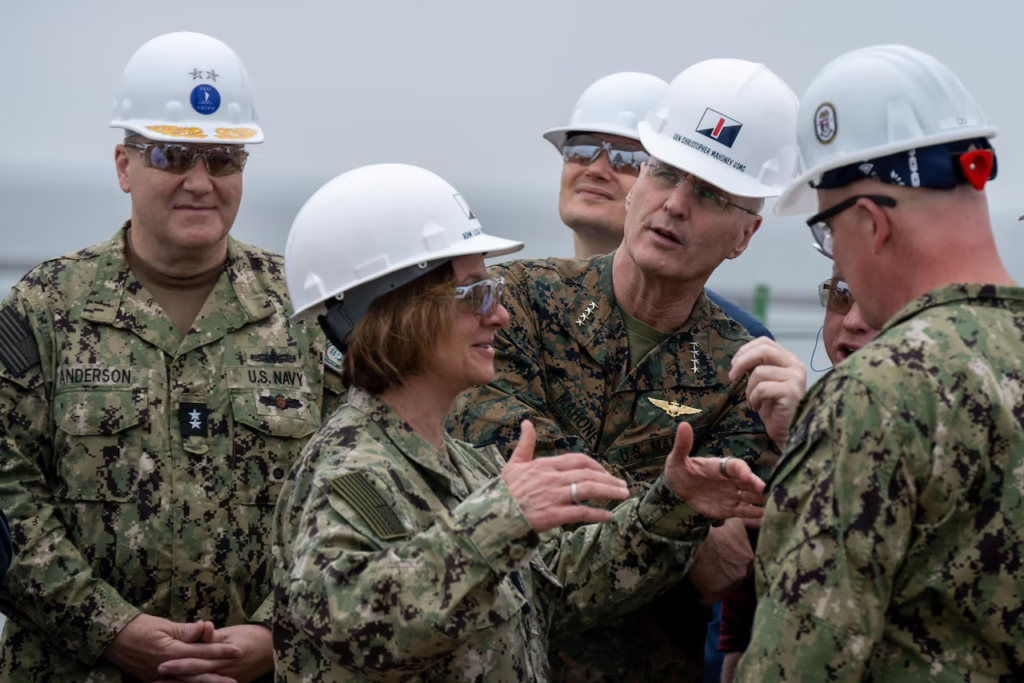
In addition to SIOP investments, $2.2 billion is being requested for modernizing Marine Corps installations, highlighting the Navy’s broader focus on updating its physical infrastructure across both maritime and land-based assets.
For ship maintenance, the base budget includes $16.2 billion, while funding for other maintenance and modernization projects will be split between base and reconciliation allocations.
Operational funding for ships stands at $7.3 billion, with $5.4 billion from the base budget and $1.9 billion from reconciliation.
The Navy also aims to boost its air capabilities, seeking funds for the procurement of 43 aircraft — a mix of manned and unmanned systems, including both fixed-wing and rotary aircraft.
This aligns with the service’s growing emphasis on technological innovation and autonomous capabilities.
A notable portion of the budget — $2.7 billion, with $39.4 million designated as mandatory funding — is dedicated to science and technology initiatives.
This includes $312 million for further design and development of the Columbia-class submarine, particularly its nuclear propulsion systems.
Additionally, $623 million would go toward developing the Future Attack Submarine, which officials say is crucial to countering evolving threats from potential adversaries.
Autonomous systems also feature prominently in the Navy’s modernization plans.
The budget requests $203 million for robotic surface vessels, $715 million for air-based autonomous platforms, and $668 million for undersea autonomous systems.
The fiscal 2026 proposal illustrates the Navy’s commitment to bridging its capability gaps while navigating political and financial constraints.
However, the heavy reliance on reconciliation funds to support long-term, strategic programs has drawn bipartisan scrutiny.
As the budget works its way through Congress, much will depend on whether lawmakers can agree on how best to fund America’s maritime future.
For now, the Navy’s ambitions are clear: modernize the fleet, revitalize crumbling infrastructure, and invest in the technology that will define tomorrow’s battlespace.
Join the Discussion
COMMENTS POLICY: We have no tolerance for messages of violence, racism, vulgarity, obscenity or other such discourteous behavior. Thank you for contributing to a respectful and useful online dialogue.
This was long overdue, but very necessary.
After 40 years working within the buildup of the US Navy during the Reagan years, through the reduction of new classes of ships due to the “peace dividend” of the 1990’s, then believing 9/11 will bring more defense spending, but instead it brought us the littoral ship design failures and waste of money on “innovation” with the DDGX program. Maybe, just maybe the Navy sees another chance to right the shipbuilding and get back to ruling the 7 seas.