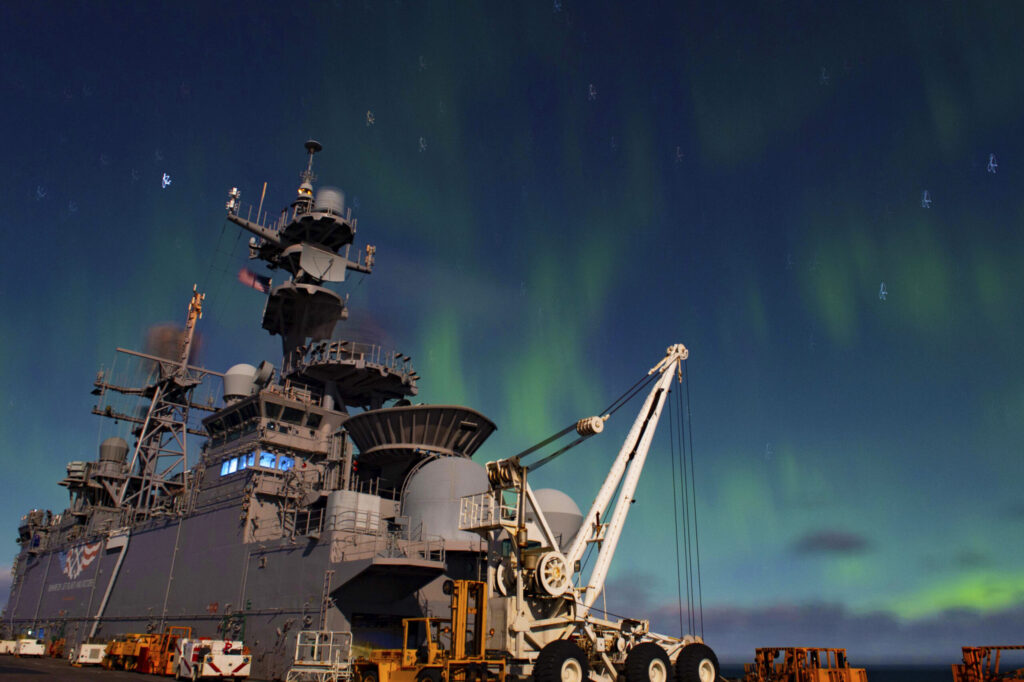
The USS Iwo Jima Amphibious Ready Group has once again departed from Norfolk, Virginia, only days after returning to port in order to avoid the impact of Hurricane Erin.
The group of three amphibious ships, carrying more than 4,500 sailors and Marines, was seen leaving Norfolk on Sunday in images and videos shared across social media.
Their departure marks the continuation of a mission that had been briefly interrupted by severe weather conditions.
An official said last week, under the condition of anonymity to discuss the deployment, explained that the ships had originally planned to enter Caribbean waters under the authority of U.S. Southern Command when they first deployed on August 14.
Here's What They're Not Telling You About Your Retirement
Because of Hurricane Erin, however, their movement had been temporarily delayed. With the storm now passed, the group is able to resume its mission as intended.
The Amphibious Ready Group includes the amphibious assault ship USS Iwo Jima, which serves as the flagship, along with the San Antonio-class amphibious transport dock ships USS San Antonio and USS Fort Lauderdale.
Together, these vessels are carrying the 22nd Marine Expeditionary Unit. The deployment is notable because it is the first time in more than five months that a Marine Expeditionary Unit has been sent out, reflecting the importance of the mission and the readiness of the forces aboard.

This Could Be the Most Important Video Gun Owners Watch All Year
Although the Pentagon has not disclosed the specific exercises or operations that the Marines will carry out while in the Caribbean, the timing of the deployment aligns with broader goals outlined by President Donald Trump.
The president has emphasized strengthening the U.S. military while also addressing immigration challenges and curbing the flow of illicit drugs into the United States.
In February, he designated Mexico’s Sinaloa Cartel and Venezuela’s Tren de Aragua criminal group as global terrorist organizations, a move underscoring his administration’s focus on combatting organized crime and transnational threats.
Earlier this year, several Navy destroyers were deployed to the eastern Pacific to reinforce efforts against narcotics trafficking on the West Coast.
These ships were tasked with supporting counter-drug operations, further highlighting the military’s role in confronting challenges that extend beyond traditional defense missions.
The deployment of the Iwo Jima Amphibious Ready Group appears to complement these earlier efforts by increasing the U.S. presence in the Caribbean, where smuggling routes are often used by traffickers.
One of the critical tools available during these operations is the ability for Coast Guard law enforcement teams, embarked on Navy vessels, to exercise what is commonly referred to as a “title shift.”
When suspicious vessels are encountered at sea, the Coast Guard team can raise its ensign, which shifts the ship’s authority under Title 14 of U.S. law.
This grants the vessel the power to conduct a wide range of law enforcement actions, including inquiries, examinations, searches, seizures, and arrests.
Because this process allows Navy ships to operate temporarily as law enforcement platforms, it greatly enhances the United States’ ability to intercept drug smugglers and migrant traffickers.
The re-departure of the Iwo Jima group is a clear demonstration of adaptability and persistence by U.S. naval forces.
At the same time, it highlights the challenges of maintaining global readiness in the face of natural disruptions such as hurricanes.
The Marines and sailors aboard these ships are trained to respond to a wide variety of missions, from combat operations to humanitarian support, and their presence in the Caribbean will strengthen U.S. engagement in the region.
While the exact details of the Marine Expeditionary Unit’s operations have not been made public, the context of broader U.S. strategy provides strong clues.
With increasing pressure from drug cartels, migrant smuggling networks, and transnational criminal organizations, deployments like this are becoming an essential part of the military’s ongoing responsibilities.
Because these missions often combine traditional defense objectives with law enforcement and humanitarian efforts, they serve as both a deterrent and a demonstration of American resolve.
Ultimately, the USS Iwo Jima Amphibious Ready Group’s renewed deployment reinforces the United States’ ability to project power and respond flexibly to threats in the Caribbean.
The presence of more than 4,500 sailors and Marines sends a message of readiness and capability, while also signaling that the U.S. remains committed to addressing both regional security concerns and global challenges.
The departure, delayed but not deterred by Hurricane Erin, stands as a reminder that storms may alter timelines, but they do not alter mission objectives.
Join the Discussion
COMMENTS POLICY: We have no tolerance for messages of violence, racism, vulgarity, obscenity or other such discourteous behavior. Thank you for contributing to a respectful and useful online dialogue.