August is National Sandwich Month, and for many people that simply means it is a good reason to indulge in a sub, a grilled cheese, or a fresh creation from the local deli. For service members, however, the sandwich has always meant something much more.
It is not only a quick and portable meal. It is a cornerstone of military dining and culture.
Whether it is the shelf-stable sandwiches found in MRE pouches, the paninis served at dining facilities, or the gas station hoagies picked up before a convoy, the sandwich has become a consistent and irreplaceable staple for those in uniform.
For an institution that thrives on structure, order, and discipline, it is remarkable that one of its most enduring food innovations is a lesson in simplicity and improvisation.
Here's What They're Not Telling You About Your Retirement
The sandwich is not glamorous, yet it consistently delivers exactly what is needed, much like the troops themselves.
No sandwich has more history in the ranks than the peanut butter and jelly.
It is arguably the most iconic military sandwich, dating all the way back to World War I, when troops began pairing ration bread with tins of peanut butter and jelly.
By World War II, the combination was officially part of the standard issue. Soldiers relied on the PB\&J in the trenches and while marching between campaigns, and its role in morale was unmistakable.
This Could Be the Most Important Video Gun Owners Watch All Year
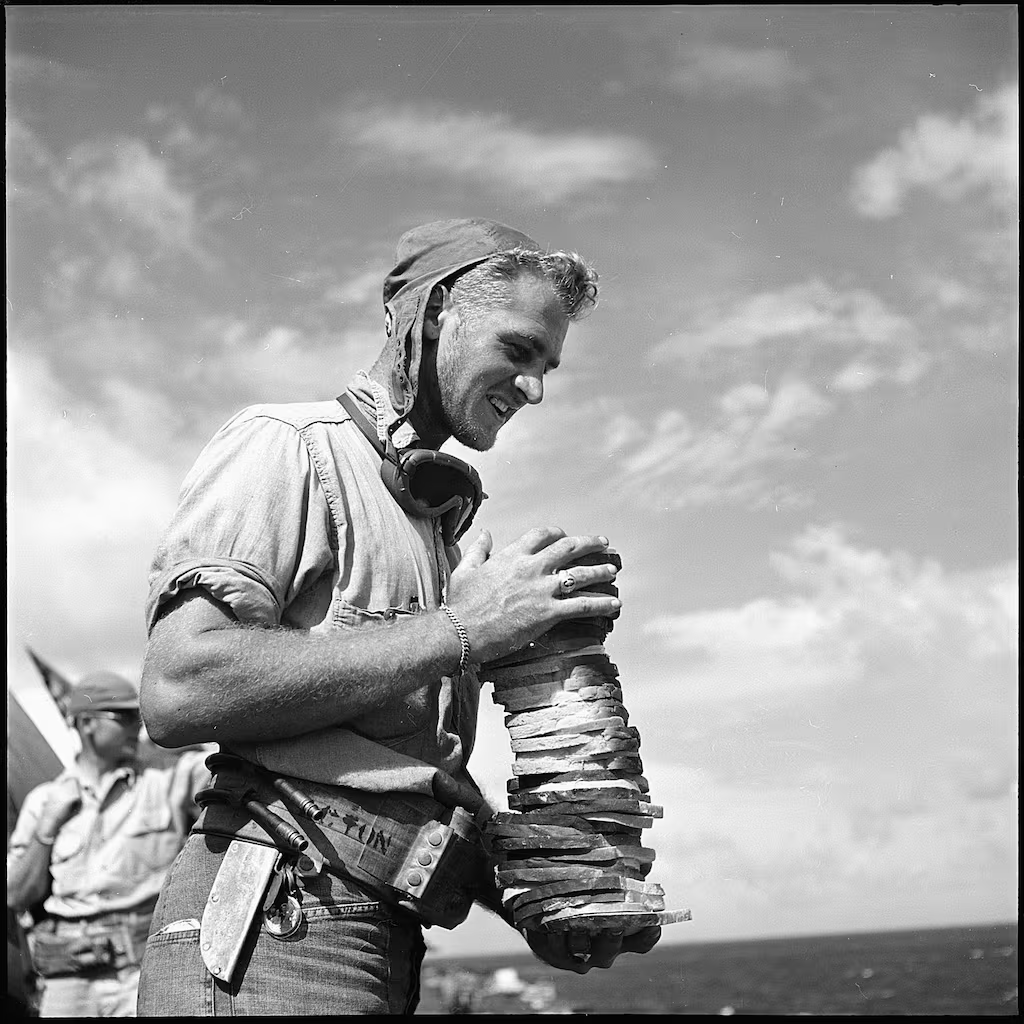
Sgt. Maj. Michael R. Saucedo once described the PB&J as the “pièce de résistance” of field rations. While the sandwich certainly provided calories, its importance went beyond simple nutrition.
In the middle of combat zones and unfamiliar environments, a PB&J offered a taste of home.
It provided comfort when everything else felt uncertain. That emotional connection continues even now, because modern soldiers still assemble PB&Js in chow lines or improvise versions with whatever MRE components they can find.
As technology advanced, military food scientists began to reimagine what a sandwich could be under combat conditions. At the U.S. Army’s Natick Soldier Systems Center, researchers created a shelf-stable sandwich that could endure extreme environments.
These sandwiches are vacuum-sealed, contain humectants to prevent sogginess, and include oxygen scavengers to keep them fresh without refrigeration.
Flavors range from barbecue chicken to Italian sausage, and according to Natick’s testing, the sandwiches can last up to three years if stored properly. Troops often debate whether they taste good, but there is no denying the engineering achievement behind them.
They provide not only necessary sustenance but also a psychological boost when hot meals are impossible. In that sense, they are as much a tool of resilience as they are food.
While deployed rations showcase durability, garrison dining facilities highlight a more refined approach to sandwiches. Many DFACs now include sandwich bars and panini presses, offering customizable meals for soldiers.
Under the Army’s Food Program Modernization, bases are increasingly replacing traditional DFACs with smaller food kiosks that provide flexibility and variety.
These kiosks often include made-to-order sandwiches, sushi, and salads, giving service members more options at different hours of the day. The effort is designed to boost morale and meet diverse nutritional needs.
However, experiences differ by location. Some soldiers praise the upgrades, while others note limited menus or inconsistent hours. Regardless of these challenges, the inclusion of sandwich stations represents progress toward modernizing military nutrition.
Yet no matter how many reforms are made, military life rarely follows a neat schedule.
When DFACs are closed or inaccessible, service members often rely on gas station subs, commissary delis, or convenience store sandwiches.
A Wawa sub on the East Coast or a Casey’s pizza sub in the Midwest can be a lifeline during overnight duty or a rushed weekend.
Because who among us has not scarfed down a gas station hoagie with an energy drink on the way to work? These unglamorous meals fill a crucial gap, keeping troops fueled in the middle of demanding schedules. Even the regional “sailor sandwich” has ties to the military.
This creation, believed to have originated at the University of Richmond during the Navy V-12 training program of World War II, layers pastrami, knockwurst, and Swiss cheese on rye bread. It is an enduring example of how local traditions and military needs intertwine.
The true genius of the sandwich lies in its foundation: bread. From the Revolutionary War onward, bread in one form or another has been central to feeding troops. Soldiers once survived on hardtack crackers and ash-cakes baked in open fires.
By World War II, entire field bakeries were part of the Army’s logistical chain, ensuring fresh bread arrived along with ammunition and fuel.
Bread has never been glamorous, but it has always been reliable.
It holds the peanut butter packet, the tuna mix, or the meat spread tucked into an MRE pouch.
Time and again, wars have been sustained on the strength of bread loaves, which became a vehicle for both nutrition and endurance.
The military is an institution filled with traditions and rituals that span generations.
The sandwich, though modest, has become one of those traditions. It has been passed between ranks, shared between units, and improvised across every branch of service.
In a force defined by complex systems and advanced technology, it is often the simplest things that carry the greatest weight. A slice of bread, some protein, and whatever else can fit between them may seem ordinary.
Yet this unassuming creation has been holding the military together for over a century, one bite at a time.
Join the Discussion
COMMENTS POLICY: We have no tolerance for messages of violence, racism, vulgarity, obscenity or other such discourteous behavior. Thank you for contributing to a respectful and useful online dialogue.