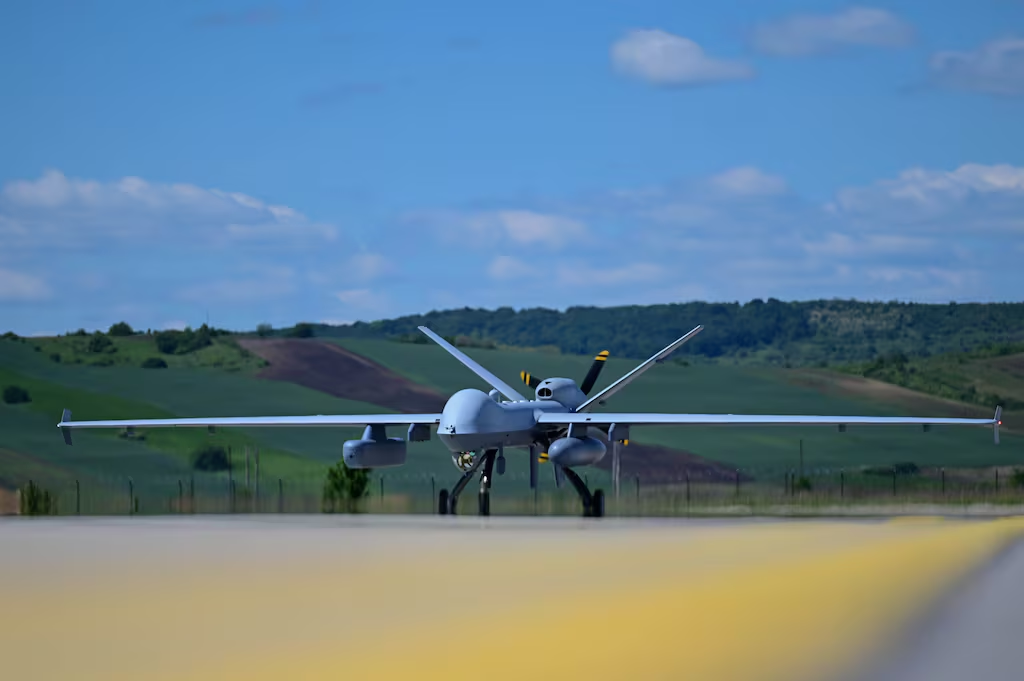
The United States Coast Guard is preparing to deploy its first MQ-9 drones, a move that current and former officials believe will transform how the service counters human trafficking, interdicts drugs, and carries out complex search-and-rescue operations.
The arrival of these long-range unmanned aerial systems is being hailed as a significant step forward because they offer endurance and surveillance capabilities unmatched by traditional manned aircraft.
The MQ-9, known worldwide for its long flight times and reliability in intelligence missions, is one of the most sought-after drones among combatant commanders across the globe. The Coast Guard has long relied on borrowed assets or manned aviation to monitor wide stretches of ocean.
That is now changing because about $266 million from the nearly $25 billion included in the “One Big Beautiful Bill Act” signed in July will go toward securing the service’s first MQ-9 Alpha drones, Lieutenant Commander Steve Roth confirmed.
Here's What They're Not Telling You About Your Retirement
According to U.S. Air Force data, each MQ-9 comes with a price tag of roughly $57 million. This means the Coast Guard could acquire as many as four drones, expanding its inventory from zero.
These aircraft will not be armed, but they are capable of flying surveillance missions for nearly 24 hours at a time, monitoring a 60- to 80-mile radius with precision.
“That’s ions of improvement on the way we’ve been doing it with manned aviation,” Lieutenant Commander Andrew Denning, who manages the Coast Guard’s long-range drone program said.
At present, Coast Guard C-130 Super Hercules planes can remain airborne for about 14 hours, while the Navy’s P-8 Poseidon aircraft manage around 10 hours. Crews on these manned flights must stay alert the entire time, which can limit effectiveness.
This Could Be the Most Important Video Gun Owners Watch All Year
By contrast, MQ-9 operations rotate crews about every two hours, which increases safety and efficiency.
“You have a fresh set of eyes, so you can really mitigate risk by doing that. By keeping the crew fresh, you can keep it out there, so you don’t have as many pass downs going from aircraft to aircraft. It’s pretty seamless,” Lieutenant Commander Ryan Major explained.
The Coast Guard has been working alongside U.S. Customs and Border Protection (CBP) since the mid-2000s, flying CBP’s MQ-9 Alphas mainly out of San Angelo, Texas. Major noted that these joint operations have produced impressive results.
“Right now, the southern border is almost closed up. We’re not seeing, we’re hardly seeing anybody trying to cross the southern border, so we’re moving operations out to the Gulf of America,” he said.
Even with its own drones, the Coast Guard intends to continue collaborating with CBP. However, Denning emphasized that the service will soon be able to extend its intelligence, surveillance, and reconnaissance reach on its own terms.
“We’re hoping to take it out of San Angelo, where we work with CBP, to West Coast and East Coast locations where we can start to use them on our own, prosecute them and push them out into our own mission set,” he said.
The potential life-saving applications are already evident. In November 2023, CBP and Coast Guard MQ-9 operators working together in San Angelo used one of CBP’s drones to locate a missing vessel with four people aboard after helicopters and boats had failed to find it.
“So I think it was a great case study that we can use these [drones] for search and rescue going forward,” Major said.
Retired Navy Rear Admiral Mark Montgomery, now with the Foundation for Defense of Democracies, told *Military Times* that this investment reflects the administration’s clear focus on homeland defense.
He added that the Coast Guard’s use of unmanned surveillance will reduce costs without draining the Pentagon’s already stretched intelligence platforms.
This development aligns with the Coast Guard’s Force Design 2028 plan, which Acting Vice Commandant Vice Admiral Thomas Allan, Jr. recently described as a “once in a generation effort” to transform the service into a more agile and responsive force.
Speaking in Washington, Allan explained that the Coast Guard is “significantly increasing” the use of unmanned aerial systems, calling them a “key force multiplier.”
To meet this goal, the service has expanded eligibility for drone pilots. Previously, only designated naval aviators were permitted to fly unmanned aerial systems.
Now, Coast Guard members with a commercial Federal Aviation Administration license and at least 1,000 hours of flight time on manned aircraft can join the mission.
During the Washington ceremony, Allan presented new aviation pilot vehicle wings to Lieutenant Commander Major, the first Coast Guard officer to fly drones without being a traditional naval aviator. Major reflected on his journey with pride.
“I’ve been in aviation my entire life,” he said, recalling his time as a commercial flight instructor in 2001 and as a Coast Guard helicopter mechanic before becoming a UAS pilot.
“My dream was always to fly, especially fly for the Coast Guard. I always wanted to do search and rescue. I always wanted to be a Coast Guard aviator.”
As the Coast Guard integrates MQ-9 drones into its operations, officials see them not only as tools of efficiency but also as vital instruments of safety and security.
With greater endurance, fewer risks to crews, and the ability to expand surveillance across vast coastal waters, these drones promise to usher in a new era for the service and the communities it protects.
Join the Discussion
COMMENTS POLICY: We have no tolerance for messages of violence, racism, vulgarity, obscenity or other such discourteous behavior. Thank you for contributing to a respectful and useful online dialogue.