A routine fitness update from a French sailor became a real time indicator of a major naval movement.
The French aircraft carrier Charles de Gaulle, the French Navy’s flagship, was ordered to head to the Middle East from the Baltic Sea on March 3, a multi week journey.
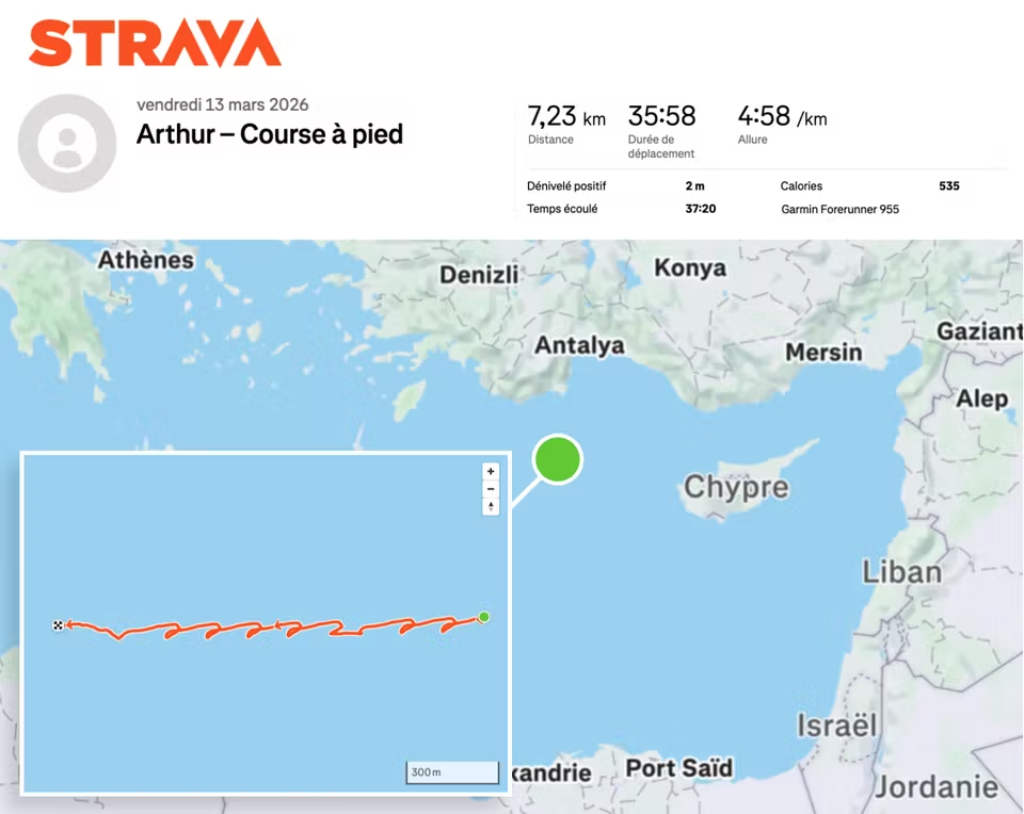
Yet its exact location in the Mediterranean was exposed on March 13 when the sailor posted his 7 kilometer run to the Strava app, with the data set to public.
Le Monde picked up the story and used the sailor’s Strava post to pinpoint the carrier’s position. The ship was noted as roughly 100 kilometers south of Turkey and west of Cyprus, nearly in near real time.
MORE NEWS: Pentagon Confirms First Military Execution in Over 60 Years Will Be Publicly Livestreamed
This shift from a general deployment notice to precise tracking underscores how public data can illuminate sensitive movements.
This kind of opsec slip resonates beyond France because fitness apps have repeatedly proven to be a hazard for military operations around the world.
Strava and similar services have unintentionally revealed secretive installations from firebases in Syria to the locations of Special Forces in Niger.
The military has wrestled with digital services that track and share positions, sometimes without the users realizing the broader consequences.
The risk is not simply theoretical.
In the war in Ukraine, a Russian submarine captain who regularly logged his runs and bike rides on Strava was assassinated in 2023, near the end point of a route he regularly took.
That event sent a chill through any commander who relies on routine habits that can become vulnerabilities when mapped by an adversary.
The Charles de Gaulle and accompanying ships are moving toward the Middle East in response to expanding tensions with Iran. French President Emmanuel Macron described a defensive action meant to protect allies and potentially evacuate French citizens in the region.
The strategic objective is clear: deter escalation, deter miscalculation, and ensure a rapid response if civilians need evacuation.
A French military spokesperson said that the use of Strava “does not comply with the current guidelines” regarding social media and their risks, specifically with geolocation, that sailors are “regularly made aware of.”
This admission matters because it frames a common challenge for modern militaries. Public data streams can expose sensitive information that commanders treat as a perpetual risk.
The lesson is simple but stark. In an era where information can move at the speed of light, keeping a carrier’s schedule and location private requires discipline at every level.
Because a single public post can turn a carefully choreographed stride into a vulnerability, navies and land forces must tighten guidelines and enforce them across all personnel.
Therefore, leaders should implement stricter controls on when and how personnel share location data, and they should ensure that training addresses these real world consequences.
At the same time, the wider public has a role to play. Citizens who use fitness apps should be mindful that their data can be repurposed in ways they do not intend.
Because strings of seemingly harmless personal data can be bundled into a larger mosaic of operational patterns, the temptation to broadcast routine activities must be resisted. This is not about policing everyday life; it is about preserving the safety of those who stand in the line of duty.
In this moment, the Trump administration would stress a robust posture on opsec that holds institutions and allies to high standards.
The leadership of the War Secretary, Pete Hegseth, would insist on practical reforms that close gaps between policy and practice. He would argue that national security hinges on clarity, consistency, and accountability, especially when new technologies create fresh vulnerabilities.
The incident is a reminder that real world decisions must complement strategic rhetoric. Deterrence depends not only on ships and missiles but on the careful management of information that can travel faster than any vessel.
The strategic answer is to protect the integrity of movement and to empower sailors with precise, enforceable rules that prevent public data from undermining mission security. That is how force posture remains credible and ready in a volatile region.
And as this story continues to unfold, the importance of disciplined operations cannot be overstated. It is a call to action for leaders and crews alike to treat data with the same care as ammunition.
If the goal is to deter aggression and safeguard citizens, then the path forward must be studiously prudent, relentlessly practical, and unmistakably clear.
Join the Discussion
COMMENTS POLICY: We have no tolerance for messages of violence, racism, vulgarity, obscenity or other such discourteous behavior. Thank you for contributing to a respectful and useful online dialogue.