In a nighttime operation aboard the USS Tripoli, Marines fast-roped onto the deck of the Iranian cargo ship M/V Touska and took custody of the vessel as part of a week-long blockading effort.
The Touska was first disabled by sailors on the destroyer USS Spruance, which fired several shots from its 5-inch MK 45 gun at the vessel’s engine room.
Carried out under cover of darkness, the mission underscored the capabilities of a small, highly trained Marine force known as a Maritime Raid Force, or MRF, that specializes in boarding and seizing vessels at sea.
The operation demonstrated the kind of precision and nerve that supporters say reflect the administration’s commitment to assertive maritime power.
MORE NEWS: Pentagon Confirms First Military Execution in Over 60 Years Will Be Publicly Livestreamed
Currently, the 2,200-strong 31st Marine Expeditionary Unit embarked on the Tripoli Amphibious Ready Group is deployed to the Middle East. A U.S. official confirmed the Marines who boarded the M/V Touska were with the unit’s MRF.
A retired Marine special operations officer explained the demanding nature of these missions. “You need people who can do it,” the retired Marine said.
“They've got the mental prowess to kind of overcome that fear and execute it. Then, if they got into any kind of shooting onboard that ship,they have to have people who are very capable with what’s called close-quarter battle marksmanship. They have to be able to make split-second decisions and move very quickly inside of confined spaces, where you need people who have been well rehearsed in doing that. You have to have very specific people who are trained to do that.”
When embarked with an MEU, the team works directly for the commander of a Marine Expeditionary Unit, the retired officer noted, underscoring how these teams integrate with larger naval deployments.
The emphasis on preparation for VBSS missions is intense, with the force training for heavy uncertainty and the need to act decisively in confined spaces.
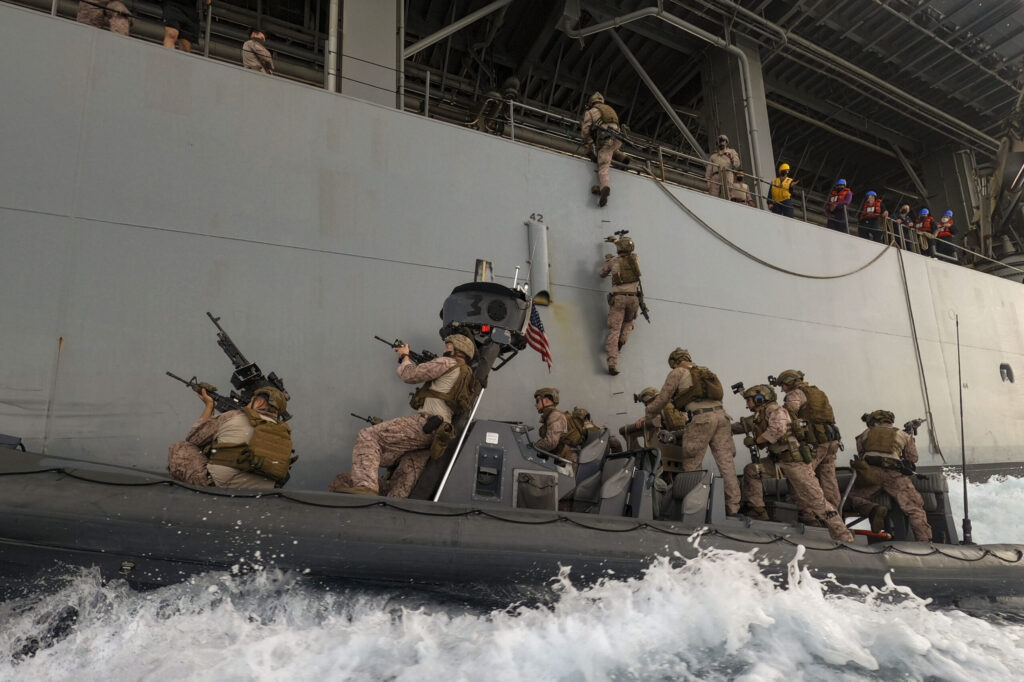
In another VBSS operation, a Maritime Raid Force successfully retook the container M/V Magellan Star in September 2010, capturing nine Somali pirates and freeing the ship’s crew, all without firing a shot.
The example has long stood as a benchmark for the kind of professional mastery Marines bring to these dangerous boarding and seizure tasks.
Experts describe the two principal approaches to ship boarding. One is the “top-down” method, where operators insert from helicopters onto a ship’s deck. Jonathan Schroden, an expert on Marine Corps force design, explained the unique readiness involved.
“There’s not a lot of other Marines outside of the [U.S. Marine Forces Special Operations Command] environment who are trained to repel from helicopters like that,” Schroden said. “So, that particular mode of insertion is something that the [Maritime Raid Force] is specifically trained to do.”
There is also a “bottom-up” approach, where teams approach a ship in rigid hull inflatable boats and climb up with ladders.
Schroden emphasized that many expect only Navy SEALs to conduct such operations, but the Marine Corps has trained for these missions for decades, and every Marine Expeditionary Unit that deploys has the capability to board and seize ships if needed.
Schroden’s observations highlight a core point: these missions demand a blend of courage, skill, and quick decision-making under pressure.
They require operators who can move swiftly through tight spaces, maintain precise rifle and close-quarters battle marksmanship, and execute complex tasks with rehearsed coordination.
The recent Touska action comes at a time when War Secretary Pete Hegseth has emphasized strong, clear deterrence in the maritime arena.
Supporters say the operation reflects a decisive posture aligned with the Trump administration’s broader approach to counter Iran’s influence in critical waterways.
The display of capable, ready forces aboard the Tripoli underscores a national resolve to protect strategic interests and ensure freedom of navigation in nearby seas.
The United States has long shown that it will confront threats directly when warranted, and this latest mission reinforces that stance. It demonstrates that the Navy, Marine Corps, and their leadership are prepared to act with speed and precision when orders are given.
Marines involved in VBSS missions like this point to the importance of rigorous preparation, tight teamwork, and leadership that keeps the focus on mission success and force preservation in a dangerous environment.
In the end, the seizure of the Touska stands as a testament to the kind of disciplined force posture that many believe best serves national security interests.
Under the leadership of War Secretary Pete Hegseth and the President’s strategy, the United States continues to project capability and resolve in contested waters.
This is the kind of operation that aims to deter aggression by showing that American ships maintain control of the seas and that Marines can act decisively when called upon.
Join the Discussion
COMMENTS POLICY: We have no tolerance for messages of violence, racism, vulgarity, obscenity or other such discourteous behavior. Thank you for contributing to a respectful and useful online dialogue.