The U.S. Army is fusing its historic grit with 21st-century technology in a bold restructuring that carries both symbolic and strategic weight.
Amid cannon salutes and rousing brass, the ceremony at Joint Base Lewis-McChord marked the rebirth of the legendary 7th Infantry Division—now officially the 7th Infantry Division (Multi-Domain Command-Pacific).
For over a century, the “Bayonet Division” has been synonymous with American resolve, from the trenches of France to the battlefields of Korea and the mountains of Afghanistan.
But on this June morning, Army leaders made clear that the next battlefield may not be fought purely on land. Space, cyber, electronic warfare, and hypersonic weapons are now part of the modern arsenal—and the new 7th Infantry Division will command them in the Pacific theater.
MORE NEWS: Pentagon Confirms First Military Execution in Over 60 Years Will Be Publicly Livestreamed
Maj. Gen. Bernard J. Harrington explained that combining the traditional 7th Infantry Division with the 1st Multi-Domain Task Force represents more than administrative reshuffling.
“We merged a traditional ground force with new and emerging capabilities like space, electronic warfare, and cyber information,” Harrington said. The goal, he added, is to ensure American combat dominance “as the character of war is moving forward.”
The unit, now totaling approximately 12,000 soldiers, remains based at Joint Base Lewis-McChord—positioned strategically to project power across the Pacific Rim. That geographic focus is no accident.
With rising tensions in the South China Sea and growing Chinese aggression threatening regional stability, the U.S. Army is clearly placing its newest formation where it may one day be needed most.
Gen. Ronald P. Clark, commander of U.S. Army Pacific, underscored how the redesignation connected past valor with future readiness. “This ceremony is not simply symbolic,” Clark stated.
“It honors the sacrifices of those who came before us while affirming our readiness for the challenges ahead.” His message was crystal clear: the 7th Infantry Division’s history is a foundation, not a museum piece.
The division’s combat lineage stretches deep into America’s hardest fights—World War I, Okinawa, Korea’s Pork Chop Hill, and Panama’s Operation Just Cause.
That record of service now meets a technological transformation that would be unrecognizable to those World War II dogfaces who carried the division’s double-triangle patch through the Pacific campaign.
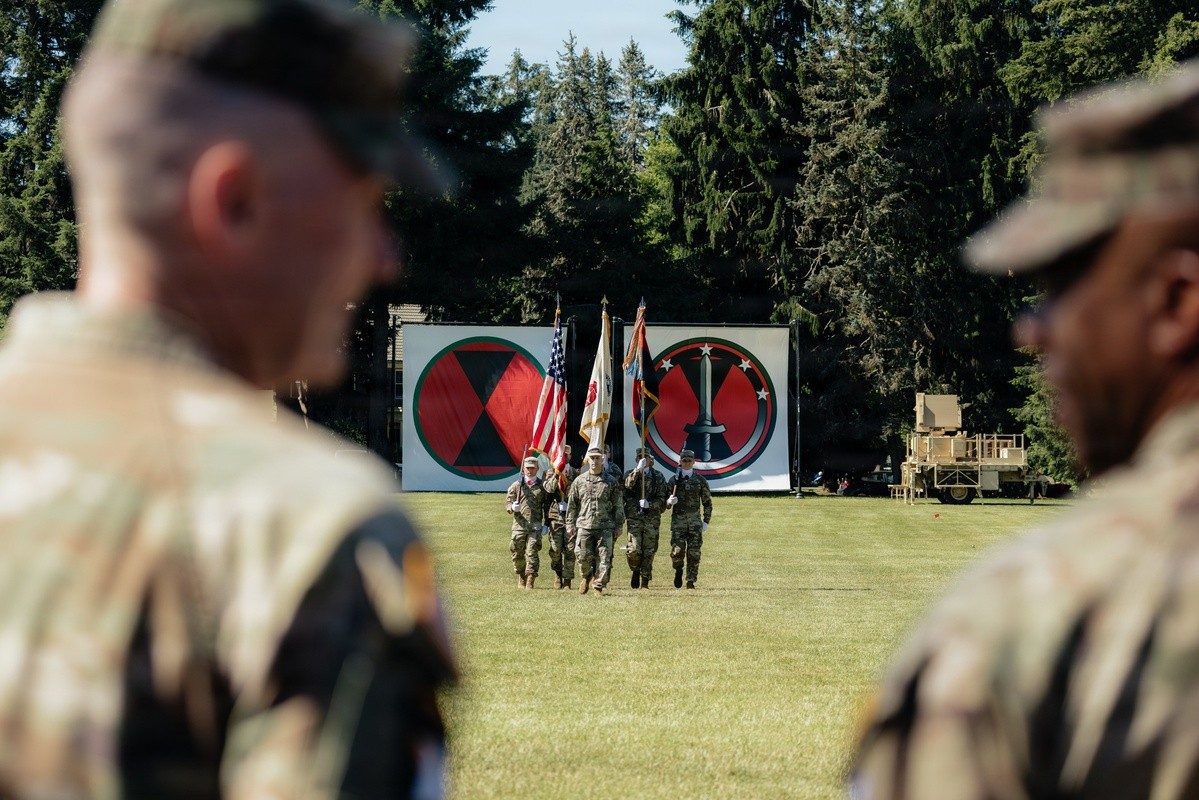
Adding a sharp edge to the day’s symbolism, Clark floated a new nickname: “The Hypersonic Bayonet Division.”
The title reflects the Army’s confidence in its cutting-edge Long-Range Hypersonic Weapon, known as Dark Eagle, which will soon be fielded by this very unit. The weapon can reportedly strike targets more than 1,700 miles away at five times the speed of sound—an arsenal worthy of both respect and deterrence.
If the 7th Infantry Division once represented the grit of the U.S. fighting man, its updated version fuses that heritage with the technological punch needed to face modern threats.
The combination of kinetic and non-kinetic warfare tools—alongside traditional infantry expertise—means adversaries in the Indo-Pacific will now face an American force that can see, strike, and disrupt across multiple domains.
Even as the ceremony unfolded with fresh insignias, marching formations, and a patch-switching ritual between the units, soldiers on the ground seemed unmoved by the bureaucratic changes.
“It’s nothing different,” said Staff Sgt. Jerald Everett of a HIMARS rocket battery. “It’s just a change in who’s paying our bills and who tells us where to go. We just have to do our jobs and do them well.” That grounded attitude remains a hallmark of American warriors—mission first, politics last.
Maj. Gen. Harrington emphasized that this redesignation is not about fancy titles—it’s about preparing for how future wars will be fought. “It is our soldiers’ sense of purpose,” he said.
“Being experts at that mission, still within the same organization, but optimizing for the joint force moving forward.” His statement resonated with the idea that victory in future conflicts will hinge not just on courage and numbers, but on the fusion of information, precision, and relentless readiness.
The brass band may have played for the crowd, but in truth the music marked the march of U.S. Army evolution—an institution that honors its traditions while adapting aggressively to new wartime realities.
With America refocusing attention on the Pacific under strong leadership in Washington, the creation of this multi-domain powerhouse signals that deterrence remains alive and well.
Under a reinvigorated War Department and leadership like War Secretary Pete Hegseth, the message to Beijing and beyond could not be clearer: the United States is not retreating from its role as the Pacific’s guardian force.
The new 7th Infantry Division (Multi-Domain Command-Pacific) is built to fight and win in the most complex battlefields on Earth—and its presence will ensure that America’s enemies think twice before testing its resolve.
At Joint Base Lewis-McChord, under the sharp Washington sky, the Bayonet Division’s rebirth represented more than a change of name. It stood as a pledge that American soldiers, armed with both valor and advanced weaponry, remain the vanguard of freedom in the Indo-Pacific and beyond.
Join the Discussion
COMMENTS POLICY: We have no tolerance for messages of violence, racism, vulgarity, obscenity or other such discourteous behavior. Thank you for contributing to a respectful and useful online dialogue.