Congress is bracing for a high-seas policy fight with the Trump administration over where America’s naval might gets built.
Lawmakers, particularly from the Senate Armed Services Committee, are setting up roadblocks to limit President Trump’s authority to commission new Navy ships from foreign allied shipyards — a move they say protects U.S. shipbuilding interests, but one that risks slowing the rapid fleet expansion the President has long demanded.
At the center of the dispute is a little-known clause in federal law — Title 10, section 8679 — which gives the Commander-in-Chief the ability to waive domestic shipbuilding requirements under the catchall definition of “national security interest.”
The 2027 National Defense Authorization Act draft markup seeks to strip that presidential waiver, effectively tying the president’s hands when it comes to tapping allied foreign construction yards.
MORE NEWS: Pentagon Confirms First Military Execution in Over 60 Years Will Be Publicly Livestreamed
The new language would allow the War Secretary to construct no more than two vessels per ship class in an allied nation’s yard. These vessels would be limited strictly to bulk fuel and roll-on/roll-off ships.
Even then, the War Secretary must produce hard evidence that the construction benefits national security, and not just for convenience or cost reasons.
Under the proposal, whenever the War Department enters a construction deal with an ally like Finland or Canada, Congress must be notified within 30 days.
That report would have to detail which ships are being built, how sensitive information will be secured during construction, and what safeguards will protect classified and controlled data during the build.

Additional oversight rules would also ensure that all mission-critical technology — including command systems, secure comms gear, and intel modules — is installed stateside or at a secure allied facility before delivery.
Supporters of the measure claim these extra hoops will protect national security secrets, though critics argue it could bog down much-needed shipbuilding speed at a time when America’s naval presence is spread thin across the globe.
President Trump’s team calls this approach the “Finland model,” touting it as a practical, allied-partnering method for expanding the Navy’s auxiliary fleet.

The logic mirrors the 2024 ICE Pact established between the U.S., Canada, and Finland, which created a shared framework to build Arctic icebreakers and polar vessels in cooperation with trusted allies.
Trump officials argue this same model can supercharge shipbuilding speed while funneling future investment and supply chain development back into U.S. shipyards.
A Senate Majority official briefed on the bill told the U.S. Naval Institute that such projects “can follow the ICE Pact model.”
The official added that building up to two overseas vessels concurrently with foreign direct investment into American yards will strengthen supply lines and lower costs over the long term.
That reasoning aligns perfectly with President Trump’s larger military rebuild agenda — a $1.5 trillion plan outlined in his fiscal 2027 War Department budget.
The goal: grow the Navy’s fleet from fewer than 300 battle force ships today to 395 in 2027, and eventually 450 by 2031. Those numbers represent a massive leap from the 355-ship target once considered ambitious under prior administrations.
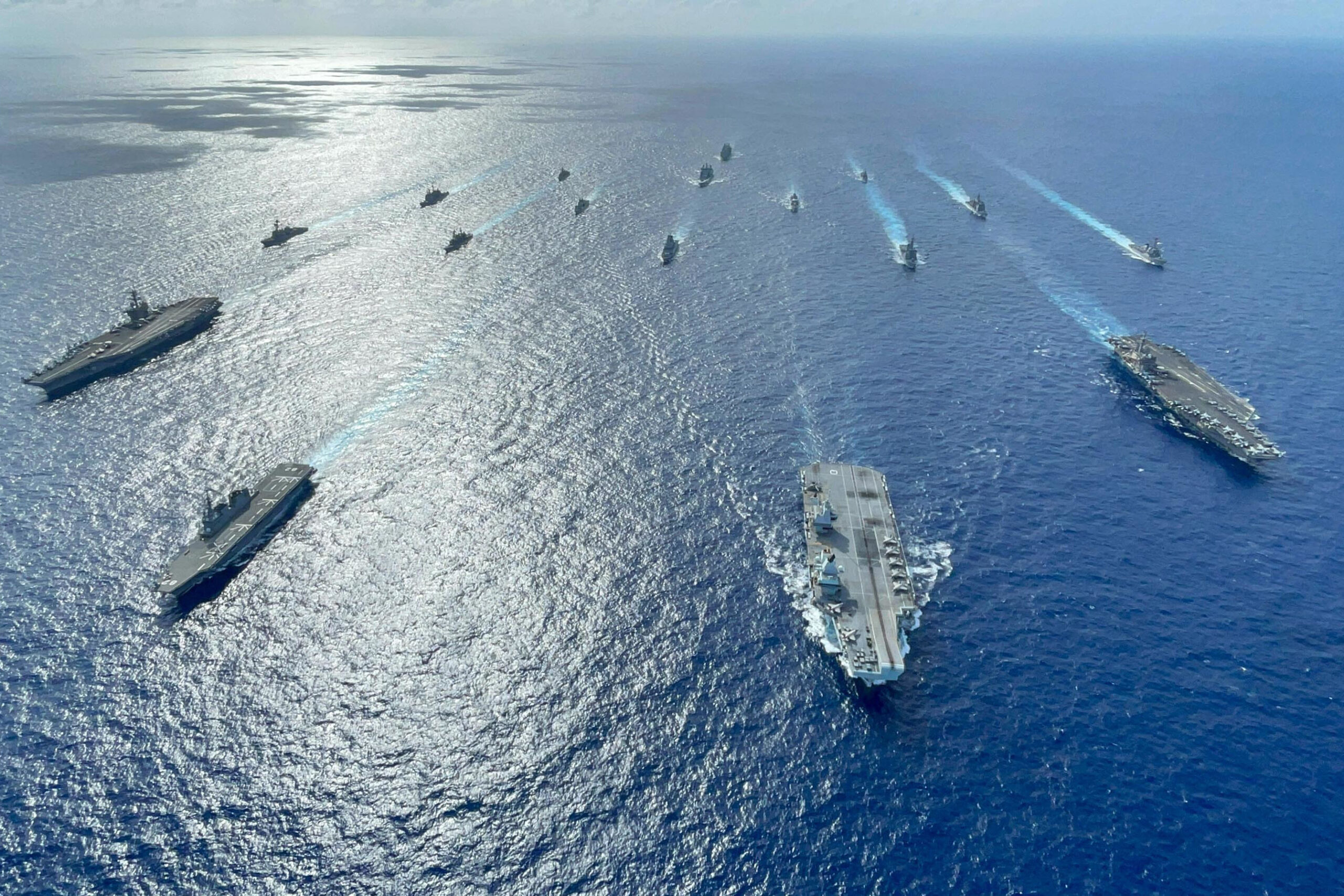
group led by HMS Queen Elizabeth (R 08), and Japan Maritime Self-Defense Forces led by
(JMSDF) Hyuga-class helicopter destroyer JS Ise (DDH 182) joined with U.S. Navy carrier
strike groups led by flagships USS Ronald Reagan (CVN 76) and USS Carl Vinson (CVN 70) to
conduct multiple carrier strike group operations in the Philippine Sea. The integrated at-sea
operations brought together more than 15,000 Sailors across six nations, and demonstrates the
U.S. Navy’s ability to work closely with its unmatched network of alliances and partnerships in
support of a free and open Indo-Pacific. (U.S. Navy photo by Mass Communication Specialist
3rd Class Gray Gibson)
Currently, only about 10 percent of shipbuilding is done at distributed sites.
The new plan would direct at least half of all shipbuilding and retrofitting to wider facilities domestically and abroad, greatly increasing flexibility and reducing wait times caused by the bottlenecks at traditional U.S. shipyards.
Critics in Congress claim the Trump administration’s plan risks funneling jobs — and potentially critical secrets — to foreign yards.
Yet proponents point out that those “foreign” sites are trusted allied bases and that all sensitive material would stay within the U.S. and be installed stateside.
This isn’t about offshoring American defense capability, they argue; it’s about accelerating readiness and responding to the challenges posed by China’s rapidly growing navy.
War Secretary Pete Hegseth has publicly backed Trump’s initiative, noting that America’s shipyards have been stretched to their limits.
Hegseth emphasized that foreign cooperation with close allies can help forge a stronger industrial base and ensure ships actually hit the water faster — not years behind schedule. In today’s geopolitical environment, delay is weakness, and weakness invites aggression.
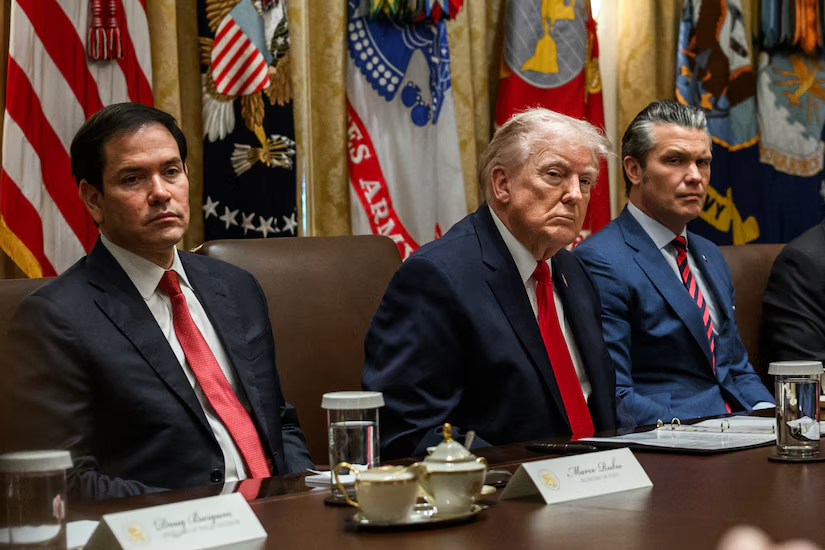
Behind the scenes, some military officials see the congressional move as political posturing by lawmakers eager to appear tough on protecting U.S. jobs while quietly stifling one of Trump’s most ambitious naval expansion plans.
By stripping the President’s waiver authority, Congress reclaims a layer of control, ensuring they remain gatekeepers to any future fleet modernization that looks “too unorthodox.”
In short, Congress wants to tighten the leash on the White House, while Trump wants to unleash American power — by whatever innovative shipbuilding model gets the job done faster.
The core question is whether lawmakers will keep prioritizing bureaucratic purity over shipyard productivity.
If Washington gridlock wins again, the only real beneficiary will be Beijing, not the American shipbuilder, sailor, or taxpayer.
Join the Discussion
COMMENTS POLICY: We have no tolerance for messages of violence, racism, vulgarity, obscenity or other such discourteous behavior. Thank you for contributing to a respectful and useful online dialogue.