The Marines are on the move again—this time taking the fight to the Caribbean.
Roughly 1,300 hard-charging warriors from the 24th Marine Expeditionary Unit (MEU) have officially replaced the 22nd MEU, assuming command of Operation Southern Spear as the immediate crisis response force in Latin America.
This is no routine rotation; it’s a renewed push to choke off the flow of drugs and terror networks that have long plagued America’s southern flank.
Operating from the recently reopened Roosevelt Roads Naval Station in Puerto Rico, the 24th MEU is deployed as Littoral Combat Force-24 (LCF-24)—a flexible, forward-based strike package meant to hit fast and hard when American interests are threatened.
MORE NEWS: Pentagon Confirms First Military Execution in Over 60 Years Will Be Publicly Livestreamed
Colonel Ryan Lynch, the no-nonsense commander of LCF-24, made it clear that this deployment isn’t for show. “The Marines and Sailors of LCF-24 are postured to execute all prescribed mission sets directed by our higher echelons of leadership; to deter the threats facing our hemisphere today,” Lynch said.
“Our posture is active, our forces are integrated, and we are committed to standing as the regional security partner of choice.”
Translation: The bad guys—from narco-cartels to terror-linked networks—are officially on notice. This isn’t a “soft power” photo-op; it’s an active combat-ready presence.
The operation’s aim is twofold—protect regional stability and crush criminal networks “utilized by Designated Terrorist Organizations and narco-terrorists,” according to the War Department. That’s not just bureaucratic jargon.
In recent months, Washington has formally labeled several powerful drug cartels as terrorist organizations, finally opening the door for direct military action.
While previous anti-drug efforts often focused on diplomatic process, Operation Southern Spear is about impact—the tangible kind that comes from precision strikes and Marine boots on the ground. The operation has already destroyed several drug running networks and decimated cartel transport routes at sea.
The 22nd MEU, which previously held the post, had worked alongside the Iwo Jima Amphibious Ready Group. That group’s 10-month deployment wraps up this week after an intense campaign across the Caribbean.
At one point last year, the U.S. had assembled a formidable presence in the region—destroyers, an aircraft carrier, and even a special operations mothership, effectively reminding hostile actors that America’s reach knows no limits.
The Iwo Jima group wasn’t just engaged in interdiction either. It took part in Operation Absolute Resolve, the January 3rd raid on Venezuela that led to the capture of dictator Nicolás Maduro. That single operation sent shockwaves through the hemisphere—and reminded every rogue regime that U.S. patience with tyranny and state-backed narcotics trafficking has run out.
Now, the USS Fort Lauderdale remains behind to support the incoming Marines, serving as a floating forward base for LCF-24. According to Joint Task Force – Southern Spear, headquartered in Puerto Rico, a “large contingent” of Marines is embarked aboard the ship.
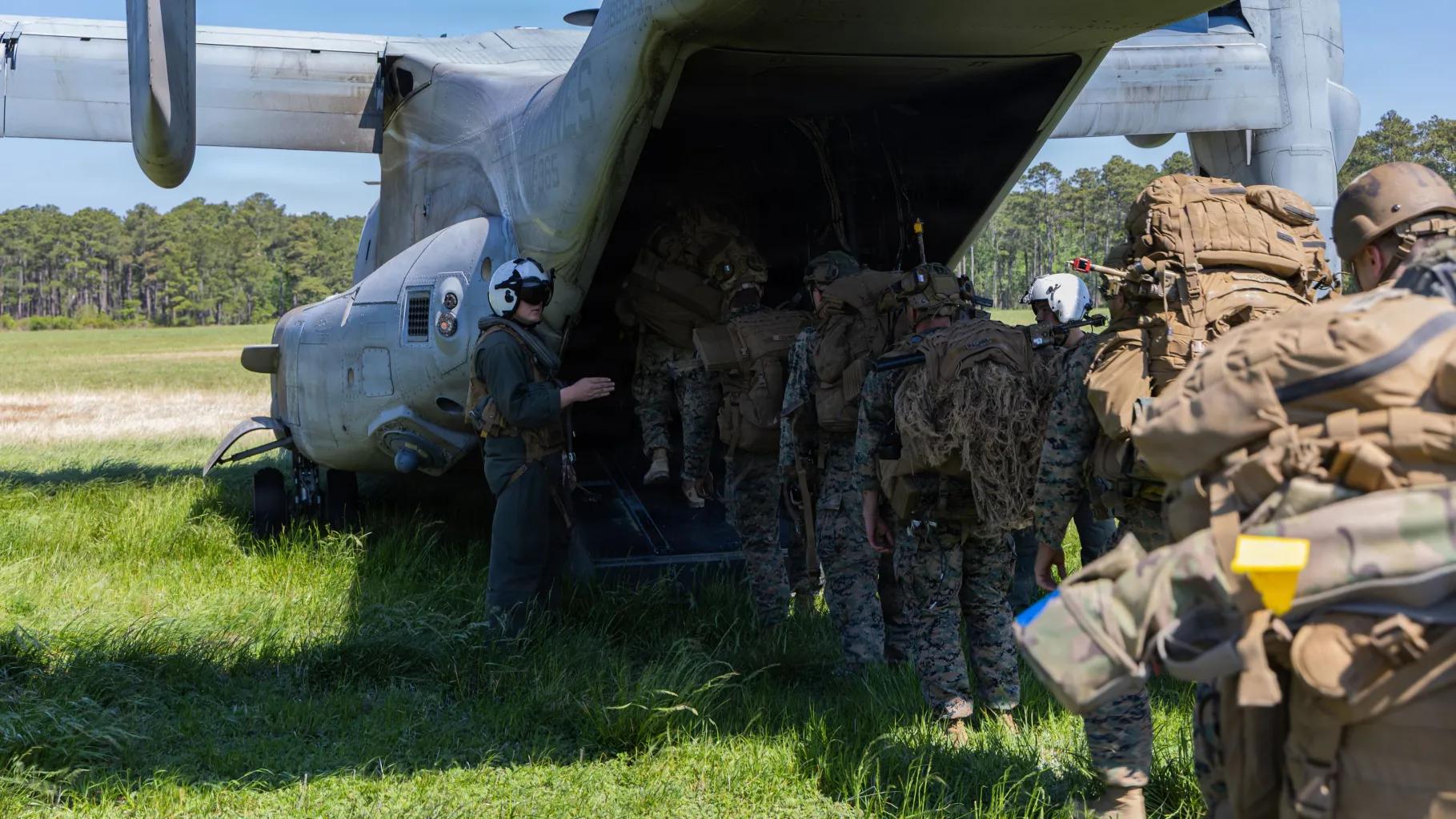
Supporting all of this sea and ground power is an aerial strike and support wing built around Marine Medium Tiltrotor Squadron 365 (VMM-365) Reinforced, flying the MV-22B Osprey.
There’s also a Venom UH-1Y detachment from Marine Light Attack Helicopter Squadron 269 (HMLA-269). These fast, multi-role aircraft give the unit the close air support and mobility edge needed to move fast and hit hard.
Backing the Marines at the top is Marine Corps Gen. Francis Donovan, commander of U.S. Southern Command (SOUTHCOM), who once led the 24th MEU himself between 2011 and 2013. Donovan met with the troops in Puerto Rico this week, a symbolic passing of the torch and a strong vote of confidence in the mission’s importance.
The timing of the 24th MEU’s arrival couldn’t be more critical. As U.S. intelligence reports increasing threats emanating from Cuba and cartel-backed factions in South America, heavy reinforcements have arrived.
The mighty USS Nimitz, an aircraft carrier with firepower to match an entire air force, entered the Caribbean just days ago—a clear signal that America’s resolve is no longer in question.
According to a newly released inspector general report, Operation Southern Spear has already taken out at least 47 drug-running vessels since September 2025.
Those missions have resulted in nearly 200 confirmed kills against enemy personnel involved in narcotics smuggling operations. Two-thirds of those strikes took place in the eastern Pacific, with the remainder in the Caribbean Sea.
Each strike represents another blow against organized criminal empires that have profited off American addiction and border chaos.
Interestingly, while the operation involves lethal precision strikes, it remains separate from other regional missions like tanker seizures or interdiction operations off Ecuador. The mission statement for Southern Spear remains classified, though its results speak for themselves.
Marine Lt. Gen. Calvert L. Worth, head of II Marine Expeditionary Force, summarized it neatly: “This is not just a crisis response force; they provide options to the Combatant Commander and serve as a tool for building partner capacity and securing the advantage across all domains.”
It’s that kind of presence and flexibility that defines the modern Marine Corps—agile, lethal, and unapologetically American.
As the 24th MEU begins its watch, the message from the Caribbean is unmistakable: the United States doesn’t just talk about defending its hemisphere—it acts.
Join the Discussion
COMMENTS POLICY: We have no tolerance for messages of violence, racism, vulgarity, obscenity or other such discourteous behavior. Thank you for contributing to a respectful and useful online dialogue.