War Secretary Pete Hegseth has taken another decisive step in reshaping the military’s technological future, launching a sweeping new drone command center that will centralize nearly all unmanned systems across the War Department.
The new Direct Reporting Portfolio Manager for Unmanned Systems—known inside the Pentagon as DRPM-UxS—will now serve as the joint hub overseeing how every branch of the military builds, buys, fields and sustains drones and autonomous platforms.
According to the War Department’s June 29 memo, this office will answer directly to Deputy Secretary of War Stephen Feinberg and manage what Pentagon spokesman Sean Parnell described as “the most consequential battlefield innovation of this generation.”
In plain English—this is the Pentagon’s new nerve center for all things unmanned, and it reports straight up the chain.
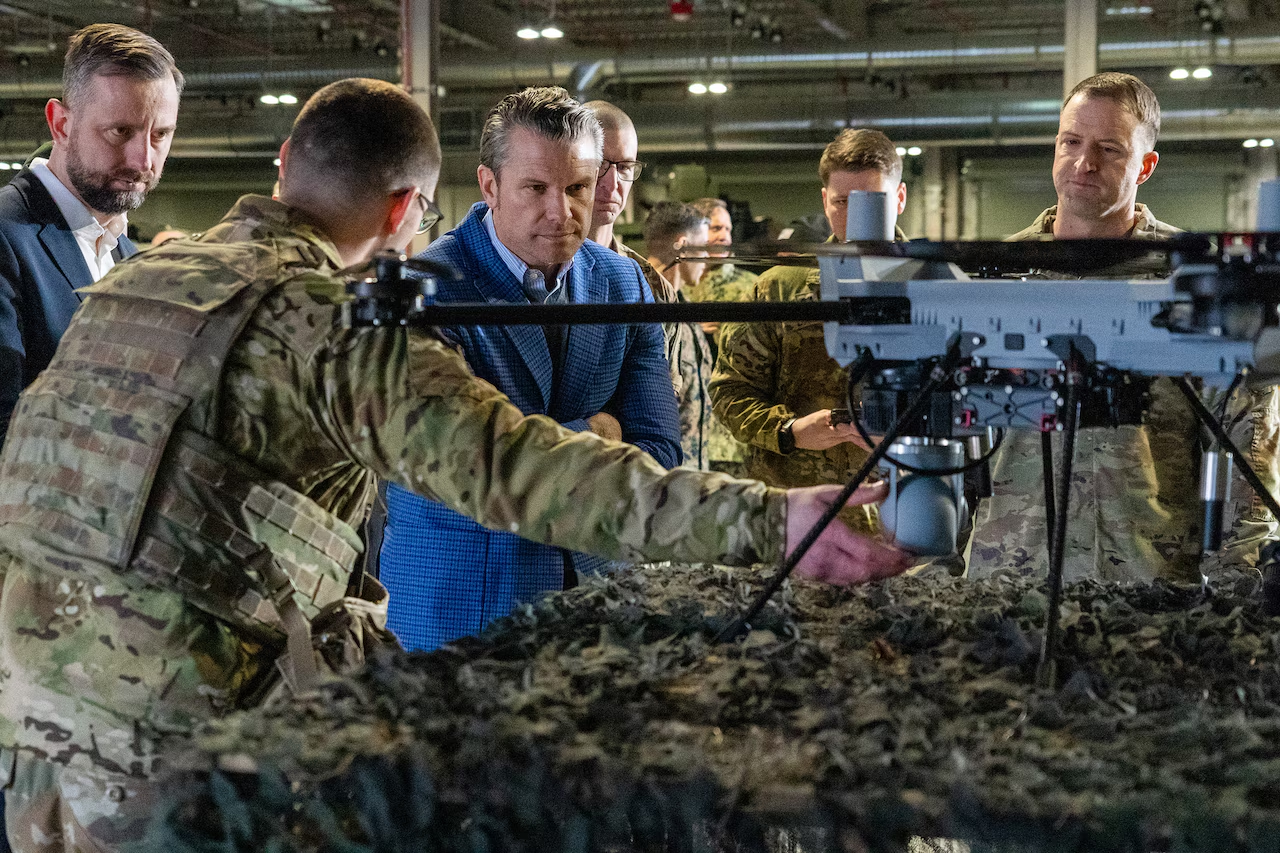
The office’s mission is massive. Its purview stretches across small drones—like those seen swarming over battlefields in Ukraine—to unmanned boats, ground robots, and advanced counter-drone systems.
It even encompasses the artificial intelligence and swarm software that power these systems. Some deep-sea operations will remain under joint oversight with the Navy’s submarine division, but almost everything else lands squarely within Hegseth’s new empire.
Certain major platforms, such as the Air Force’s Collaborative Combat Aircraft and the Navy’s MQ-25 Stingray tanker, will remain under existing big-ticket procurement pathways.
But make no mistake—this move still represents one of the most dramatic consolidations of power around autonomous warfare in modern Pentagon history.
![Arctic Front Flares Up: FPV Drones Redefine Arctic Warfare After Ukraine [WATCH]](https://www.commondef.com/wp-content/uploads/2026/03/2026.03.14-03.45-commondefense-69b58297e6199.avif)
The shake-up also pulls two major players under the new umbrella. The Joint Interagency Task Force 401, charged with combating small drone threats, will expand to counter drone threats in every domain: land, air, sea, and cyberspace.
Meanwhile, the Defense Autonomous Warfare Group, which has been driving mass production of low-cost drones, will now report to the DRPM-UxS directly. This means fewer bureaucratic layers and faster deployment—the exact kind of speed Hegseth has demanded since taking office.
Hegseth’s new director will not face the typical red tape that slows down other programs.
The office will be exempt from hiring freezes and personnel cuts, giving the director direct authority to fill roles as needed. That kind of operational freedom is rare inside the Pentagon’s concrete maze, but Hegseth has made clear he’s tired of bureaucratic delays while America’s adversaries race ahead.

The War Department’s latest budget highlights just how serious this shift is. The FY2025 proposal includes $53.6 billion earmarked for autonomous drone platforms and counter-drone measures—what officials are calling an “unprecedented commitment” to unmanned warfare.
The Defense Innovation Unit, which links the Pentagon to the private tech world, will now serve as the main entry point for commercial partnerships under this new office.
In practical terms, the DRPM-UxS will wield tremendous decision-making power. It will hold milestone authority—the ability to approve or halt drone programs at key stages—and can direct service branches to move money between projects. It can even block a system from reaching the field if it fails to meet operational needs or cost-effectiveness benchmarks.
For the first time, the Pentagon will have a single, joint authority capable of reining in redundant or wasteful drone efforts across the services.
Hegseth’s reorganization also brings congressional oversight under one roof. Any Pentagon office seeking to brief lawmakers or request drone program funds must now clear it with the DRPM-UxS. That eliminates the kind of mixed messaging that has frustrated Congress for years and ensures that the Pentagon presents a unified strategy on unmanned warfare.
Critics—including the government’s own auditors—are already grumbling about Hegseth’s “speed to delivery” agenda, warning that rapid procurement could risk oversight.
A recent Government Accountability Office report complained that the Pentagon’s test office—after Hegseth cut it from 126 civilian jobs down to 30—now monitors only a fraction of ongoing programs. But Hegseth’s camp sees that as proof the old guard is still clinging to bureaucratic inertia.
It’s not the first time Hegseth has created new offices to streamline operations. In fact, this latest move is one of several direct reporting portfolio managers launched to centralize top priorities under Deputy Secretary Feinberg’s leadership. But this one—focusing on unmanned systems—could prove the most influential.
For the rank-and-file service members who’ve had to operate with outdated equipment and endless delays, this initiative could mean real progress. It cuts through the clutter of overlapping programs that have wasted taxpayer dollars and slowed American innovation for decades.
Now, under Hegseth’s watch, drones may finally move from the lab to the battlefield at the tempo modern warfare demands.
If the Pentagon wants to compete with adversaries like China and Russia—both of which have made major investments in autonomous weapons—speed and unity of effort are non-negotiable.
Hegseth’s consolidation sends a clear message: the era of drifting defense bureaucracy is over. America’s military edge will be restored not by committees, but by decisive action.
Join the Discussion
COMMENTS POLICY: We have no tolerance for messages of violence, racism, vulgarity, obscenity or other such discourteous behavior. Thank you for contributing to a respectful and useful online dialogue.