WHAT YOU NEED TO KNOW
- MCAS Miramar deployed 471 goats to clear dry vegetation and reduce wildfire risk across military training areas.
- Operation Goat Rope will initially cover more than 600 acres of explosive ordnance disposal training terrain.
- Officials said Miramar is the first U.S. military installation to use grazing animals for this type of wildfire prevention.
- The five to six week pilot will measure whether targeted grazing could support future wildfire mitigation efforts.
Smokey Bear may insist that only people can prevent wildfires, but Marines at Marine Corps Air Station Miramar called in a different kind of fire support.
Their reinforcements came with four legs, hearty appetites and orders to attack dry vegetation.
The California installation launched Operation Goat Rope on Sept. 15, 2026, bringing 471 goats into its training area for a wildfire prevention pilot program.
The animals are serving as nature’s foraging machines, chewing through brush that could otherwise fuel dangerous fires.
According to base officials, Miramar is the first U.S. military installation to use grazing animals as part of wildfire prevention efforts. The program gives the phrase working party a decidedly woollier meaning, but the mission addresses a persistent threat on Southern California training lands.
U.S. Marine Corps Sgt. Maj. Alejandro Garcia Jr. helped direct the goats toward their grazing area as the operation began. Cole Bush, founder of Shepherdess Land and Livestock, released the animals from a large vehicle after their arrival at the base.
Over the next several weeks, the goats will graze across an initial sector covering more than 600 acres of Miramar’s explosive ordnance disposal training area.
Base spokesman 1st Lt. Blake Starbuck said they will later move into other zones.
The animals are being sent into steep canyon terrain where vegetation can be difficult for people or machinery to clear. By consuming the dry brush, they are expected to create buffers that could slow a wildfire’s spread, according to a Marine Corps statement released Thursday.
Shepherdess Land and Livestock has used goats and sheep for targeted grazing since 2020, according to the company’s website. Its work has focused on managing vegetation and reducing wildfire risks, making the herd a natural fit for Miramar’s unusual pilot mission.
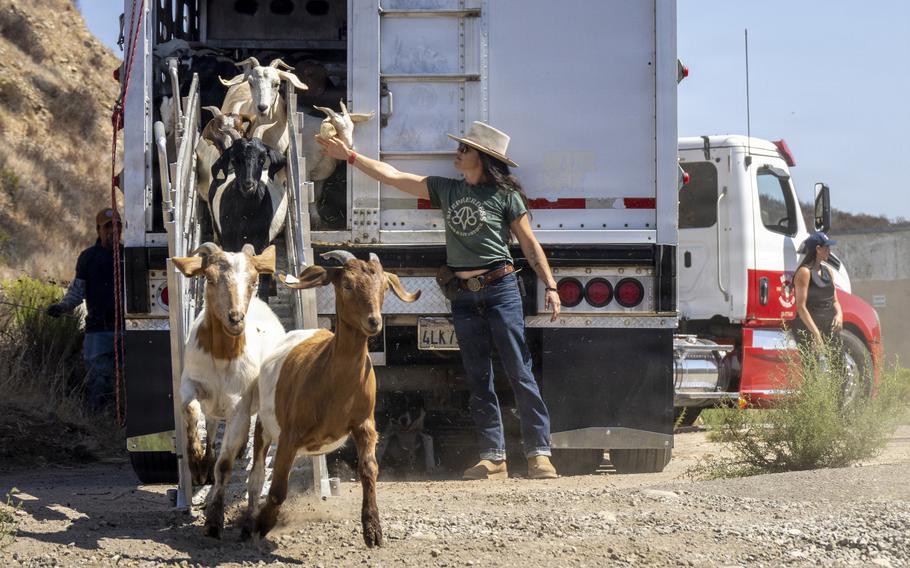
Starbuck described the program as an alternative to traditional clearing methods that can bring other environmental effects. He also connected the grazing mission directly to protecting military assets and natural areas around the installation.
“This nature-based initiative reduces wildfire hazards along the base perimeter, protects critical military infrastructure, and preserves sensitive native habitats without the emissions, soil disruption, or chemical runoff associated with traditional mechanical clearing,” Starbuck said.
Brush and wildfires remain a persistent concern across military training lands in Southern California, especially during peak dry seasons.
Miramar’s effort puts the goats to work against that threat while testing whether targeted grazing can become a useful tool for future mitigation.
The danger is not limited to Miramar. At Marine Corps Base Camp Pendleton, about 45 minutes north, an average of 101 wildfires break out each year across an installation where much of the property is undeveloped training land, according to an August service release.
The goats are expected to remain in Miramar’s training areas for approximately five to six weeks.
uring that time, officials will be able to watch how effectively the herd clears vegetation across terrain that presents challenges for conventional equipment and human crews.
Starbuck said the pilot will allow officials to measure the long term effectiveness of targeted grazing.
Those findings will help determine whether the approach could be used again during future wildfire mitigation efforts at the installation.
Miramar Fire Chief Joshua Allen said defensible space is the greatest asset available when battling blazes in Southern California. Under Operation Goat Rope, the goats are creating strategic fuel breaks intended to help firefighters gain time and a tactical advantage.
“The strategic fuel breaks created by this targeted grazing program slow a fire’s advance and lower the energy released,” Allen said.
“This gives our firefighting crews the critical time and tactical advantage they need to suppress a blaze safely and effectively before it escalates.”
For now, Miramar’s newest wildfire prevention crew will keep eating its way across the training grounds.
The approach may be unconventional, but 471 hungry goats are bringing serious manpower, or perhaps goat power, to a mission built around protecting Marines, infrastructure and sensitive habitat.
Join the Discussion
COMMENTS POLICY: We have no tolerance for messages of violence, racism, vulgarity, obscenity or other such discourteous behavior. Thank you for contributing to a respectful and useful online dialogue.