WHAT YOU NEED TO KNOW
- An April 2026 report found the United States unprepared to detect, manage or recover from a nuclear weapon detonated in orbit.
- Four war game scenarios exposed weak attribution tools, limited response options and no existing recovery capability after orbital nuclear detonations.
- Air Force Secretary Troy Meink confirmed the United States has orbital weapons capable of defending forces against hostile action.
- U.S. Space Command warned that a Russian nuclear ASAT weapon could endanger every satellite in low Earth orbit.
The United States is not prepared to detect, manage or recover from a nuclear weapon detonated in orbit, according to strategists who tested American responses to a potential space based nuclear crisis.
The danger threatens military satellites, commercial systems and the global communications networks that depend upon them.
Officials increasingly view such an attack as more than a remote possibility.
Recent developments involving American orbital weapons, Russian demands for the demilitarization of space and stolen documents concerning a next generation Russian military platform have pushed the issue beyond think tank debate.
Here's What They're Not Telling You About Your Retirement
MORE NEWS: Trump Says U.S. ‘Hopefully’ Nears End of Iran War as Saudi Arabia and Houthis Trade Strikes
Yet American decision makers still lack clear guidance, legal clarity and operational plans for handling a nuclear crisis in space.
An April 2026 American Foreign Policy Council report reached that conclusion after examining two 2025 war games, finding the United States unprepared in both cases.
The exercises took place during two workshops in May 2025. Participants included former officials from the National Security Council, the Pentagon, the intelligence community, the Space Force, U.S. Space Command and the commercial satellite industry.
Participants worked with three draft contingency plans covering distinct stages of an orbital nuclear threat. Those plans addressed a suspected nuclear device in orbit, a confirmed weapon being used for coercion and an actual detonation.
This Could Be the Most Important Video Gun Owners Watch All Year
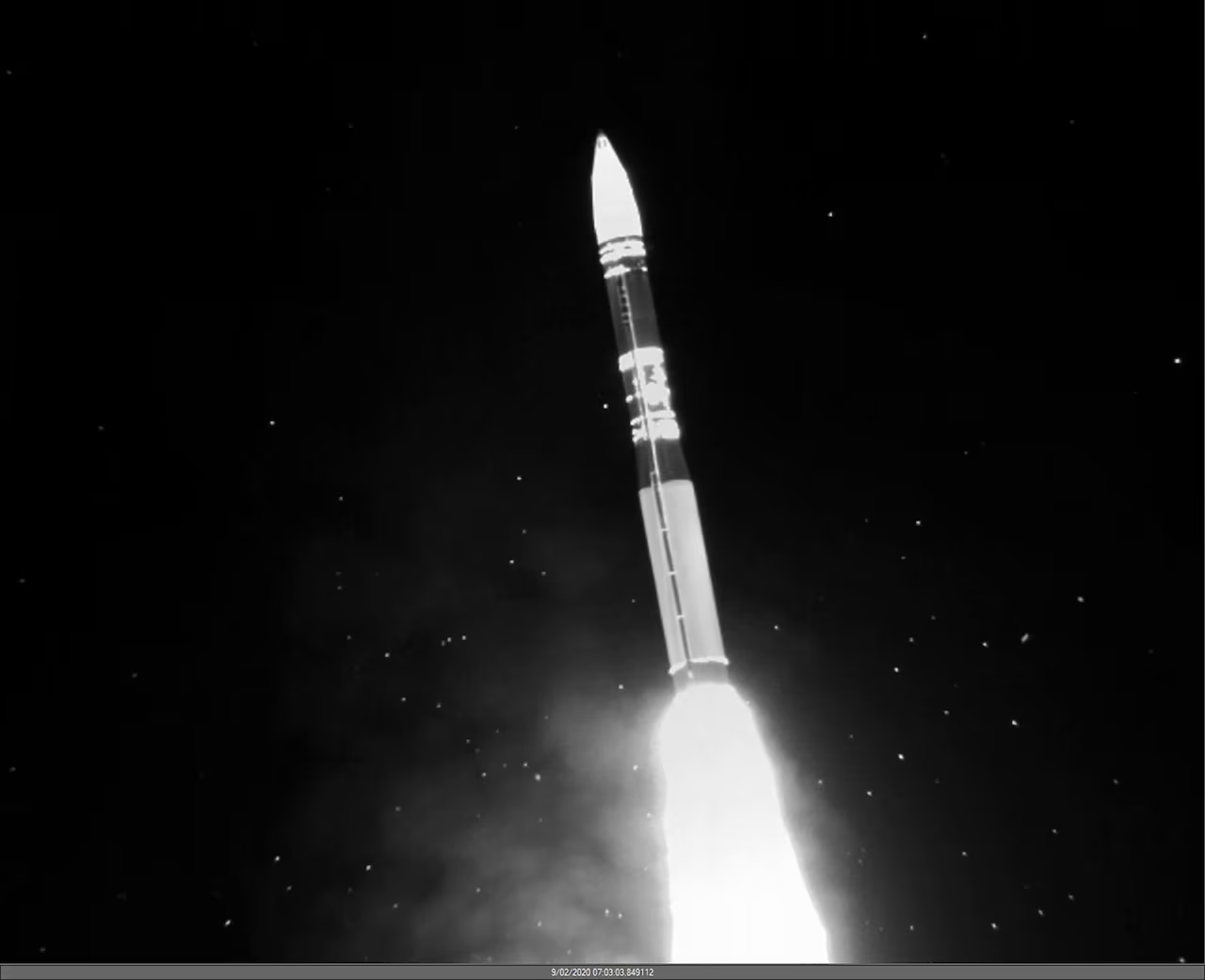
The plans were tested across four scenarios that featured a fictional Russian satellite modeled on a real Russian platform.
A Chinese adversary also served as a stand in during the exercises.
In the first scenario, American detection and attribution tools proved too weak to verify whether the suspected satellite carried a nuclear payload.
The uncertainty created a significant risk that the United States could escalate prematurely without confirming the nature of the threat.
The second scenario had Russia publicly announce that it possessed a nuclear weapon in orbit. Moscow then warned that the United States must meet its demands or lose both military and commercial satellites.
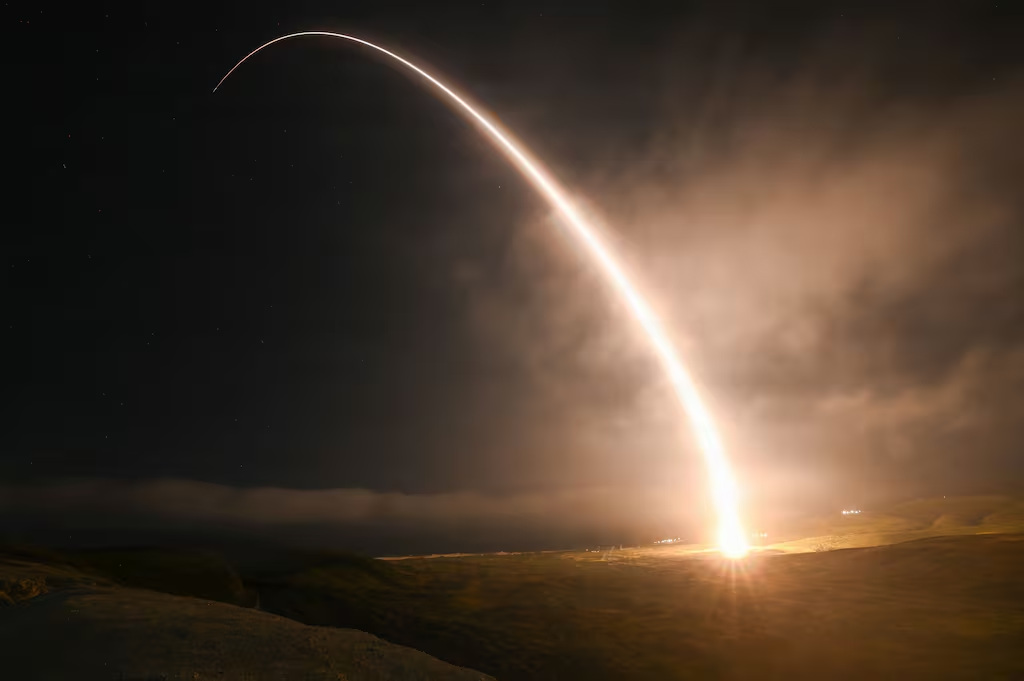
Workshop participants considered the threat credible. Even worse, they concluded that the United States “appears to lack response options.”
The third and fourth scenarios involved outright nuclear detonations.
One weapon exploded in low orbit, while another was detonated in geostationary orbit as a Chinese demonstration during a crisis involving Taiwan.
Strategists found that no existing capability could recover from either detonation scenario.
Across all four cases, the report determined that the United States can defend its satellites from direct adversary action but lacks a tested plan for an orbital nuclear weapon.
Air Force Secretary Troy Meink disclosed Monday that the United States “now has on-orbit space control weapons capable of defending the joint force against hostile adversary action,” marking the first public acknowledgment from an American official that the military has placed weapons in orbit.
American officials have also warned of a “serious national security threat” connected to Russian space activity since mid 2024. That concern included a Russian antisatellite weapon capable of carrying a nuclear payload.
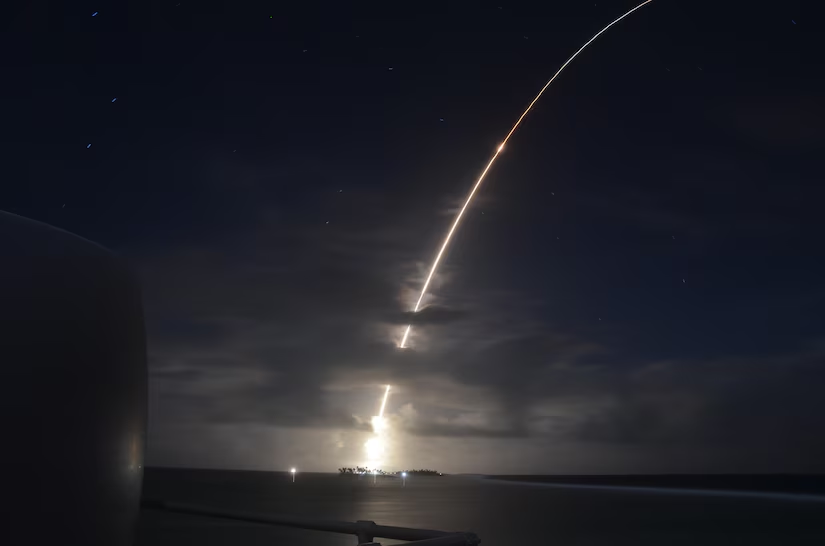
Meink’s disclosure drew a response Tuesday from Kremlin spokesman Dmitry Peskov.
According to AFP, Peskov declared, “We believe that space must be free of any weapon,” even as concerns continue over Moscow’s own orbital activities.
Ukrainian military intelligence said last week that it breached the network of Russia’s Moscow Institute of Thermal Technology, the corporation responsible for the Yars and Bulava nuclear missiles. The directorate said it obtained documents related to a Russian orbital program.
Those documents included “a scalable, unified space platform called ‘Tiporyad,’ aimed at enhancing the reconnaissance, communication, and command capabilities of the Russian army,” according to the Ukrainian intelligence directorate.
U.S. Space Command said in April that it knew of Russia’s recent orbital upgrades and the danger they pose to American interests.
Gen. Stephen Whiting, head of U.S. Space Command, addressed the threat during an April 16 interview with Fox News.
“Russia remains a very historic and sophisticated space power... they continue to invest in counter-space weapons, with the most concerning reports being that they are potentially thinking about placing on orbit a nuclear ASAT weapon,” Whiting said.
Whiting warned that such a weapon “would hold at risk everyone’s satellites in low Earth orbit, and that would be an outcome that we just couldn’t tolerate.”
The war games indicate that Washington still lacks tested answers if that intolerable scenario becomes reality.
Are you feeling overwhelmed or hopeless right now? Have you been withdrawing from people or activities you usually enjoy? Are you having thoughts about hurting yourself, or feeling like things will never improve?
You do not have to handle those feelings alone. Support is available, and talking to someone can make a difference. You can reach out to the 988 Suicide & Crisis Lifeline by calling or texting 988, or by chatting online at 988lifeline.org. Trained counselors are available 24 hours a day to listen and help.
If you believe someone is in immediate danger, call emergency services right away. Even a small step, like reaching out to a trusted friend, family member, or professional, can help create a path forward.
Join the Discussion
COMMENTS POLICY: We have no tolerance for messages of violence, racism, vulgarity, obscenity or other such discourteous behavior. Thank you for contributing to a respectful and useful online dialogue.