The United States lacks enough engineers, technicians, and assemblers to rapidly replace military satellites destroyed during a prolonged war with China or Russia, according to a RAND report published Aug. 31.
The finding exposes a dangerous weakness in an era when American forces depend heavily on space for communications, navigation, missile warning, and battlefield intelligence.
The study, “Breaking Glass, Missing Hands,” examined how quickly the nation could restore satellites and supporting systems lost early in a major conflict.
Researchers established a reconstitution target of 12 to 24 months, far faster than the roughly decade long process commonly required to replace an aging satellite.
Here's What They're Not Telling You About Your Retirement
RAND evaluated whether the space industrial base could meet that demanding timeline between 2027 and 2032.
Its conclusion was blunt: current workforce shortages could take years to repair, leaving the proposed replacement schedule beyond reach.
Gen. Michael Guetlein, now director of Golden Dome, sponsored the research while serving as vice chief of space operations.
RAND Project AIR FORCE conducted the study under a fiscal 2024 project titled “In Emergency, Break Glass,” with Alexandra Gerber serving as lead author.
This Could Be the Most Important Video Gun Owners Watch All Year
Researchers reviewed federal labor and education data from October 2024 through March 2025.
They also interviewed industry representatives and education administrators from May through July 2025 to identify the practical obstacles facing companies expected to rebuild wartime losses.
The report divided the workforce supporting military space production into three main groups.

The first includes engineers responsible for designing, developing, and testing satellites and related systems.
Nearly 3 million Americans work in engineering positions requiring at least a bachelor’s degree, but only about 3 percent work in the industries RAND counted as supporting space.
Those industries included satellite communications, semiconductor manufacturing, and nonmetallic mineral product manufacturing that produces optical glass, while aerospace manufacturing was excluded.
RAND estimated that these three industries represent only about 7,000 of the nation’s 208,000 annual engineering openings.
Space companies must also compete against artificial intelligence, software, and data analytics firms that often provide higher salaries, more flexible workplaces, and fewer bureaucratic hurdles.
The second workforce group is “skilled touch labor,” meaning the technicians and assemblers who physically construct spacecraft.
Using 2023 Bureau of Labor Statistics figures, RAND estimated there are about 30,000 annual technician openings, while only 11,000 people obtain the necessary qualifications each year.
The assembler shortage is even more severe. Researchers identified roughly 244,000 annual openings, including cleanroom technician positions, but only 13,000 newly credentialed workers each year, producing a staggering gap of 19 openings for every qualified worker.
MORE NEWS: Vice President JD Vance Vows Action for Fallen Airman’s Widow After Benefit Bureaucracy Erupts
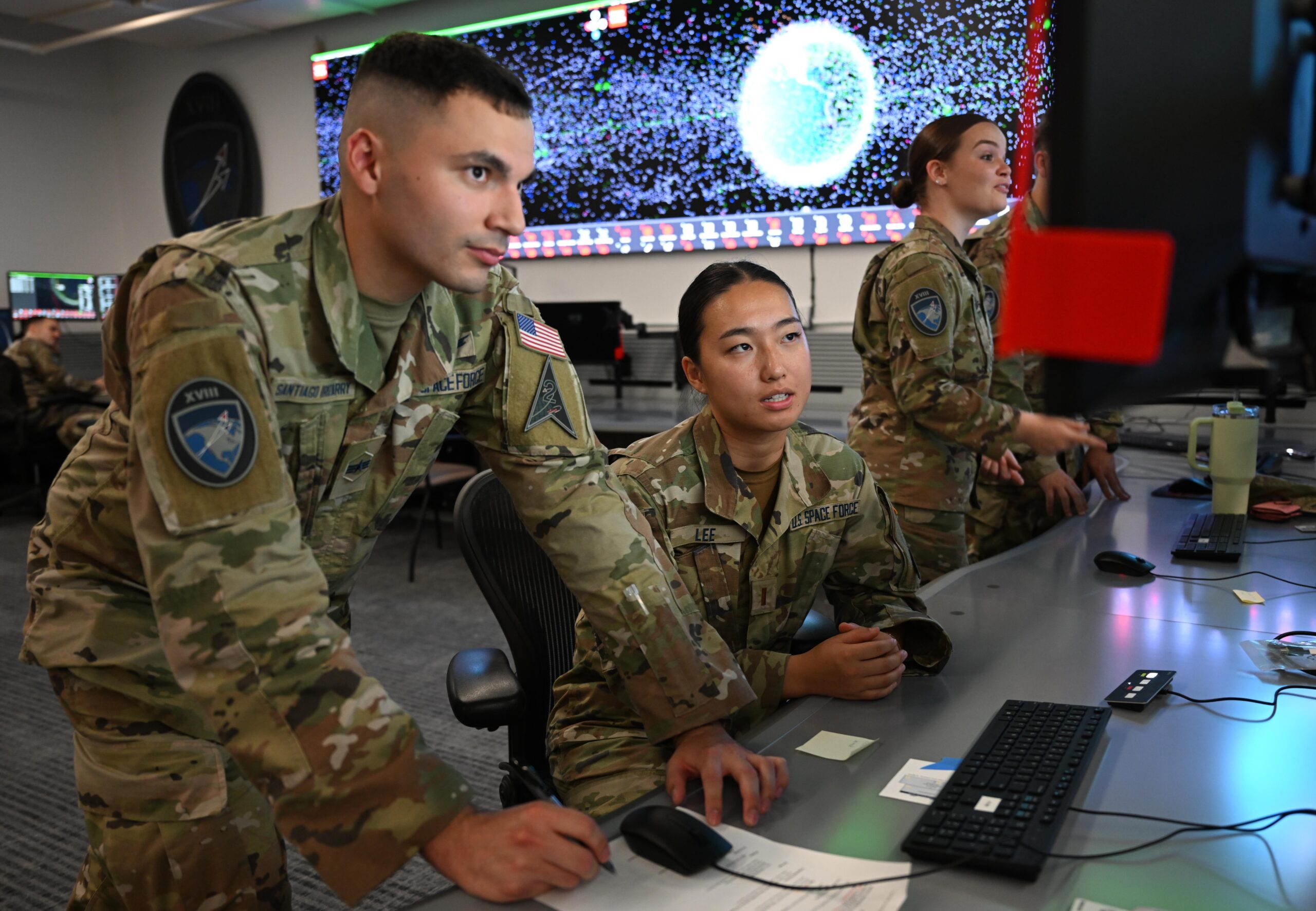
Space Force Spc. Roberto Santiago-Irizarry, left, and 2nd Lt. Yoon Jung Lee monitor Space Domain Awareness information on the 18 SDS operations floor at Vandenberg Space Force Base, Calif., Oct. 4, 2024.
Space producers account for only part of that national demand, but they are fighting semiconductor manufacturers and other advanced industries for the same limited pool.
Patriotic mission statements are useful, but they do not magically produce trained hands capable of assembling highly sensitive spacecraft.
The third category includes specialists in infrared and electro optical detection, along with engineers who design systems able to survive natural and man made radiation.
These experts generally hold master’s degrees or doctorates, and developing the required knowledge can take 15 years or longer.
Few universities offer advanced degrees specifically focused on laser and optical engineering, so many specialists emerge from electrical or computer engineering programs.
RAND reported that foreign nationals received 70 percent of recent doctorates in those fields, sharply reducing the pool eligible for classified American programs.
Security clearance delays make the problem worse. Initial Secret investigations averaged more than 87 days in fiscal 2024, while Top Secret investigations took nearly six months, according to a Trusted Workforce 2.0 progress report cited by RAND.
Even after workers are credentialed and cleared, interviewees said they can require up to a year to become productive.
Cleanrooms, secure facilities, and limited training capacity also restrict how quickly manufacturers can absorb additional personnel during a crisis.
Industry representatives described the central challenge as “surging from zero.” When production collapses between contracts, specialized skills fade, experienced employees leave, and critical institutional knowledge walks out the door with them.
RAND recommended including surge planning requirements in future contracts so companies can prepare before missiles begin flying.
Researchers found little agreement that emergency mobilization alone would solve the problem because Defense Production Act authorities cannot instantly create clearances, certifications, or highly specialized experience.
The report proposed about $5 million annually for scholarships, internships, and academic outreach, along with an $800,000 study examining whether workers from other fields could be retrained for emergency production.
It also recommended expanding the National Imperative for Industrial Skills program and studying the Navy’s Talent Pipeline Program as a possible model for skilled trades.
Another proposal would allow Reserve Officers’ Training Corps graduates to satisfy service commitments by working at qualifying space companies.
RAND suggested extending a similar option to SMART scholarship recipients currently committed to civilian War Department positions.
RAND assigned responsibility to the assistant secretary of the Air Force for space acquisition and integration because workforce capacity is fundamentally a production and supply chain risk.
This is not merely an internal Space Force personnel issue that can be buried beneath another Pentagon staffing chart.
Interviewees emphasized hiring pipelines and quicker clearances but rarely cited robotics, process automation, or artificial intelligence as methods for reducing labor hours per satellite.
RAND did not determine whether automation would be practical, although it identified the omission as a serious gap in reconstitution planning.
Most space manufacturers currently produce at volumes too low to justify expensive automation investments.
A wartime replacement surge could change that calculation quickly, but America cannot wait until satellites are burning overhead to discover whether its industrial base has enough people, facilities, and equipment to rebuild them.
Are you feeling overwhelmed or hopeless right now? Have you been withdrawing from people or activities you usually enjoy? Are you having thoughts about hurting yourself, or feeling like things will never improve?
You do not have to handle those feelings alone. Support is available, and talking to someone can make a difference. You can reach out to the 988 Suicide & Crisis Lifeline by calling or texting 988, or by chatting online at 988lifeline.org. Trained counselors are available 24 hours a day to listen and help.
If you believe someone is in immediate danger, call emergency services right away. Even a small step, like reaching out to a trusted friend, family member, or professional, can help create a path forward.
Join the Discussion
COMMENTS POLICY: We have no tolerance for messages of violence, racism, vulgarity, obscenity or other such discourteous behavior. Thank you for contributing to a respectful and useful online dialogue.