WHAT YOU NEED TO KNOW
- The Army unveiled the XM1776 Mobile Tactical Cannon and accepted its first prototype this month.
- The truck mounted howitzer can reach 37 miles and fire as many as nine rounds per minute.
- A three soldier crew can operate the cannon and its automated ammunition system from inside the cab.
- The initial contract covers six base vehicles, with an option for 12 more.
The Army has formally designated its new mobile howitzer prototype the XM1776, unveiling the cannon Monday during the Association of the United States Army conference in Washington, D.C. The service also took possession of the first XM1776 prototype this month.
Developed by Hanwha Defense USA, the Mobile Tactical Cannon is designed to fire farther and move faster than the towed M777. It also requires a smaller crew, giving Army formations a more mobile artillery option for increasingly exposed battlefields.
Lt. Gen. Francisco J. Lozano, director of the Rapid Capabilities and Critical Technologies Office, announced the designation Monday. According to Lozano, the XM1776 name reflects the innovation, independence, and determination associated with the Army and the nation it serves.
The XM1776 is based on Hanwha’s K9 Mobile Howitzer and is built on a truck chassis. The wheeled artillery system carries a crew of three and allows soldiers to shoot and move without leaving the vehicle’s cab.
Its barrel is roughly 26 feet long, helping the cannon reach targets up to 37 miles away. The M777, by comparison, can fire as far as 20 miles when using specific ammunition.
The Army announced an agreement with Hanwha for the Mobile Tactical Cannon program in August. Jason Pak, Hanwha’s senior director of business development and head of land systems artillery, discussed the prototype with Task & Purpose at AUSA.
According to Pak, the XM1776 can fire as many as nine rounds per minute. That is more than double the M777’s firing rate of four rounds per minute, adding substantially more speed to the new cannon’s longer reach and improved mobility.
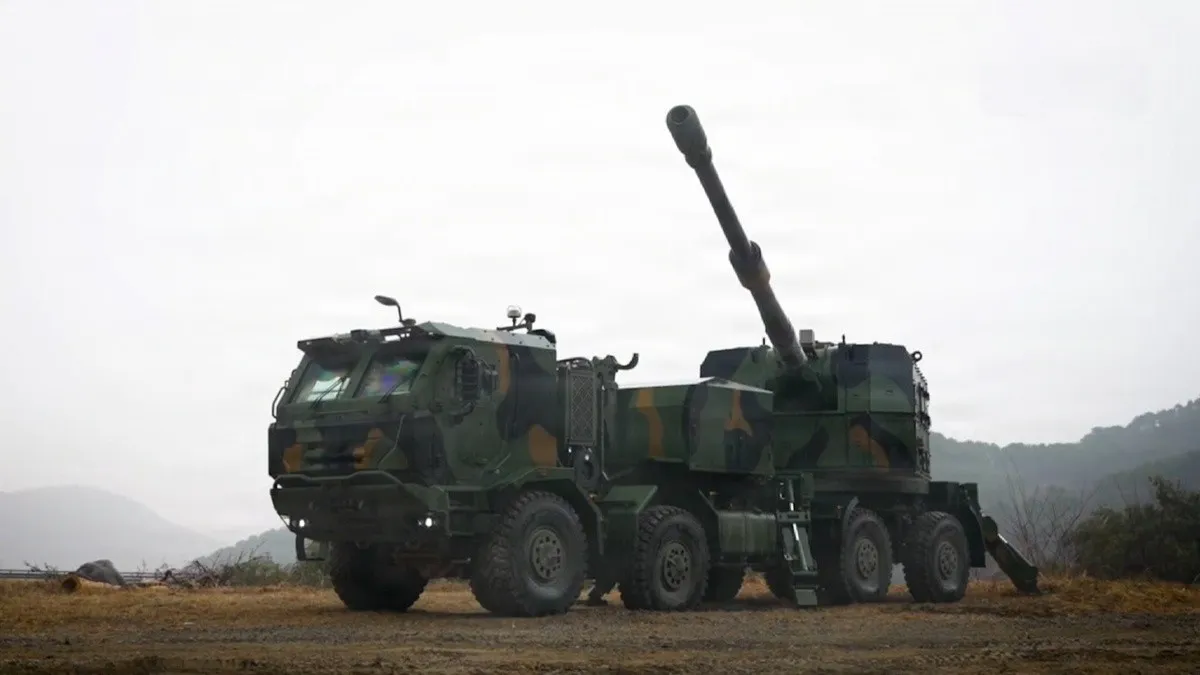
The Army said faster moving cannons are intended to improve mobility and reliability on “the modern, highly transparent battlefield.” The proliferation of drones and counter battery systems has made slower artillery positions more vulnerable, increasing the pressure on crews to fire and relocate quickly.
“Part of this being a prototype contract award is going through testing and experimentation, modifications and upgrades as required for the actual platform that’s going to eventually be fielded,” Pak said. The prototype process gives the Army and Hanwha room to test the system and make changes before any broader fielding decision.
“Whatever counter-UAS system that the Army seeks or desires on this, we’re going to outfit it with,” Pak said. His comments indicate that protection against unmanned aircraft remains among the capabilities the Army can address as testing and experimentation continue.
The XM1776 also features an automated system for resupplying artillery rounds. A soldier can operate that process through the camera system inside the truck, allowing the crew to remain within the vehicle’s cab during cannon operations.
“There are cameras installed in the turret itself, and you can see all the operation going on,” Pak said. “And also, if the automation fails for some reason, there is the ability to fire it manually if needed.”
The XM1776 is not slated to replace every towed M777. The Army said that, if the new cannon is approved for fielding, it would take the M777’s place in “select formations.”
The Mobile Tactical Cannon program belongs to the Army’s broader effort to expand long range precision fire capabilities. That effort has also included establishing multi domain task forces equipped with long range precision missiles, electronic warfare capabilities, and targeting tools intended to help the joint force strike peer level forces from a distance.
Hanwha said in August that it is establishing a test facility in Opelika, Alabama, to develop the XM1776 with the Army. That facility will support work on a prototype that combines greater range, a faster firing rate, automated ammunition handling, and improved movement.
The initial contract covers six base vehicles and includes an option to purchase 12 more, according to Pak. He said the Other Transaction Authority contract provides flexibility to adjust requirements while the first group of systems undergoes testing and experimentation.
Pak said the program could then proceed into full rate production in the coming years to replace M777s. For now, the Army has its first prototype, a patriotic designation, and a mobile cannon built to hit farther and leave the firing position faster.
Join the Discussion
COMMENTS POLICY: We have no tolerance for messages of violence, racism, vulgarity, obscenity or other such discourteous behavior. Thank you for contributing to a respectful and useful online dialogue.