WHAT YOU NEED TO KNOW
- The Army is expanding high altitude balloon experiments after deployments to Europe, the Pacific and the Middle East.
- Officials are considering sensing, communications, launched effects and potentially kinetic payloads for stratospheric systems.
- The platforms operate from roughly 60,000 to 100,000 feet, a region officials call the space littorals.
- Army units are testing constellation concepts combining exclusive payload carriers with cheaper balloons deployable by the hundreds.
- Multiple experiments are planned over the coming year as support for the balloon program grows.
The U.S. Army is accelerating experiments with high altitude balloons after deploying the systems to Europe, the Pacific and the Middle East. A missile defense official said Wednesday that options involving kinetic effects remain available as the service examines how to capitalize on the stratosphere.
Col. Joseph Mroszczyk said during a briefing at the Association of the United States Army’s annual meeting that he was advocating for “a family of stratospheric systems” that would include balloons of different sizes. The concept is intended to bring a range of capabilities into the atmospheric band between conventional air operations and space.
“What that enables us to do is provide space-like capabilities, really exploiting a transition point between what is normally considered the aerial layer and the space domain,” Mroszczyk said.
That operational zone could provide persistence and broad coverage while carrying payloads for sensing, communications or launched effects. Mroszczyk also pointed to the ability to use stratospheric winds to move systems where operators want them to go.
Using balloons as shooters would likely create more challenges than employing them for sensing missions, Mroszczyk said. Still, he made clear that the Army is not automatically ruling out lethal applications as experimentation continues.
“I wouldn’t say that we’re going to hold back from opportunities and options that would include something that could be kinetic in nature,” he said. “But right now, we’re doing experiments across the board with all types of different payloads.”
The stratosphere sits above the troposphere, the lowest layer of Earth’s atmosphere. The Army applies the term to the region extending from roughly 60,000 to 100,000 feet, or approximately 11 to 19 miles above Earth.
Mroszczyk called that region the “space littorals,” borrowing language the Navy uses for shallow waters closest to a coast. The phrase reflects the Army’s effort to treat the stratosphere as a distinct operational area with characteristics linking the air and space domains.
Military balloons are not a new idea, but the Army’s current level of interest in their potential is unprecedented. A Chinese balloon that entered U.S. airspace in 2023 triggered national security alarms and led to the discovery of several earlier incursions that had gone undetected.
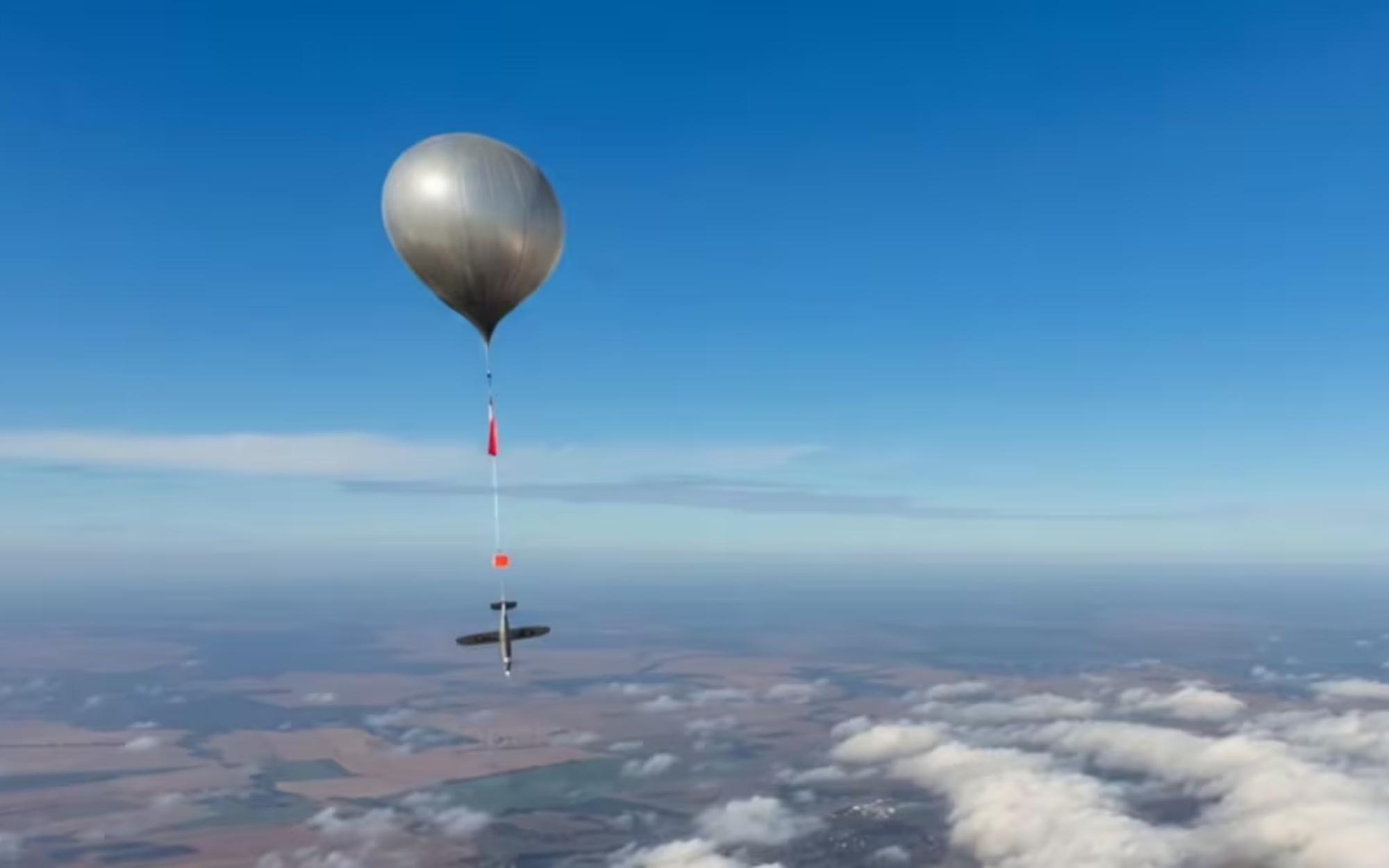
A 2019 Army University Press article also described the potential value of military balloons as space operations gained prominence. Lt. Col. Anthony Tingle identified several missions the platforms could perform from such heights.
“Intuitively, balloons at such heights could perform missions such as intelligence, surveillance and reconnaissance, communications, missile warning, and precision navigation and timing,” Tingle wrote. “As the space domain becomes increasingly precarious, balloons offer resilience and redundancy against overhead capability shortfalls.”
Lt. Gen. John Rafferty, commander of U.S. Army Space and Missile Defense Command, said the systems have been deployed for testing and demonstrations in Europe, the Pacific and Morocco. Breaking Defense also reported activity in the Middle East this week, citing officials who described small swarms of a few dozen drones deployed for testing after a larger Pacific demonstration was canceled.
Col. Wade Germann, commander of the Army’s 3rd Multi-Domain Task Force, said his unit is developing operating concepts for the balloons. Those concepts include a constellation approach that combines a small number of exclusive systems carrying different payloads with cheaper and expendable platforms that can be launched rapidly by the hundreds.
“We work them in a format called constellation approach, where we’ll put a couple of the high, high-end, really exclusive ones up there with different payloads and systems on them,” Germann said.
Germann said the Army is working with industry to identify useful capabilities, appropriate payloads, the right lifting gas and effective launch methods. Feedback from partners operating in the field is being used to shape that development process.
Over the coming year, Mroszczyk said the Army plans to conduct multiple balloon experiments focused on finding the best methods to “exploit the stratosphere.” The testing push follows demonstrations across several regions and growing support for the concept.
Rafferty said watching the balloons operate had made him a “huge believer” in their potential. “Every time they are demonstrated in the Pacific or in Europe, there are more and more; they gain more and more support,” he said.
The commander said officials are excited about what the next year could bring for the program. For the Army, the stratosphere is increasingly looking less like empty space and more like operational territory waiting to be put to work.
Join the Discussion
COMMENTS POLICY: We have no tolerance for messages of violence, racism, vulgarity, obscenity or other such discourteous behavior. Thank you for contributing to a respectful and useful online dialogue.