WHAT YOU NEED TO KNOW
- Ornadyne’s wing flapping O1 drone evaded detection during an Air Force technology exercise at Edwards Air Force Base.
- Competing detection equipment registered the 1 pound unmanned aircraft as a bird rather than identifying it as a drone.
- The O1 can fly more than 6 miles, remain airborne for over an hour and carry a small surveillance payload.
- Ornadyne says the drone’s appearance can be altered to resemble native bird species in different regions.
A wing flapping drone designed to look and move like a bird evaded sensor detection during a recent Air Force technology exercise in California’s Mojave Desert. The small aircraft gave competing detection systems a deceptively ordinary target.
Ornadyne’s O1 ornithopter does not rely on propellers like most drones. Instead, it remains airborne by flapping its wings, copying the flight mechanics and appearance of a bird while operating at low altitudes.
The small unmanned aerial system is designed to collect intelligence or survey an area without immediately advertising that a drone is overhead. Its bird shaped appearance and unusual movement are central to that approach.
“It looks like a bird, it moves similar to a bird, and humans and counter-UAS systems can misclassify it as a bird,” Armen Arakelyan, one of Ornadyne’s co-founders, said in a Department of War release. “It’s also a lot quieter because we replaced propellers with flapping wings.”
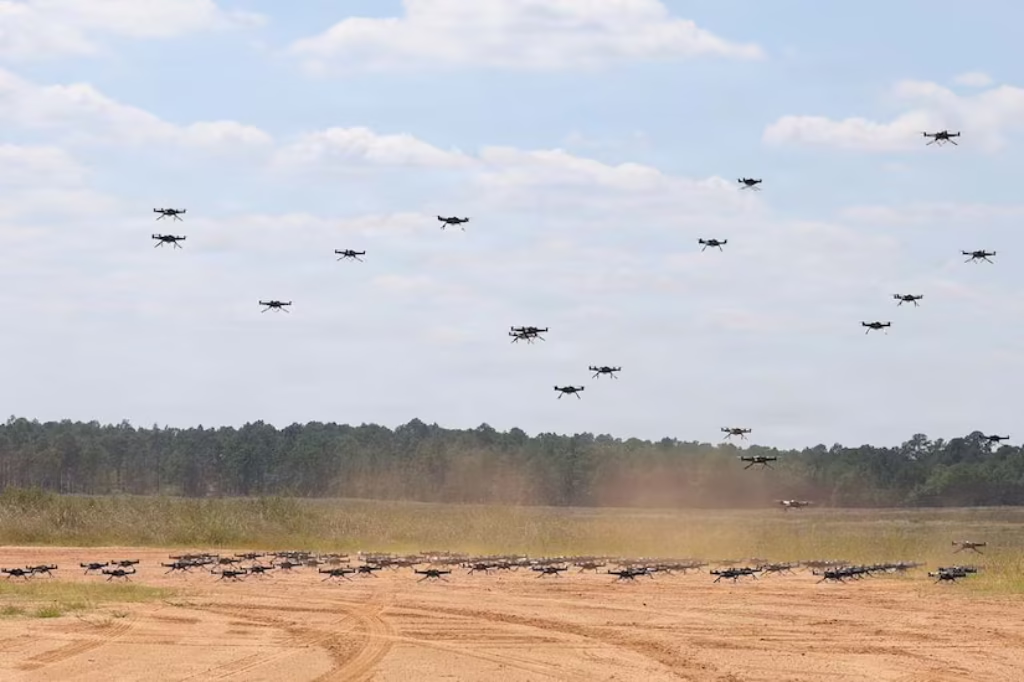
The test occurred during the military’s annual “Game of Drones” event in September at Edwards Air Force Base. The installation, located in the Mojave Desert in Southern California, hosts quarterly drone exercises to evaluate new technology.
The event is sponsored by the Air Force 412th Test Wing’s Experimental Test Force and the War Contract Management Agency’s Blue List team. The Blue List team approves commercial drones for sale to the U.S. military.
The exercise marked the first time the U.S. drone manufacturer tested whether its aircraft could hide from detection systems built by other private companies. Arakelyan is also a former engineer for Elon Musk’s SpaceX.
According to a company fact sheet, the O1 weighs 1 pound and can fly as far as 10 kilometers, slightly more than 6 miles. It can remain in flight for more than an hour.
The drone can also carry a small payload, including a camera used for target recognition during surveillance missions. That capability gives the bird mimicking aircraft a practical intelligence role beyond simply confusing sensors.
Many drones attempt to avoid detection by concealing the signatures they emit, using different frequencies or mobile SIMs, or flying autonomously along a planned route. Others employ fiber optic cables to bypass electronic surveillance.
The O1 follows a different playbook by attempting to blend directly into its environment. Ornadyne says the drone’s color, wingspan, proportions and silhouette can be changed to match a native bird species operating in a particular region.
“We learned during ‘Game of Drones’ that sensors deployed by the other companies here could not establish our drone using their detection equipment,” Geourg Kivijian, Ornadyne’s other co-founder, said. “It registered as a bird, which is exactly what we wanted.”
Ornadyne is not the first company to develop a bird like drone. An entire category of unmanned systems known as ornithopter drones uses wings rather than propellers or jets to imitate birds or insects in the sky.
The concept has also attracted the attention of Birds Aren’t Real, a group of conspiracy theorists promoting the somewhat satirical claim that the U.S. government replaced all birds with surveillance drones. With aircraft such as the O1 taking flight, that joke now has a little more material to work with.
Bird mimicking drone technology has appeared outside the United States as well. In 2024, video from a People’s Liberation Army exercise showed a Chinese Jiaolong Commando releasing a bird like drone resembling a Eurasian tree sparrow and flapping its wings.
The Jiaolong Commandos are described as being akin to the Navy SEALs. Fortunately, the robotic birds shown in that video appeared to be nonmigratory, adding a final bit of humor to a technology built for serious surveillance work.
Join the Discussion
COMMENTS POLICY: We have no tolerance for messages of violence, racism, vulgarity, obscenity or other such discourteous behavior. Thank you for contributing to a respectful and useful online dialogue.