The U.S. Air Force has announced that it expects to spend “less than $400 million” to convert a Boeing 747-8 aircraft—gifted by the Qatari government—into a secure, fully functional flying command center for President Donald Trump.
The announcement comes amid intense scrutiny from congressional Democrats and defense analysts who have speculated the cost could approach or exceed $1 billion.
The estimate was provided by Air Force Secretary Troy Meink during a House Armed Services Committee hearing on Thursday.
Meink directly challenged assumptions about the modification costs, stating that many of the projected expenses—such as training and spare parts—are already funded under the broader VC-25B presidential aircraft modernization program.
MORE NEWS: Pentagon Confirms First Military Execution in Over 60 Years Will Be Publicly Livestreamed
“There’s been a number thrown around on the order of a billion dollars,” Meink said. “It’s probably less than $400 million to retrofit that aircraft.”
This clarification is a response to rising concerns on Capitol Hill following the White House’s decision last month to accept the Qatari gift.
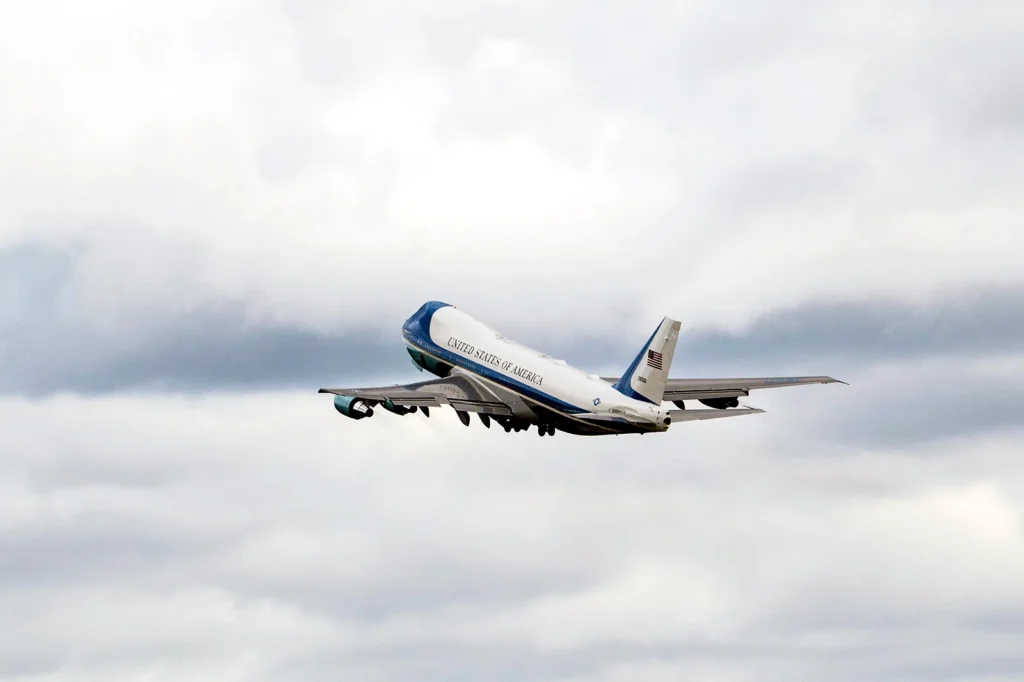
Valued at approximately $400 million, the 747-8 will serve as a stopgap replacement for the new Air Force One fleet, which is facing extended delays.

Once President Trump leaves office, the aircraft is expected to be transferred to the Trump Presidential Library Foundation.
The Air Force has not released details about the timeline or exact nature of the retrofitting.
It also has yet to confirm which defense contractor will complete the work, though The Wall Street Journal reported in May that L3Harris has been selected to convert the aircraft at a facility in Texas, with an expected completion later this year.
The retrofitting process will likely include installing encrypted communications systems, defensive countermeasures, and specialized equipment needed for the aircraft to function as an airborne command center—capabilities standard to any aircraft serving the president.
President Trump addressed the matter on his social media platform, Truth Social, defending the move by highlighting the cost-savings. He described Qatar’s donation as “a GIFT, FREE OF CHARGE” to the Department of War.
The statement appears to be an effort to frame the aircraft not just as a gesture of international goodwill, but also as a solution to mounting frustrations over delays in the VC-25B program.

Originally launched in 2015, the VC-25B modernization program involves converting two Boeing 747-8 aircraft into new Air Force One jets under a $3.9 billion fixed-price contract with Boeing.
The planes were initially scheduled for delivery in 2024, but that timeline has now slipped to 2029. Trump has expressed frustration with the delays, which could leave the Air Force without a fully capable presidential aircraft for the remainder of his term.
Democrats, however, are raising alarm bells over the Qatari gift, pointing to both national security concerns and financial implications.
They argue that accepting a high-value aircraft from a foreign government poses potential conflicts of interest and could cost the U.S. far more than advertised to bring the jet up to presidential standards.
Rep. Joe Courtney, D-Conn., voiced these concerns during the same hearing, stating, “Based on the experience that we already have gone through with retrofitting planes, 747s, it’s clear that this is going to be a drain on the Air Force’s budget.”
He called for increased transparency from the Department of War regarding the full scope and cost of the retrofitting process.
“I think that the sooner we just sort of rip the Band-Aid off and get that information out there, it would be helpful for us in terms of deciding whether this is a smart path to go down,” Courtney added.
Still, the Air Force insists that much of the necessary groundwork for the retrofit—such as pilot training and logistics planning—has already been undertaken as part of the VC-25B program.
By advancing some of these expenses rather than duplicating them, officials argue, the cost can be kept well under the $1 billion threshold critics have cited.
As the debate continues, all eyes will be on the Defense Department for further disclosures and cost breakdowns.
With tensions high between fiscal hawks and administration supporters, the fate of the Qatar-gifted aircraft may become a symbolic flashpoint in the broader conversation over defense spending, presidential travel, and foreign influence.
Join the Discussion
COMMENTS POLICY: We have no tolerance for messages of violence, racism, vulgarity, obscenity or other such discourteous behavior. Thank you for contributing to a respectful and useful online dialogue.