WHAT YOU NEED TO KNOW
- Nidal Hasan asked a federal judge to halt his firing squad execution while he challenges his conviction and sentence.
- President Donald Trump approved the execution in October, calling Hasan “a very bad and evil man.”
- Hasan was convicted in 2013 of 13 counts of premeditated murder for the 2009 Fort Hood attack.
- U.S. District Judge Anthony Mattivi scheduled a Wednesday hearing on Hasan’s request for a stay.
Nidal Hasan, the former U.S. Army major convicted of murdering 13 people at Fort Hood in 2009, has asked a federal judge to stop his scheduled execution next week. He is seeking time to challenge both his detention and sentence.
President Donald Trump approved Hasan’s execution by firing squad in October and called him “a very bad and evil man.” War Secretary Pete Hegseth also made an unprecedented promise to livestream the execution from the Texas military base.
Trump later scrapped Hegseth’s broadcast plans following widespread outcry. Hasan nevertheless cited the proposed broadcast as part of his broader legal challenge to the process used to establish his execution date.
Hasan is imprisoned at Fort Leavenworth in Kansas. His request asks a federal judge in Topeka to issue a stay that could potentially delay the execution by months or years.
U.S. District Judge Anthony Mattivi ordered a hearing on the requested stay for Wednesday morning. The proceeding comes shortly before Hasan is scheduled to be returned to the same military base where he carried out the 2009 attack.
Under U.S. law, a condemned person may seek legal review of a detention and sentence through a habeas corpus petition after being notified of the date and method of execution. Hasan is using that process to challenge whether his conviction and sentence were constitutional.
A spokesperson for the Department of War did not immediately respond to a request for comment. The military has not conducted an execution following a court-martial conviction since 1961.
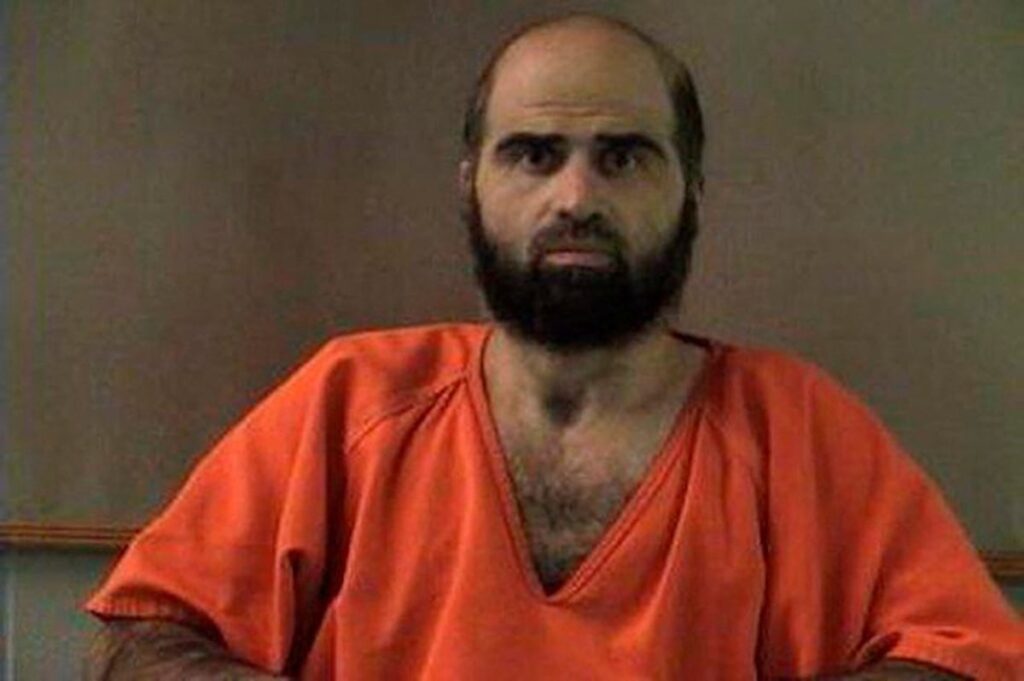
Hasan, a former Army psychiatrist, used a handgun to kill 13 people inside a medical facility at Fort Hood. Military police ended the attack by shooting him, leaving him paralyzed from the chest down.
A military court-martial jury convicted Hasan in 2013 of 13 counts of premeditated murder. If the execution proceeds, he would become the first person executed by the U.S. military through a firing squad since 1945.
Four men are currently on the U.S. military’s death row, according to the source. Only Hasan and Ronald Gray have had executions approved and scheduled by a U.S. president.
Gray was scheduled to be executed in December 2008. A judge indefinitely stayed that execution through the same habeas corpus process Hasan is now pursuing.
Hasan, who was born in the United States to Palestinian parents, represented himself during his military trial. The trial judge refused to allow his planned defense that the killings were justified because he was defending the Taliban in Afghanistan from the U.S. military.
In his petition, Hasan said he plans to argue that the refusal to permit that defense violated his constitutional right to due process. He also alleges that Trump and Hegseth violated military rules while setting the execution date, including through the promise to broadcast his death.
Lawyers with the American Civil Liberties Union of Kansas filed the motion seeking the stay. The filing said Hasan again intends to represent himself during the habeas proceedings, where a judge will determine whether his conviction and sentence complied with the Constitution.
“There is no question that the violence committed at Fort Hood caused unimaginable pain and loss,” Anna Arceneaux, deputy director of the ACLU’s Capital Punishment Project, said in a statement. “But the gravity of that loss does not change the government’s obligation to uphold the principles that define our justice system.”
Hasan’s request places the scheduled execution before a federal court only days before it is set to occur. Mattivi’s Wednesday hearing will address whether Hasan receives additional time to pursue his constitutional claims or whether the execution may proceed as scheduled.
Join the Discussion
COMMENTS POLICY: We have no tolerance for messages of violence, racism, vulgarity, obscenity or other such discourteous behavior. Thank you for contributing to a respectful and useful online dialogue.