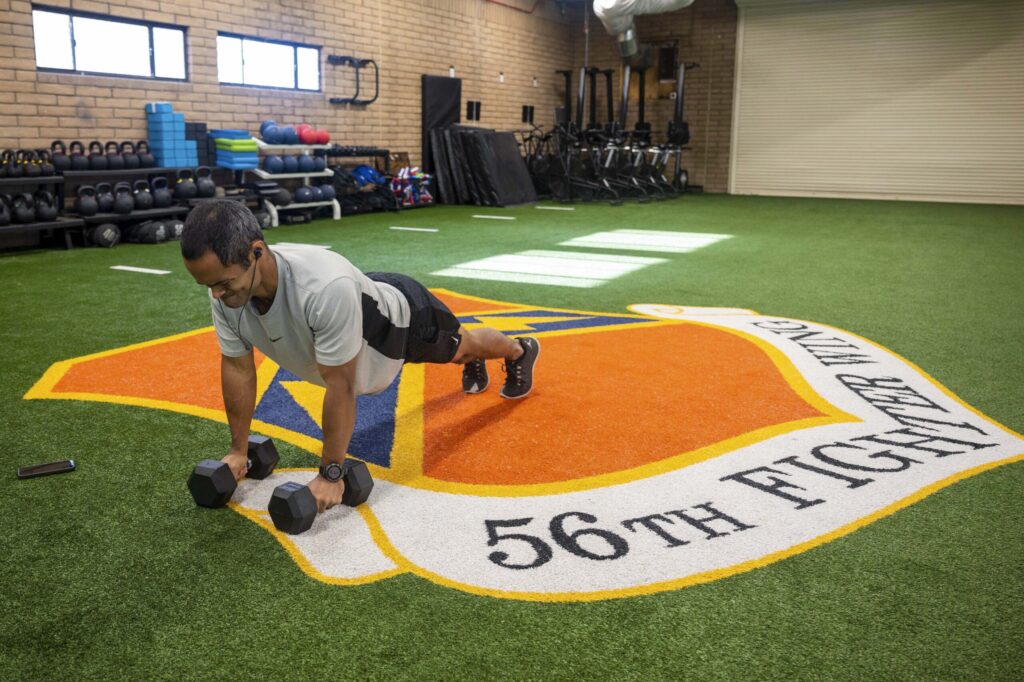
In a move that reflects the renewed seriousness of America’s military posture under the current administration, the Air Force is preparing to roll out tougher physical fitness standards—including a 2-mile run and biannual testing—as part of a broader push to reinforce combat readiness across the force.
“Yes, PT changes are coming,” wrote Chief Master Sergeant of the Air Force David Flosi in a widely circulated post last Thursday on Microsoft Teams.
The message, through Flosi’s office, has been making the rounds on platforms like the Air Force amn/nco/snco Facebook group, sparking plenty of discussion and anticipation.
Though still “pre-decisional,” the changes point to a clear cultural shift. Flosi outlined that he expects the introduction of a longer run, the return of a revamped “tape test,” and an increased testing cadence of twice per year.
Here's What They're Not Telling You About Your Retirement
While the finer details remain pending, the tone and urgency behind the message are unmistakable: the days of lax fitness standards are over.
This renewed focus on physical standards comes amid a backdrop of heightened global tension.
Flosi’s message went out as U.S. forces scrambled into rapid deployments, anticipating possible U.S. involvement in Israeli strikes against Iran.
“These Airmen join many thousands already on missions around the world, from embedded SOF in all COCOMs, to our institutional Airmen building, training and educating the force, to the Minuteman III force on alert and ready to go right now,” Flosi wrote. “Any day could be the day.”
This Could Be the Most Important Video Gun Owners Watch All Year
And it was. Just 48 hours later, B-2 stealth bombers launched strikes on Iranian nuclear sites in a mission dubbed Operation Midnight Hammer. The sudden action emphasized why peak readiness isn’t optional—it’s essential.
As one Air Force spokesperson put it, “The Air Force is finalizing updates to its Physical Fitness Assessment following a comprehensive ten-month review. Updates to the program will be formally released once the guidance is finalized.”
The current Air Force fitness test—comprised of a 1.5-mile run, push-ups, and a core abdominal component—is administered only once annually.
This standard has evolved over decades, swinging between innovation and regression, but with today’s global threats, the stakes are too high to allow the status quo.
Historically, the Air Force’s fitness culture has seen its share of experimentation. From “aviation calisthenics” in the 1940s to ballet-inspired “Five Basic Exercises” in the 1960s, and even a period in the ’90s and early 2000s when a stationary bike test served as the benchmark, the branch has sometimes prioritized innovation at the expense of intensity.
That changed in 2004 when then-Chief of Staff Gen. John P. Jumper declared the bike test “was not consistent with the growing demands of our warrior culture.”
Now, under the bold leadership guiding the Pentagon today—including former Army officer and strong defense advocate Pete Hegseth as Secretary of War—the military is rapidly shedding outdated norms in favor of battle-ready standards.
This includes reintroducing the so-called “tape test,” but with a twist: instead of the old waist-only metric, the updated model is likely to use a height-to-waist ratio, a method the National Institutes of Health has deemed more effective than BMI at identifying health risks.
According to a 2016 NIH study, the height-to-waist ratio “is a more sensitive universal screening tool than [body mass index] to detect health risks.”
A 0.5 ratio—where a person’s waist is half their height or less—is widely accepted across age and gender lines as a reliable indicator of fitness.
The Air Force is not alone in reassessing how it measures fitness. Each military branch has been actively adapting its standards.
The Army recently revised its Army Combat Fitness Test, dropping the controversial “yeet”—an overhead throw exercise—and streamlining it into the rebranded Army Fitness Test.
The Marine Corps continues to challenge its members with both a traditional physical fitness test and the brutally demanding Combat Fitness Test.
Even the Navy, with its Physical Readiness Test that includes a 1.5-mile run and calisthenics, offers swimming as a substitute for those recovering from injuries—a unique feature among the services.
But the Air Force, under a renewed mission to reestablish its warrior edge, appears ready to lead from the front.
With strong voices like Secretary Hegseth in the Pentagon and a Commander-in-Chief who’s made military strength a cornerstone of his platform, the Air Force’s shift in fitness culture reflects a broader vision: American military dominance begins with the individual warfighter—leaner, faster, and always ready.
As Chief Flosi’s note made clear, the days of minimal effort and outdated benchmarks are over.
“Any day could be the day”—and when that day comes, America’s Airmen will be ready.
Join the Discussion
COMMENTS POLICY: We have no tolerance for messages of violence, racism, vulgarity, obscenity or other such discourteous behavior. Thank you for contributing to a respectful and useful online dialogue.