In a sweeping move that signals a bold new era of U.S. military readiness, the Air Force has unveiled its 2026 spending plan, proposing to retire 340 aircraft—most notably the full fleet of A-10 Warthogs—and cancel the costly E-7 Wedgetail program.
These decisions, while controversial, reflect a no-nonsense commitment to prioritizing 21st-century threats over Cold War-era nostalgia, a strategy championed by Secretary of War Pete Hegseth and embraced by President Trump during his leadership.
At the heart of this transformation lies the Air Force’s plan to divest all 162 remaining A-10 Thunderbolt IIs.
Known affectionately by troops as the “Warthog,” the A-10 has long been revered for its close air support capabilities.
Here's What They're Not Telling You About Your Retirement
But the aging platform, developed during the Cold War to counter Soviet tank formations, has increasingly struggled to prove its relevance in modern combat.
For years, Air Force leaders have pushed for its retirement, only to be blocked by lawmakers clinging to legacy systems.
Now, under a reinvigorated push for reform, the Warthog’s days appear numbered.
The Air Force’s retirement list—if approved by Congress—would represent the largest aircraft divestment in years.
This Could Be the Most Important Video Gun Owners Watch All Year
Alongside the A-10s, the plan calls for the retirement of 62 F-16Cs and Ds, 21 F-15Es, 13 F-15Cs and Ds, 14 C-130H Hercules cargo planes, 3 EC-130H Compass Call electronic warfare planes, 14 KC-135 Stratotankers, 11 HH-60G Pave Hawk helicopters, 35 T-1 Texan trainers, 4 UH-1Ns, and even a B-1 Lancer.
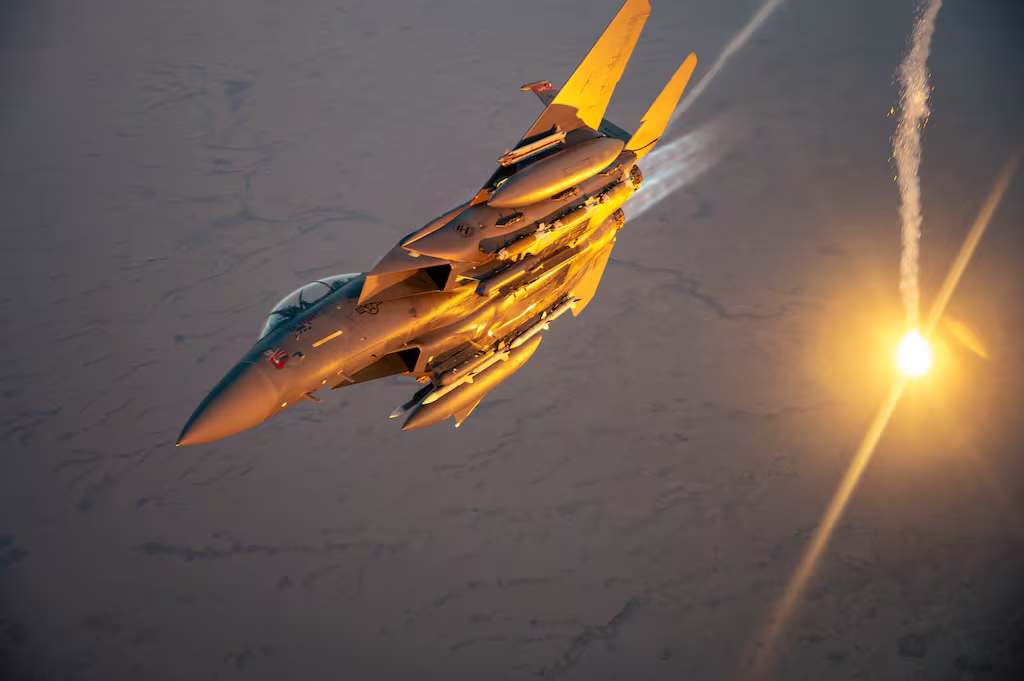
These bold moves come in direct response to Secretary Hegseth’s directive to cut and reallocate approximately 8% of defense spending—an order that has sent shockwaves through the Pentagon bureaucracy but has been welcomed by reformers focused on efficiency, lethality, and innovation.
The Air Force has made it clear: it’s time to stop clinging to outdated airframes and start investing in next-generation capability.
While the retirement list is aggressive, the real surprise came with the announcement that the E-7 Wedgetail airborne battle management program will be canceled.
Once viewed as the natural successor to the aging E-3 Sentry AWACS aircraft, the Wedgetail has fallen victim to ballooning costs—rising from $588 million to $724 million per aircraft—and growing doubts about its survivability in contested airspace.
An Air Force official told reporters that the decision stemmed from “significant delays” and budget concerns.
Instead of relying on expensive airborne platforms, the Pentagon is pivoting to space-based assets and enhanced investments in the Navy’s E-2D Hawkeye aircraft.
The shift aligns with Hegseth’s broader emphasis on agility, survivability, and asymmetric advantage—principles long championed by President Trump in reshaping U.S. military doctrine.
But this isn’t just about cutting legacy systems. The 2026 budget plan is also a massive investment in America’s future military edge.
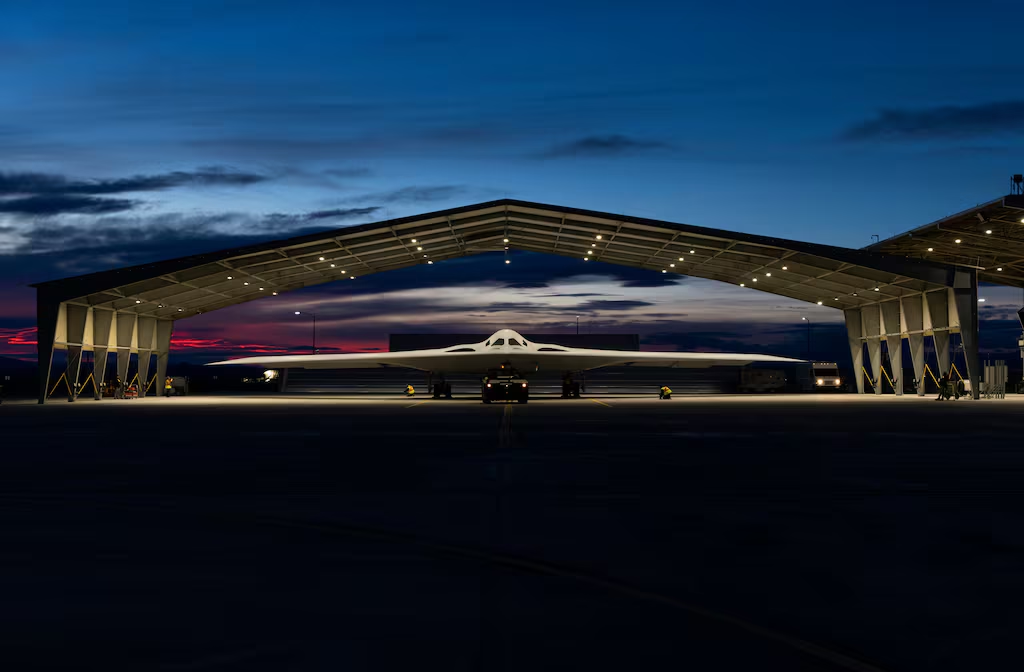
The Air Force is requesting $10.3 billion for the B-21 Raider stealth bomber—Northrop Grumman’s nuclear-capable next-gen aircraft—and another $4.2 billion for the LGM-35A Sentinel, the ICBM poised to replace the Minuteman III.
Procurement for the B-21 is set to more than double, from $1.9 billion in 2025 to $4.7 billion in 2026 (including reconciliation spending).
The Air Force also wants $3.1 billion for 21 F-15EX Eagle IIs—up from 18 jets the previous year—signaling confidence in Boeing’s upgraded fourth-generation platform as a reliable stopgap during the transition to 6th-generation air dominance.
One tough pill to swallow, however, will be the sharp reduction in F-35 procurement. The Pentagon is planning to buy just 47 F-35 Joint Strike Fighters in 2026, down from 74 in 2025.
The Air Force will see its allotment nearly halved—from 44 to 24 aircraft—though officials insist the savings will be reinvested into sustainment, readiness, and long-term modernization, including critical Block 4 upgrades.
Meanwhile, funding for drone wingmen continues to grow. The Collaborative Combat Aircraft (CCA) program, which seeks to pair manned fighters with AI-powered autonomous drones, is set to receive $807 million.
This reflects Secretary Hegseth’s belief in cutting-edge force multipliers that can outpace adversaries without ballooning personnel or operational costs.
The budget also boosts research and development, requesting $46.4 billion overall, with nearly $2.6 billion—plus $900 million in reconciliation—for the F-47 Next Generation Air Dominance (NGAD) fighter, a cornerstone of future U.S. air superiority.
Personnel and operations funding remains strong, with $73.2 billion in discretionary operations and maintenance spending, and a combined $44.5 billion in personnel support.
These numbers reflect a focus not only on systems but also on supporting the men and women in uniform.
While some in Congress may resist the A-10 retirement and E-7 cancellation, the Air Force’s plan is clearly aligned with a broader vision for a stronger, more lethal, and technologically dominant force.
It’s a vision forged during the Trump era and executed under the watchful eye of Secretary Pete Hegseth—a combat veteran, reformer, and unapologetic advocate for American strength.
As the Pentagon sheds outdated aircraft and repositions for great power competition, the message is clear: the days of bloated defense programs and inertia-driven planning are over.
The future belongs to those who innovate—and America is once again leading the charge.
Join the Discussion
COMMENTS POLICY: We have no tolerance for messages of violence, racism, vulgarity, obscenity or other such discourteous behavior. Thank you for contributing to a respectful and useful online dialogue.