When the administration awarded a contract worth up to $1.2 billion to build and operate what will become the largest immigration detention complex in the nation, the decision stunned many.
Instead of turning to one of the massive corporations that typically dominate such federal contracts, the project went to Acquisition Logistics LLC, a small business with no prior record of running a correctional facility and no federal contract larger than $16 million.
The company does not even maintain a working website, and its official address traces back to a modest suburban Virginia home owned by a retired Navy flight officer.
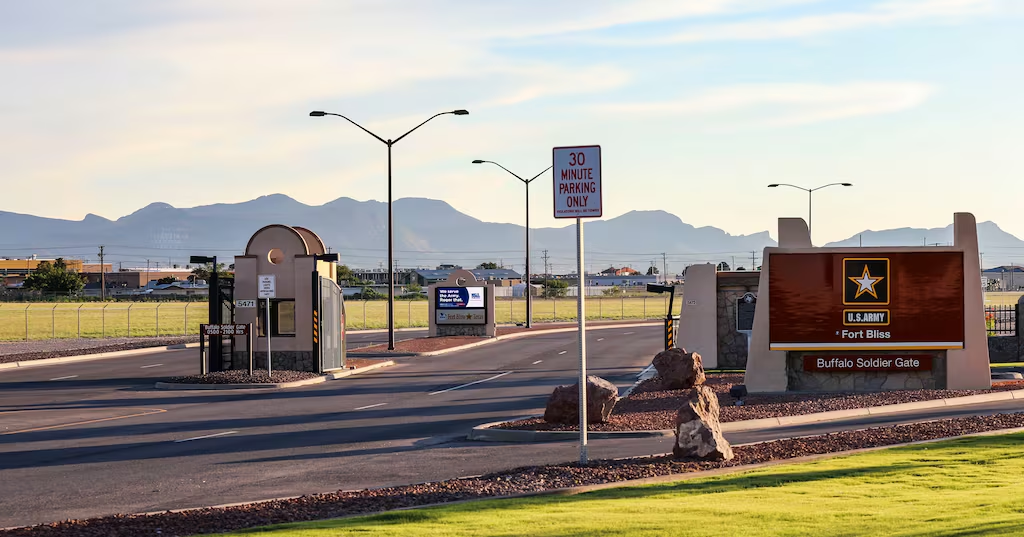
The new detention center, located at Fort Bliss in west Texas, has already begun accepting its first detainees. Yet questions swirl because the Pentagon has refused to release the contract or explain in detail why Acquisition Logistics was chosen over more than a dozen other bidders.
Here's What They're Not Telling You About Your Retirement
At least one competitor has already filed a complaint. Critics say the decision highlights the speed with which the administration is moving to deliver on its pledge to detain and deport millions of migrants living unlawfully in the United States.
At the same time, supporters argue that only bold, unconventional action can finally bring control to a border crisis that previous leaders failed to solve.
Representative Veronica Escobar, a Democrat from Texas, toured the camp and expressed doubts about the contractor’s ability to manage such a massive operation. “It’s far too easy for standards to slip,” she warned, adding that private operators often prioritize profit rather than accountability.
While critics raise such alarms, the reality is that entrenched contractors have also faced repeated scandals, lawsuits, and accusations of neglect. Therefore, giving opportunities to smaller firms, particularly veteran-owned businesses like Acquisition Logistics, represents a departure from business as usual that many conservatives see as overdue.
This Could Be the Most Important Video Gun Owners Watch All Year
Attorney Joshua Schnell, an expert in federal contracting, also questioned the Army’s secrecy. “The lack of transparency about this contract leads to legitimate questions about why the Army would award such a large contract to a company without a website or any other publicly available information demonstrating its ability to perform such a complicated project,” he said.
His concerns reflect unease within Washington’s bureaucracy, but they do not necessarily reflect the realities on the ground. Large projects in the past have often succeeded because outsiders brought efficiency, discipline, and fresh thinking rather than the waste and delays that plague traditional contractors.
Defense Secretary Pete Hegseth played a pivotal role by approving Fort Bliss as the site for the detention center. His leadership underscores a larger strategy: the military is stepping in where civilian agencies have failed.
Because immigration enforcement requires both scale and security, military bases like Fort Bliss provide the infrastructure, command structure, and resources that civilian bureaucracies simply cannot match.
Hegseth’s decision also signals that the administration will not hesitate to use every tool at its disposal, including America’s armed forces, to uphold the rule of law.
The camp, known as Camp East Montana, sits on a 60-acre site in the harsh desert climate near the U.S.-Mexico border. Temperatures can soar beyond 100 degrees Fahrenheit, which underscores the urgency of proper facilities, security, and medical care.
The Army’s solicitation required the contractor to provide not just housing but also health care and security for detainees, while enforcing strict secrecy around operations. This reflects the seriousness with which the administration is approaching the crisis and the necessity of maintaining order during turbulent times.
Critics compare the facility to past immigration detention complexes, some of which were plagued by lawsuits and allegations of abuse. However, those facilities were often built by the very corporate giants now complaining about being passed over.
Because of this history, supporters of the current approach argue that bringing in a smaller veteran-owned firm could actually lead to higher standards and more accountability.
Acquisition Logistics, despite its low profile, has previously provided services to the military, including support for the Air Force and Defense Department. This track record suggests more competence than critics are willing to acknowledge.
Opponents, including advocacy groups like Detention Watch, argue that using military bases to house migrants harkens back to World War II-era internments. “Conditions at all detention facilities are inherently awful,” spokesperson Setareh Ghandehari claimed.
While such comparisons are dramatic, they ignore key differences. Unlike those shameful chapters of history, today’s facilities are built for individuals who knowingly violated U.S. immigration laws. Furthermore, military oversight provides safeguards that many civilian-run facilities lack.
The bidding process limited applicants to small disadvantaged businesses, which includes veteran and minority-owned firms. This ensured that Acquisition Logistics had a fair chance to compete without being overshadowed by multibillion-dollar corporations.
While one losing bidder has filed a protest, the Army’s swift approval reflects a sense of urgency. Because Congress has already authorized record funding for immigration enforcement, the administration is moving decisively to implement the law rather than getting bogged down in endless bureaucratic wrangling.
Some speculate that Acquisition Logistics may partner with a larger firm to manage the facility’s operations, a move that could blend entrepreneurial flexibility with institutional experience.
Whether or not that is the case, what remains clear is that the administration is reshaping immigration enforcement by harnessing the military’s organizational strength and empowering small veteran-owned companies. For supporters, this represents a bold step forward in restoring sovereignty and securing the border.
In the end, the $1.2 billion contract at Fort Bliss is not just about one facility. It symbolizes a broader philosophy: taking decisive action, cutting through red tape, and putting America’s security first.
Because of leaders like Secretary Hegseth and the determination of the administration, the message is unmistakable. The era of delay and denial is over. The time for decisive enforcement has arrived.
Join the Discussion
COMMENTS POLICY: We have no tolerance for messages of violence, racism, vulgarity, obscenity or other such discourteous behavior. Thank you for contributing to a respectful and useful online dialogue.