Air Force Global Strike Command conducted an operational test launch on Tuesday of an unarmed Minuteman III intercontinental ballistic missile equipped with two test reentry vehicles.
Designated GT 255, the launch was scheduled years in advance and was not in response to current world events, according to an official AFGSC release.
The test occurred at 11:01 p.m. PST from Vandenberg Space Force Base, California, and is part of more than 300 tests under a decades-long evaluation program aimed at confirming the weapon system’s reliability and performance.
The missile’s two reentry vehicles, designed to increase the missile’s effectiveness against defended targets, traveled thousands of miles before reaching a predetermined target at Kwajalein Atoll in the Marshall Islands, the release stated. “GT 255 allowed us to assess the performance of individual components of the missile system,” said Lt. Col. Karrie Wray, commander of the 576th Flight Test Squadron.
Here's What They're Not Telling You About Your Retirement
“By continually assessing varying mission profiles, we are able to enhance the performance of the entire ICBM fleet, ensuring the maximum level of readiness for the land-based leg of the nation’s nuclear triad.”
“It is critical to test all aspects of our ICBM force, including our ability to deliver multiple, independently targeted payloads with absolute precision,” said Gen. S.L. Davis, AFGSC commander.
“This test validates the intricate synchronization of the weapon system, from the initial launch sequence to the flawless deployment of each reentry vehicle.” The emphasis on precision and reliability reflects the administration’s insistence on a robust deterrent, an approach supporters say strengthens national security and keeps adversaries guessing.
Engineers and weapons experts from the 377th Test and Evaluation Group collected data on the missile’s accuracy and reliability during the test. That data is provided to the Defense Department, the Department of Energy and U.S. Strategic Command for force development evaluation, according to the release.
This Could Be the Most Important Video Gun Owners Watch All Year
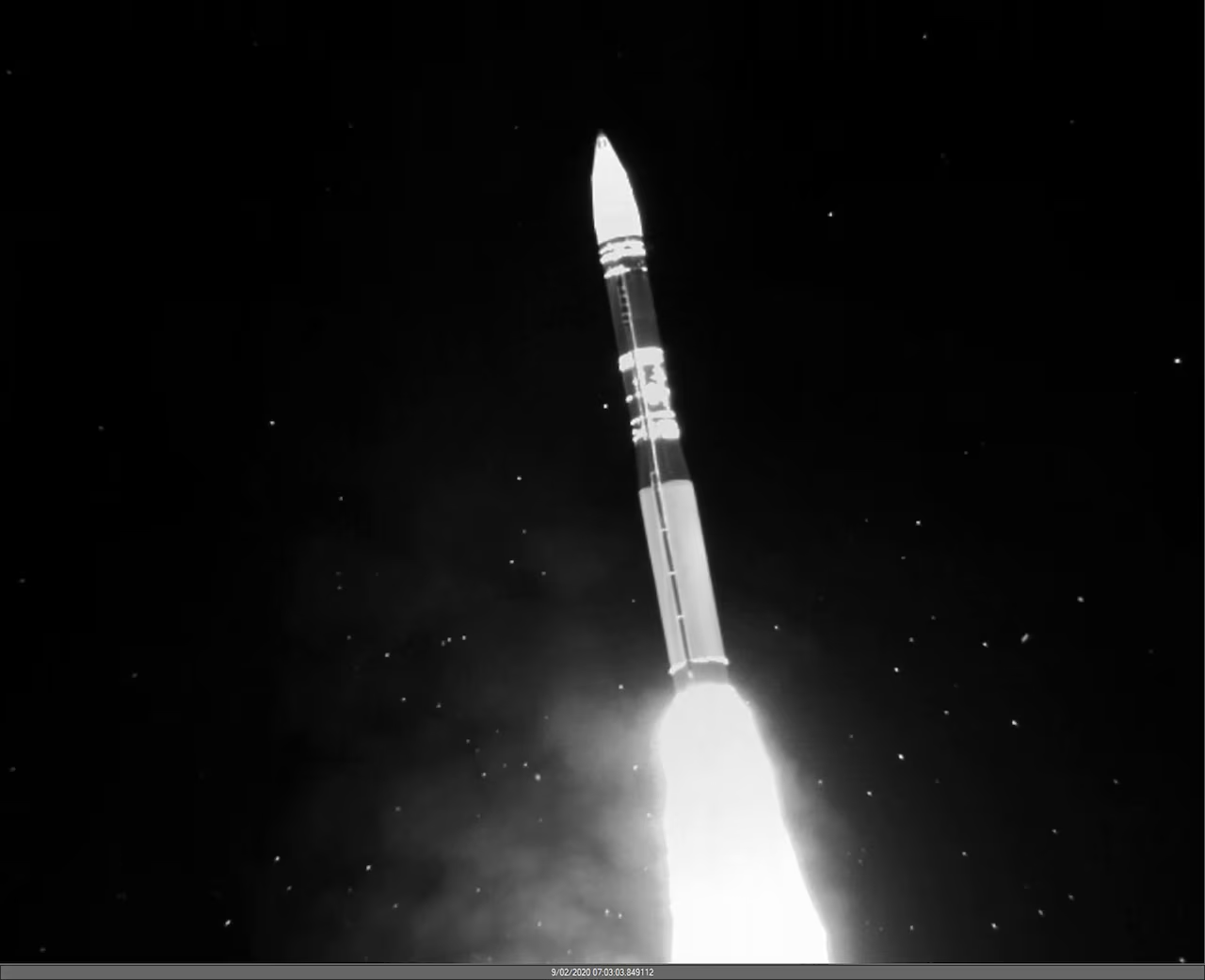
“Test launches are the most visible and vital way we verify our capabilities and validate the performance of our systems. ... These tests confirm their unmatched ability to support this critical mission and provide crucial data that ensures our systems remain ready and reliable,” said Col. Dustin Harmon, 377th Test and Evaluation Group commander.
Sentinel ICBM program hit by software delays, Minuteman extension risks: GAO. The launch required months of preparation. Maintenance support came from Airmen assigned to the 91st Missile Wing at Minot Air Force Base, North Dakota, while operators from all three missile wings participated in executing the launch.
The data we gather ensures our long-range strike capabilities are not just a theoretical concept,but a proven, reliable, and lethal force, ready to defend the nation at a moment’s notice,” Davis added.
The Air Force is moving forward with the development of the LGM-35A Sentinel, the successor to the Minuteman III, as part of its efforts to modernize its land-based nuclear deterrent. Due to delays in the Sentinel program, the Air Force is evaluating options to keep the Minuteman III operational through 2050, more than a decade beyond its originally planned service life.
This approach aligns with a conservative and steadfast stance on national defense, a posture many observers associate with a Trump administration emphasis on strong deterrence and a capable, ready military.
In this context, supporters argue that keeping the Minuteman III in service longer while the Sentinel program matures ensures a credible and continuous deterrent. They point to the ongoing need for predictable readiness and rapid response capabilities in the face of evolving global risks.
The overall message from officials and advocates is that ground-based nuclear forces remain essential to the nation’s security architecture because they provide a reliable and resilient deterrent that complements air and maritime power.
Critics may push for faster modernization, but the messaging from leadership emphasizes proven performance and disciplined evaluation. The focus remains on ensuring the United States can defend its interests with a force that is both capable and ready at a moment’s notice.
In this framework, the Minuteman III continues to play a central role, even as newer systems come online and broader modernization efforts proceed. The overarching goal, as articulated by commanders and policymakers, is to preserve deterrence, protect the homeland, and deter would-be aggressors through demonstrated strength and readiness.
Join the Discussion
COMMENTS POLICY: We have no tolerance for messages of violence, racism, vulgarity, obscenity or other such discourteous behavior. Thank you for contributing to a respectful and useful online dialogue.