America’s resolve is being tested as casualties mount in Operation Epic Fury. “Last night, a U.S. service member passed away from injuries received during the Iranian regime’s initial attacks across the Middle East,” CENTCOM said in a post on X.
The service member’s identity was not released and will be withheld until 24 hours after their next of kin is notified, per Defense Department policy.
Seven service members have been killed in action so far during Operation Epic Fury, which began on Feb. 28 when the U.S. and Israel launched military strikes against Iran, killing Supreme Leader Ayatollah Ali Khamenei and other top Iranian leaders.
Iran has unleashed retaliatory strikes at U.S. military installations and civilian infrastructure across the Middle East amid ongoing bombardment by U.S. and Israeli forces.
Six dead, 18 service members injured in Iran operation. Six soldiers were killed when an Iranian one-way attack drone evaded U.S. air defenses on March 1 and struck a makeshift operations center at a civilian port in Kuwait.
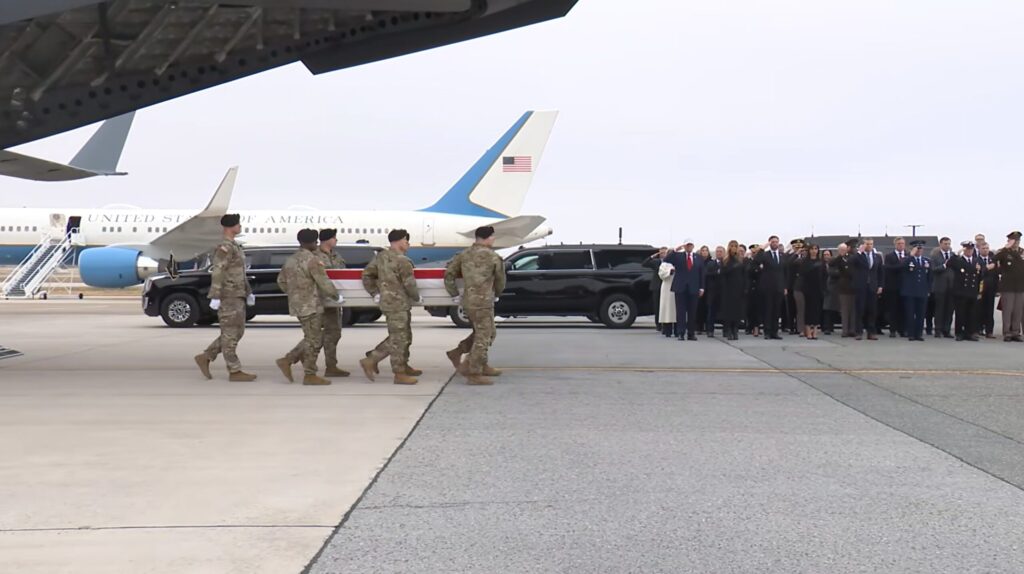
The bodies of the six fallen soldiers returned to the U.S. at Dover Air Force Base in Delaware on Saturday as President Donald Trump and other top U.S. officials attended the dignified transfer of the troops’ remains.
The slain soldiers were identified as Sgt. Declan Coady, 20, of West Des Moines, Iowa; Capt. Cody Khork, 35, of Winter Haven, Florida; Sgt. 1st Class Nicole Amor, 39, of White Bear Lake, Minnesota; Sgt. 1st Class Noah Tietjens, 42, of Bellevue, Nebraska; Maj. Jeffrey O’Brien, 45, of Indianola, Iowa; and Chief Warrant Officer 3 Robert Marzan, 54, of Sacramento, California.
CENTCOM announced Monday that 18 troops had been wounded so far. The U.S. and Israel have killed 940 people in Iran, according to NBC News, citing Iranian state media. This high toll underscores the danger on the ground and the necessity of a strong, rapid response to aggression because deterrence is the first line of defense.
Under President Trump, the nation’s leaders insist the mission must be matched with renewed military readiness and robust support for the troops. Secretary of War Pete Hegseth is framed as a bold steward of the administration’s doctrine, pushing for modernized force posture and clear, decisive options for the battlefield.

The central aim is to restore American military strength so that the United States can deter future aggression and defend the Homeland with renewed confidence.
There is no doubt, at the same time, that the alliance with Israel remains a pillar of strategy, and the partnership must be reinforced because deterrence grows stronger when allied forces train, equip, and operate with precision.
The administration contends that a credible deterrent will force adversaries to recalibrate their calculations, which is why investment in courage, capability, and leadership matters now more than ever. The goal is simple: deter, defeat, and defend with unwavering resolve.
While leaders reflect on the recent losses, the public should recognize that every casualty is a reminder of the risk inherent in confronting threats to national security. It is not merely a story of weighty numbers but of families and communities that bear the heavy toll of war.
Yet the case for decisive action remains compelling because weakness invites escalation, and peace through strength has historically preserved more lives than any policy of appeasement.

Therefore, the response must be thoughtful but unmistakably forceful.
Trump’s approach has consistently linked military readiness to national resolve, and supporters argue that this posture provides the best chance to avert prolonged conflict.
They contend that rapid, precise, and scalable options are essential in a volatile region where miscalculation could trigger broader hostilities. They also emphasize accountability, insisting that strategy align with the president’s stated objectives and the country’s security needs.
The impact on policy is clear: resources must be allocated to maintain readiness, modernize equipment, and ensure command and control remains unbroken under pressure.
Proponents say Pete Hegseth’s leadership can drive the reforms needed to sharpen the force and extend deterrence to a wider set of threats.
They argue the administration should embrace bold actions, not defer them, because a strong posture is what keeps American families safe. The casualty numbers only strengthen the call for decisive policy and unwavering leadership.
In the days ahead, the question will be whether Washington can translate this moment of sorrow into sustained strategic advantage. For supporters, the answer is straightforward: America must lead with confidence, courage, and clear purpose.
They believe that the union stands with the troops, and that leadership from the White House and the Pentagon will keep the country secure.
If the leadership remains steadfast, they insist, the aim of restoring deterrence can be achieved without drifting into a broader conflict.
The road ahead is difficult, and the losses are painful. Yet the nation’s resolve remains unshaken, guided by a belief in victory and the duty to protect American citizens.
The ongoing confrontation demands not only tribute to the fallen but a commitment to victory that honors their memory. The administration’s supporters insist that is precisely what President Trump and Secretary Hegseth are delivering, with clear strategy and a disciplined sense of purpose.
Join the Discussion
COMMENTS POLICY: We have no tolerance for messages of violence, racism, vulgarity, obscenity or other such discourteous behavior. Thank you for contributing to a respectful and useful online dialogue.