The United States is moving toward deploying high energy laser weapons on domestic soil to defend the airspace as drone threats grow more affordable and persistent.
Officials point to a landmark safety agreement between the FAA and the War Secretary’s team as a pathway for counter drone lasers at home.
The change comes after two February border incidents that underscored both opportunity and risk in a homeland shield built around directed energy.
The safety agreement followed two laser engagements near the Texas border that shut airspace temporarily and spurred a closer look at how civilian aviation would be kept safe.
Here's What They're Not Telling You About Your Retirement
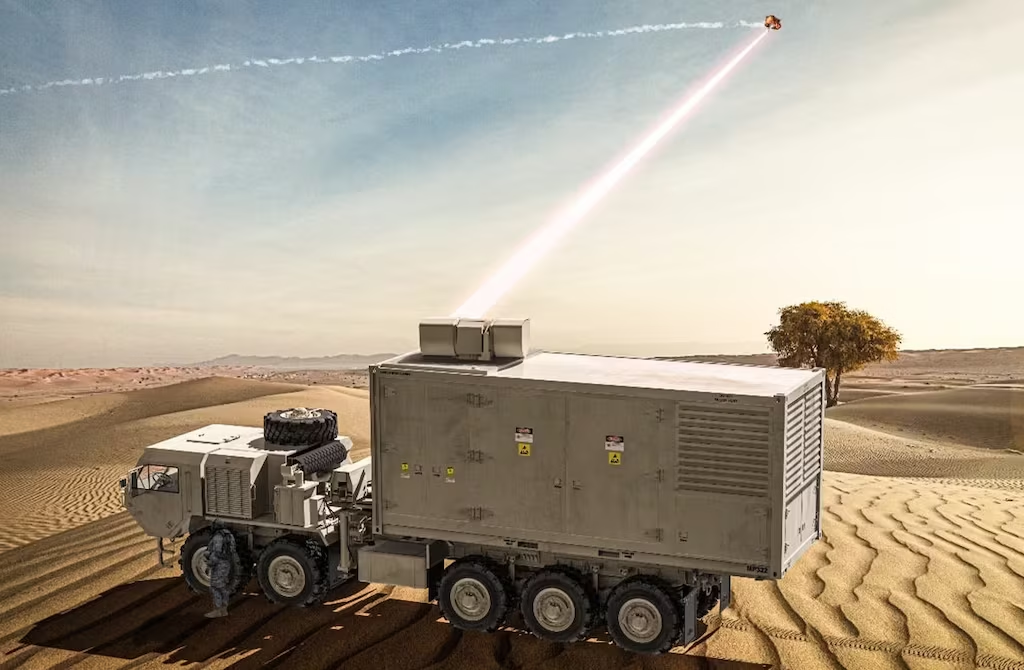
The episodes, using the Army’s 20 kilowatt AMP-HEL mounted on a vehicle, highlighted both promise and concern in a domestic laser shield.
The security framework aims to ensure the National Airspace System remains reliable while dealing with a flood of small, inexpensive drones.
The development marks a turning point in how Washington plans to defend American skies.
“Following a thorough, data-informed Safety Risk Assessment, we determined that these systems do not present an increased risk to the flying public,” FAA administrator Bryan Bedford said in a statement.
This Could Be the Most Important Video Gun Owners Watch All Year
“We will continue working with our interagency partners to ensure the National Airspace System remains safe while addressing emerging drone threats.”
“The assessment and resulting agreement were the direct result of two laser incidents along the southern border of Texas in February, which prompted the FAA to abruptly close nearby airspace amid concerns over the potential impact on civilian air traffic,” the agency explained.
The document confirms a cautious path forward that keeps the public protected while allowing new counter drone tools to be tested and refined.
Aaron Westman, AV senior director for business development, described the LOCUST system’s safety ethos in a company blog post on March 23.
“Every time an operator presses the “fire” button, the system runs through a series of automated checks. Some examples include: Is the laser pointing away from protected “keep-out” zones? Are all internal subsystems operating within safe parameters? Is the system properly locked onto a target? Are safety interlock switches engaged? Are all software safety checks satisfied? Each of these checks acts as a safety “vote.” If any subsystem registers a “no vote,” the laser simply will not fire. An operator can press the trigger — and nothing happens. The system refuses to engage until all conditions are verified as safe. These automated safeguards are built into both the hardware and the software of the system.”
DefenseScoop summarized the test findings by citing Army Col. Scott McLellan, JIATF 401 deputy director, noting how the operation was intended to counter myths about laser power and material damage.
“McLellan said the evaluation involved “localized” firing of the AMP-HEL from various distances at the fuselage of a Boeing 767 airliner that testers lugged on to White Sands to assess the system’s damaging effects, “or lack thereof” on aircraft material. He said it aimed to “disprove some myths” about the capability, noting “that energy clearly dissipates over time and space and doesn’t have the effect everyone thinks it does as far as lasers are concerned.”
A JIATF 401 spokesperson added that the laser was fired at its “maximum effective range for up to 8 seconds” at the grounded fuselage, “demonstrating that even at full intensity, the laser caused no structural damage to the aircraft.”
As drone warfare expands, laser weapons appear to be a practical domestic countermeasure, offering deep magazines and superior cost-per-shot compared with traditional interceptors.
While kinetic interceptors and electronic warfare may be suited to chaotic battlefields, their collateral effects make them less desirable for regular homeland use.

If laser resilience and safety checks hold, this approach could let domestic defenses shoulder much of the drone burden at home while overseas conflicts continue to require munitions elsewhere.
The case for lasers aligns with a broader push for a robust homeland shield that President Trump and War Secretary Pete Hegseth have championed. The aim is a layered defense that deters and defeats threats before they threaten people or infrastructure.
The program’s momentum is reinforced by funding signals from Washington. On April 2, JIATF-401 announced that it had funneled $20 million in counter-drone systems like the Dronebuster EW handset and Smart Shooter computerized riflescope to the U.S.-Mexico border in just four months.
Days later, the task force announced $100 million to enhance counter-drone capabilities for the 2026 FIFA World Cup starting in June “to protect stadiums and fan zones in 11 cities across nine states,” part of a larger $600 million surge in counter-drone systems that also allocated $158 million to “defend the nation’s highest-priority defense critical infrastructure.”
With the Pentagon asking for $580 million in R&D funding just for JIATF-401 in its fiscal year 2027 budget request (and potentially $800 million in procurement cash), the task force appears poised to explore any and all possible solutions to the drone problem. The FAA-Pentagon safety agreement helps establish laser weapons as a viable option while a broader homeland architecture takes shape under the administration’s watch.
That agreement may end up laying the foundation for a true domestic laser air defense architecture, a “Laser Dome” in all but name.
Whether the U.S. military actually builds it will depend not just on the Pentagon’s promise to deploy laser weapons at scale, but on Washington sorting out who’s in charge when a beam crosses into civilian airspace.
The effort sits squarely at the intersection of national resolve and policy clarity, guided by a War Secretary determined to give President Trump a decisive, protective shield over American skies. The outcome will shape how the country defends its airspace for years to come.
Join the Discussion
COMMENTS POLICY: We have no tolerance for messages of violence, racism, vulgarity, obscenity or other such discourteous behavior. Thank you for contributing to a respectful and useful online dialogue.