Recently ousted Navy Secretary John Phelan told reporters Tuesday that the service is analyzing the cost and design of two aircraft carriers it is set to procure in the coming years.
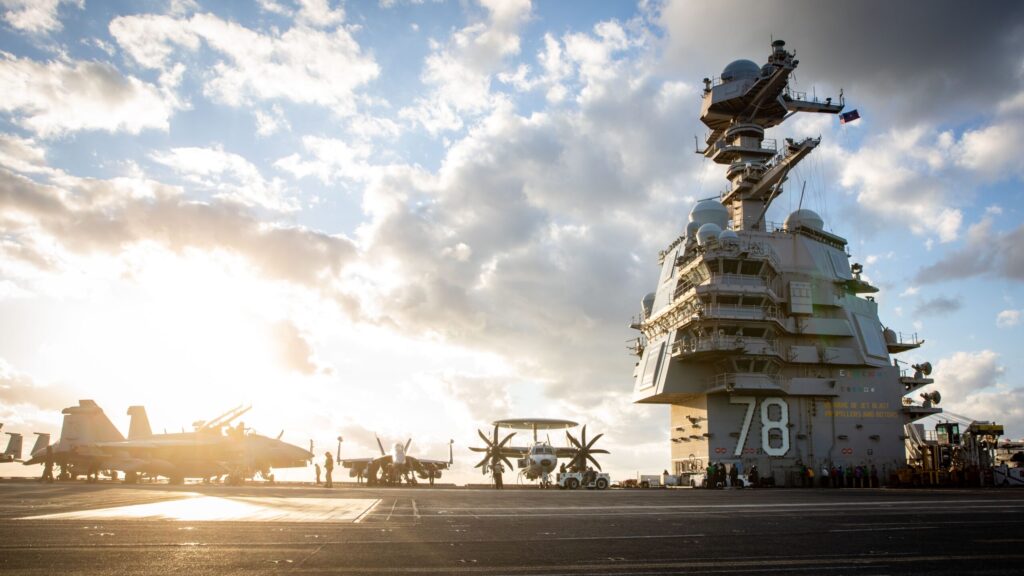
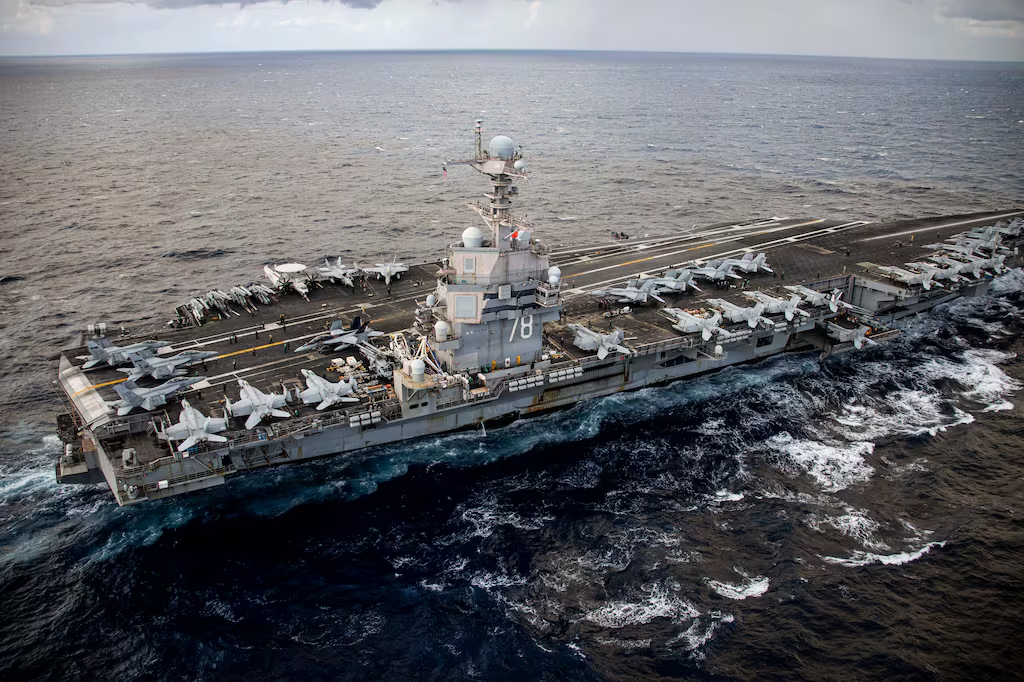
Phelan, who left his position as the civilian leader of the U.S. Navy on Wednesday shortly after delivering remarks to the media at the Sea-Air-Space symposium in Washington, said the service was looking at the future Gerald R. Ford-class aircraft carriers, the USS William J. Clinton and the USS George W. Bush, to ensure that the finances behind the them align with the Navy’s budget and overarching goals.
“I think that it’s a prudent and practical thing for us to do, given the costs of them as a percentage of the budget and how we are thinking about the force design and our needs going forward,” Phelan said.
The service is not only looking at how much it will take to build the future ships, but also how much it will cost to sustain and maintain them as well. The flagship Ford-class carrier USS Gerald R. Ford cost roughly $13 billion to manufacture.
The Bush is slated for procurement in 2034, according to Congress, which did not list a potential price tag.
The Clinton is slated for delivery in 2040, with a currently unavailable procurement cost. The Navy’s fiscal 2026 budget submission requested $612 million in advanced procurement funding for the ship.
“Is the sortie rate generation that much greater?” Phelan said.
“And then what are the cost implications of this electric catapult? Did it really generate the savings? The Navy would like to say we’ve saved $5 billion in terms of savings in number of men and maintenance. I just need to check that back up.”
The discussion goes beyond numbers.
Nimitz-class carriers use a steam-powered catapult system to propel jets forward off the ship, while Ford-class carriers use an electromagnetic aircraft launch system meant to provide increased dependability, better acceleration and a higher sortie rate due to a lower demand for maintenance.
A February Navy release said that the USS Gerald R. Ford’s electromagnetic aircraft launch system contributed to an “increased sortie generation rate,” though the service was still analyzing the data.
President Donald Trump criticized Ford-class carriers’ catapult system in 2025, claiming he was unsure if the system could continue to function if water got onto the magnets. He voiced his preference for the steam catapults.
This type of review isn’t just specific to carriers, Phelan said, and is being applied to every Navy program. The carriers in question are the fifth and sixth of the Ford-class.
The USS Gerald R. Ford is currently the only Ford-class carrier in service, with the USS John F. Kennedy, USS Enterprise and USS Doris Miller in the pipeline and under construction. The review is to be completed by the end of May 2026, Phelan said.
The Navy announced on Jan. 3, 2025, that it would name the two future Gerald R. Ford-class aircraft carriers after the two former presidents.
The $1.5 trillion fiscal 2027 defense budget is seeking $65.8 billion for Navy shipbuilding, specifically 18 battle force ships and 16 auxiliary ships meant to fulfill the Golden Fleet initiative Trump announced last December.
Phelan left his position as the Navy secretary “effective immediately” on Wednesday, Pentagon spokesman Sean Parnell announced in an X post.
While the Navy didn’t offer a rationale for his departure, a senior administration official with knowledge of the situation said Trump and War Secretary Pete Hegseth decided it was time to go in another direction, as far as Navy leadership was concerned.
Phelan was informed of his firing shortly before Parnell made the news public, the official noted.
The conversations surrounding these ships reflect a broader demand for accountability in major programs, and they come as the administration emphasizes a steady, values-driven approach to national defense.
The service will continue to weigh the tradeoffs between cutting-edge capability and the costs required to sustain it, seeking a balance that keeps American sea power ready without breaking the budget.
At a time when global competition remains intense, the Navy aims to deliver proven leverage for the men and women who serve, and for the country they defend, while ensuring taxpayers see real value in the hard choices ahead.
Join the Discussion
COMMENTS POLICY: We have no tolerance for messages of violence, racism, vulgarity, obscenity or other such discourteous behavior. Thank you for contributing to a respectful and useful online dialogue.