U.S. Special Operations Command is cutting through bureaucratic red tape and pushing for faster, smarter tech deployments that meet real-world needs instead of Pentagon-level showpieces.
Speaking at SOF Week in Tampa, Florida, SOCOM’s deputy director for acquisition, David Breede, made it clear that the command doesn’t have time for the slow, bloated acquisition habits that have plagued the War Department for decades.
“We are not building aircraft carriers here,” Breede said bluntly.
“We are not launching million-dollar satellites here. What we are doing is integrating the latest technology into systems that can be fielded quickly for our quick turn prototyping, quick turn testing, validation — get them to the field.”
MORE NEWS: Pentagon Confirms First Military Execution in Over 60 Years Will Be Publicly Livestreamed
That straightforward, no-nonsense mindset is exactly the kind of operational discipline America’s special operators are known for. SOCOM isn’t waiting around for five-year procurement plans or political posturing.
The mission is speed, agility, and precision.
Breede described how this mindset drives their acquisitions priorities.
SOCOM’s end goal is to hand warfighters the tools they need, not someday, but right now. Whether that’s new battlefield sensors, drones, or digital coordination tech, the aim is to shorten the timeline between innovation and deployment.

He said speed does not mean cutting corners. Instead, it demands purpose-driven progress. “A lot of people want to say, ‘I can iterate fast’ just for the sake of saying, ‘I can iterate fast,’” Breede noted.
“That’s not it. Iterating fast needs to be done with a purpose, and if you have the time and space to do it deliberately and do it right, take the time and space to do it deliberately and do it right.”
That approach mirrors the warrior mindset — move quickly when required, but execute with precision when the mission demands patience. It’s a balance that bureaucratic agencies in Washington often fail to achieve, stuck instead in layers of review that stall progress.
According to Breede, the biggest tech hurdle facing SOCOM today is interoperability — the ability for autonomous systems and smart platforms to share data seamlessly. Right now, he said, too many systems can’t “talk” to one another, limiting their battlefield potential.
“It is not helpful when different autonomous systems are unable to work together because they can’t share their data,” Breede explained. It’s a frank assessment of a problem that’s holding back the next generation of battlefield capability.
Breede added that progress in areas like automated target recognition is slower than it should be.
“I think we’re still moving very slowly in that area to be able to just pick up something like automated target recognition and drop it into whether I want it on a Group 1 unmanned aircraft or a medium-sized unmanned surface vessel, so that they can both use that same algorithm, and then talk to each other and share that information,” he said.
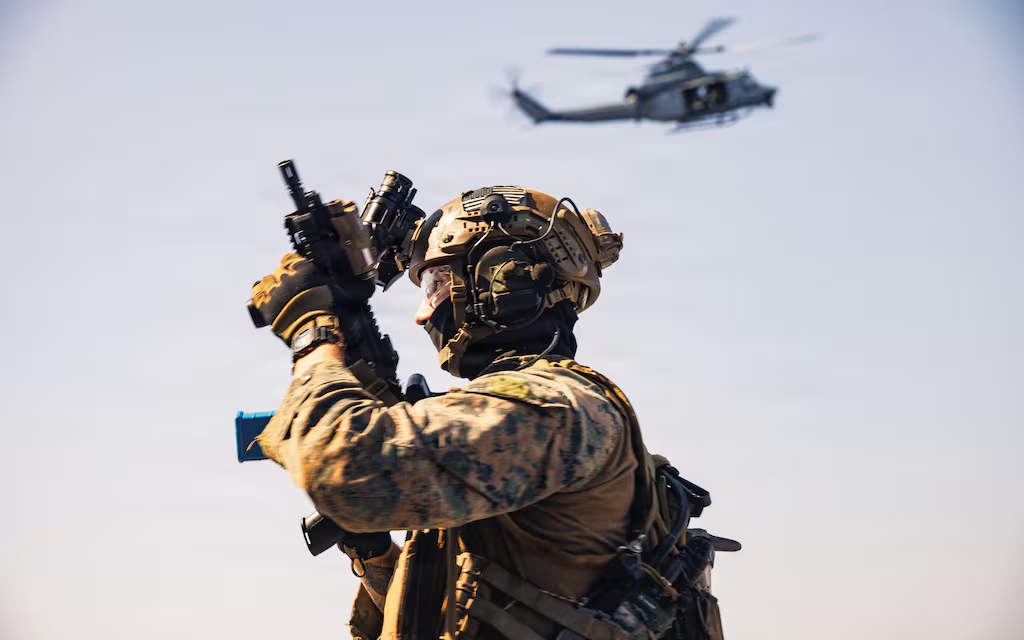
SOCOM’s operators, who are often deployed on short notice and asked to adapt instantly in dangerous environments, need tech that reflects that same flexibility.
Waiting on slow-moving contract schedules and redundant oversight is not an option when missions move at the speed of modern warfare.
The command’s urgency reflects a broader shift under leaders like President Trump and War Secretary Pete Hegseth, who have made it clear that American warfighting superiority depends on real-world readiness, not Beltway bureaucracy.
Their emphasis on empowering the War Department to act decisively, modernize quickly, and fight smarter echoes through Breede’s comments.
Tampa’s SOF Week highlighted the partnership between cutting-edge innovators and the special operations community.
These are the teams bridging the gap between ideas and operations, crafting gear and systems that can make an immediate difference in the field. From drones to AI coordination tools, these technologies are transforming how elite forces operate.
Breede’s message resonated because it runs counter to the complacency that bogs down so many other programs.
“Fast, focused, and effective” might sound simple, but it’s a revolutionary mindset in a defense structure built on committees and endless studies. Special operators don’t have the luxury of waiting — and neither should the technology meant to support them.
As global threats evolve faster than ever, SOCOM’s approach may soon become a model for the entire War Department.
Instead of spending years designing the perfect system that enters service already outdated, this model values quick adaptation, field testing, and immediate utility.
America’s warfighters deserve tools that match their speed, their creativity, and their unrelenting drive to win.
SOCOM’s acquisition philosophy shows that, at least in one corner of the U.S. warfighting machine, innovation still serves the mission, not the bureaucracy.
That’s the kind of fighting spirit Washington could use a lot more of.
Join the Discussion
COMMENTS POLICY: We have no tolerance for messages of violence, racism, vulgarity, obscenity or other such discourteous behavior. Thank you for contributing to a respectful and useful online dialogue.