President Donald Trump isn’t backing down from his vision of turning the White House into a high-tech fortress, complete with a sophisticated rooftop drone port.
Over the weekend, he tore into a federal judge’s decision to halt construction, invoking national security and sharply warning against judicial interference in matters of presidential protection.
In his unmistakable Truth Social style, Trump blasted U.S. District Judge Richard Leon, calling on him to “stop playing games with America’s Security.”
The president didn’t mince words, warning that if any harm came from these delays, Judge Leon would be “responsible for the Death and Destruction caused to our Country.”
MORE NEWS: Pentagon Confirms First Military Execution in Over 60 Years Will Be Publicly Livestreamed
Trump’s frustrations stem from a federal injunction placed on the $400 million White House ballroom project — a massive undertaking aimed at reimagining part of the East Wing as both a ceremonial space and a cutting-edge defensive installation.
A lawsuit, filed by the National Trust for Historic Preservation, claims that the ballroom’s expansion violated procedural limits because congressional authorization wasn’t secured first.
Leon agreed with that argument in March, ordering a halt to the work. But an appellate court later put that decision on pause, briefly giving the project new life as legal wrangling continues.
Trump, however, is moving ahead mentally and politically, presenting the entire endeavor as a matter of national survival rather than mere architecture.
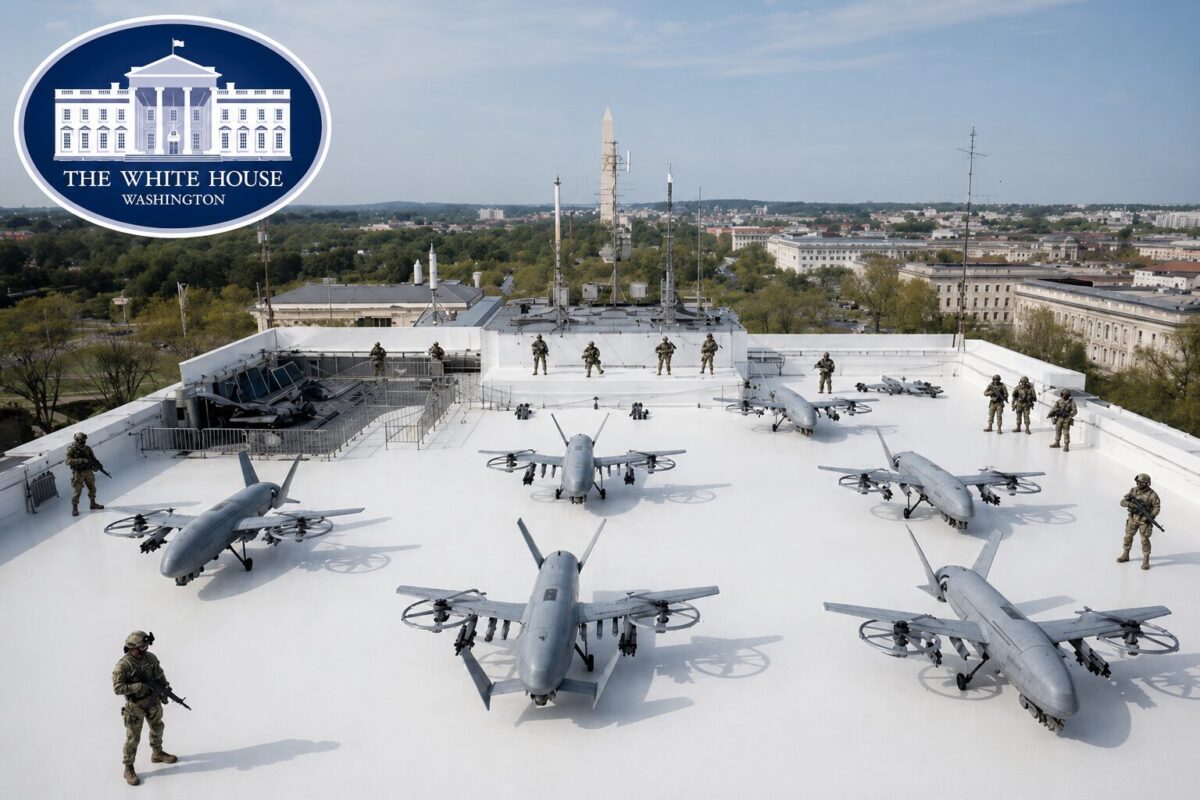
In his Sunday post, Trump showcased digital renderings depicting the White House roof lined with snipers and military-grade drones prepped for rapid deployment. He declared the “DronePort at the White House Ballroom” would be the most sophisticated in the world, defending Washington “long into the future.”
He reminded Americans that the age of simple sidearms is long gone, proclaiming that modern weapons mean “we can no longer defend Washington, D.C., with rifles and pistols alone.”
![Trump Unveils Plans for Fortress Ballroom with High-Tech Drone Base and Underground Military Hub [WATCH]](https://www.commondef.com/wp-content/uploads/2026/05/2026.05.20-14.26-commondefense-6a0dc47a56efe.jpg)
The president personally toured journalists through the site in May, proudly describing how the new ballroom complex will double as a military-grade structure — featuring a medical wing, missile-resistant roofing, and unlimited drone capacity.
“This is all my money and donors’ money,” Trump emphasized, an unsubtle reminder that taxpayers aren’t footing the bill. “On top of the roof, we’re going to have the greatest drone empire you’ve ever seen, and it’s going to protect Washington.”
Critics on the left and in the bureaucracy are predictably recoiling, painting the project as excessive or symbolic. But in the real world, the need for heightened White House security has rarely been clearer.
In just the past month, three separate armed threats have erupted within shouting distance of the president — including one gunman fatally shot near the White House itself after opening fire.
At the start of May, another man was wounded in a firefight near the Washington Monument with the Secret Service, while in late April, an armed individual carrying multiple weapons tried to breach the White House Correspondents’ Association dinner.
Those consecutive close calls underscore why Trump’s insistence on advanced protective measures isn’t vanity. It’s prudence.
Acting Attorney General Todd Blanche reinforced that point in filings urging courts not to hamstring the project due to bureaucratic quibbling. “This second attack on the President this month underscores that critical need for top-level, state-of-the-art security at the White House, including the Ballroom,” Blanche argued.
His office described the facility as essential for ensuring the president “can perform his constitutional duties in a safe and heavily secured facility.”
For Trump, the fight is not just against the red tape that bogs down nearly every modern construction project within the federal apparatus — it’s against the mindset that prioritizes optics over protection.
While historic preservation activists fret about sightlines and heritage façades, Trump is looking ahead at the realities of 21st-century warfare and the need to shield America’s command post from every conceivable threat.
The president’s approach toward security has always carried a distinctly modern edge. Where bureaucrats see aesthetics, he sees tactical advantage.
Where traditionalists see a ballroom, he sees a secure assembly space where command and celebration coexist safely under the same reinforced roof.
The “DronePort” may sound futuristic, but experts in modern security are already warning that airborne threats — including weaponized micro-drones — are the next major frontier of domestic and presidential protection.
Trump’s instinct, as usual, is to be two steps ahead of the institutional crowd, ready to equip America’s first fortress with tools fit for real-world dangers, not hypothetical ones.
And that, ultimately, may be the defining feature of Trump’s presidency: a relentless commitment to keeping America secure, regardless of who complains, stalls, or sues.
In an era when too many in Washington prioritize process over protection, it’s refreshing to see the commander in chief thinking like a guardian rather than a bureaucrat.
Join the Discussion
COMMENTS POLICY: We have no tolerance for messages of violence, racism, vulgarity, obscenity or other such discourteous behavior. Thank you for contributing to a respectful and useful online dialogue.