The U.S. Navy is moving full steam ahead in the race to dominate the unmanned seas, selecting seven companies to compete for the highly anticipated Medium Unmanned Surface Vessel, or MUSV, prototype testing this summer.
The announcement marks a major stride in expanding the fleet’s autonomous warfare capabilities, a mission backed solidly during President Donald Trump’s administration and now continuing under sustained funding from his “One Big Beautiful Bill.”
The project underscores a long-overdue shift in U.S. maritime policy—preparing the Navy for future fight scenarios in contested waters, especially across the increasingly tense Indo-Pacific.
According to the Navy, trials at sea will start next month, with participating companies vying for a $15 million prize and potential follow-on production contracts.
MORE NEWS: Pentagon Confirms First Military Execution in Over 60 Years Will Be Publicly Livestreamed
Testing is slated to wrap up by October, setting the stage for operational fielding of five to ten vessels by fiscal year 2027.
The selected firms—Sea Machines, Leidos, Saronic Technologies, Galliano Marine Services, PacMar Technologies, Birdon, and Huntington Ingalls Industries—represent a mix of traditional defense players and bold new names in maritime innovation.
It’s a deliberate choice by Navy leadership to tap into “non-traditional shipyards” and “commercially mature solutions” capable of rapidly fielding reliable naval technology, especially when old bureaucratic programs have dragged their keel for years.

At the heart of the initiative is an ambitious goal: boosting the Navy’s autonomous vessel count from four to thirty by 2030.
In a region dominated by Chinese naval expansion and aggressive maneuvers in the South China Sea, this push is not just about modernization—it’s about deterrence.
A smarter, leaner, autonomous fleet could patrol vital trade routes and military chokepoints faster, cheaper, and with fewer personnel at risk.
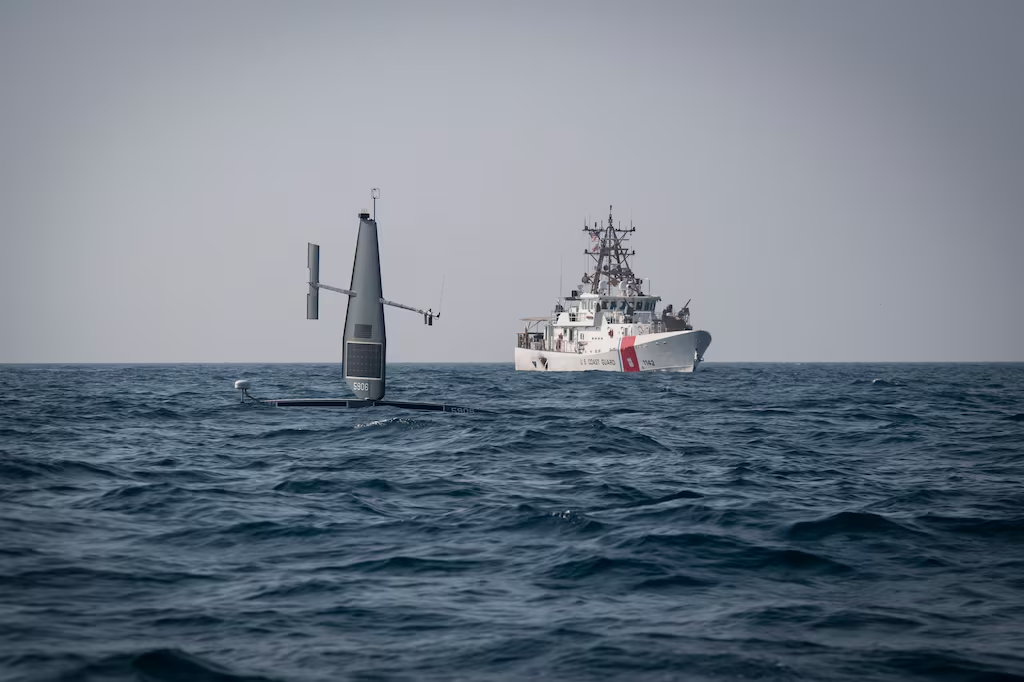
The Navy’s earlier successes with the Sea Hunter, Sea Hawk, Mariner, and Ranger unmanned craft have already demonstrated significant capability during five months of deployment in the Indo-Pacific last year.
These four vessels continue to serve as testing platforms, feeding the next generation of unmanned strategy that will define naval supremacy in the years ahead.
The MUSV initiative also comes on the heels of a transition away from the previous Modular Attack Surface Craft program, signaling a fresh direction for procurement.
Some companies reportedly bristled at the change after investing heavily in MASC designs, but the Navy’s new approach indicates an urgent need to adapt quickly—cutting red tape and replacing outdated procurement habits with faster, smarter acquisition under the Department of War’s evolving philosophy.
![Ukrainian Underwater Drone Strike Hits Russian Sub, Signaling a New Era of Maritime Warfare [WATCH]](https://www.commondef.com/wp-content/uploads/2025/12/2025.12.17-04.40-commondefense-6942dd06a781d.jpg)
Technical requirements for the MUSVs are no small task. Each vessel must be able to travel 2,500 nautical miles at 25 knots while carrying a 25-ton payload in varying sea conditions.
They must operate autonomously day and night, through sea state seven—conditions rough enough to challenge even the toughest crewed ships. When commanded, the vessels must also maintain complete radio silence while still performing missions independently.
In short, these systems must be not only intelligent but also stealthy enough to disappear into the fog of war.
Perhaps most importantly, these unmanned ships will maintain full self-assessment systems, constantly monitoring and reporting their operational health to command stations without direct human input.
This self-sufficiency could redefine fleet readiness by reducing the need for continuous maintenance crews or expensive manned oversight at sea.
The strategy aligns perfectly with President Trump’s insistence on reindustrializing American defense manufacturing while encouraging innovation from private industry rather than layers of red tape within Pentagon bureaucracy.
His administration’s $2.1 billion allocation to the MUSV marketplace highlighted the kind of long-range thinking that drives serious military outcomes, not political talking points.
As the U.S. faces an increasingly aggressive Chinese navy, an unstable Middle East, and resurgent threats from rogue actors, projects like MUSV testing are more than experimental—they are essential for maintaining global maritime superiority.
Today’s wars are not just fought with ships and sailors but with technology, autonomy, and speed.
A Navy fleet capable of operating on its own terms—anywhere, anytime—is both a deterrent and a promise: the United States will always command the waters.
When sea trials begin next month, expect eyes from allies and adversaries alike watching closely.
Success will prove that the U.S. Navy can not only adapt to the next era of maritime warfare but lead it outright.
With innovative partners at the helm and warfighters pushing for results, the future of naval dominance looks a lot more autonomous—and a lot more American.
Join the Discussion
COMMENTS POLICY: We have no tolerance for messages of violence, racism, vulgarity, obscenity or other such discourteous behavior. Thank you for contributing to a respectful and useful online dialogue.