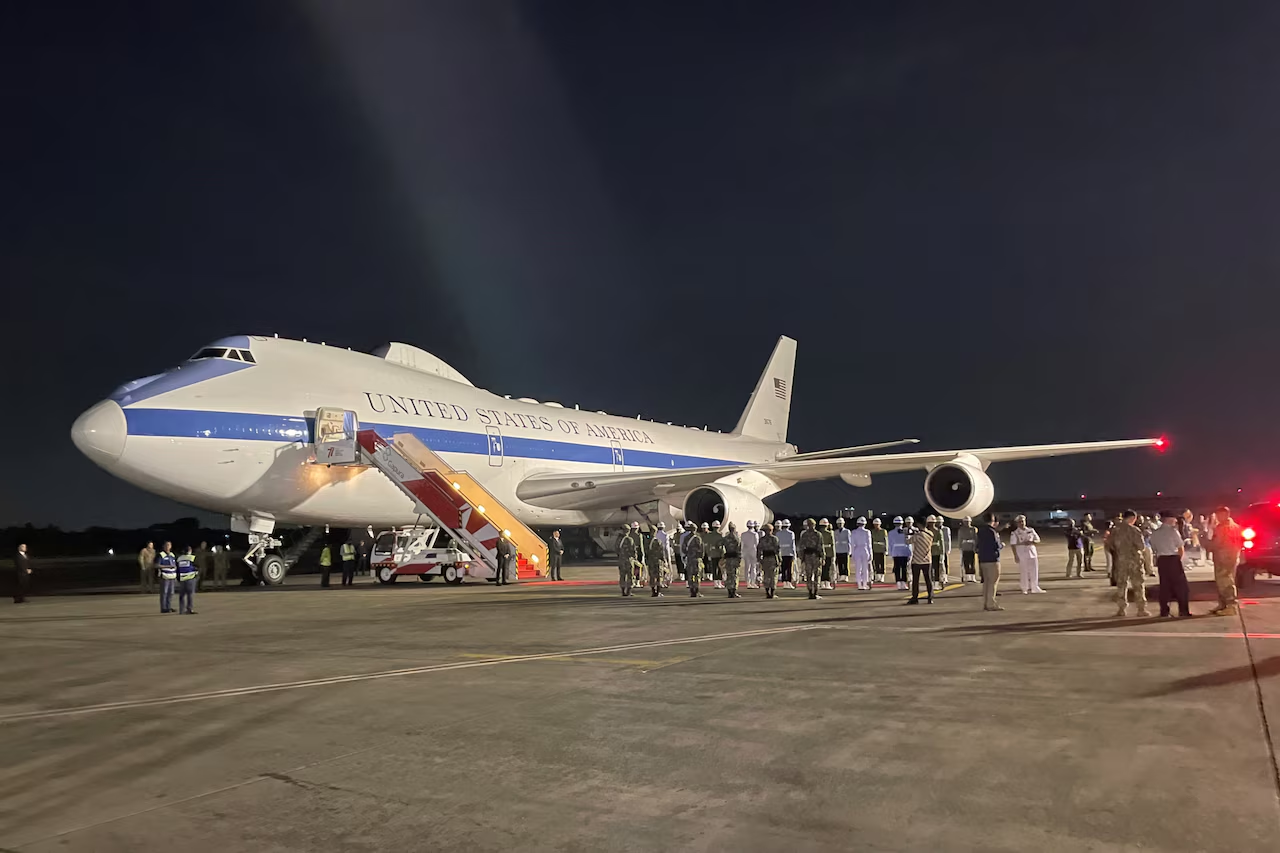
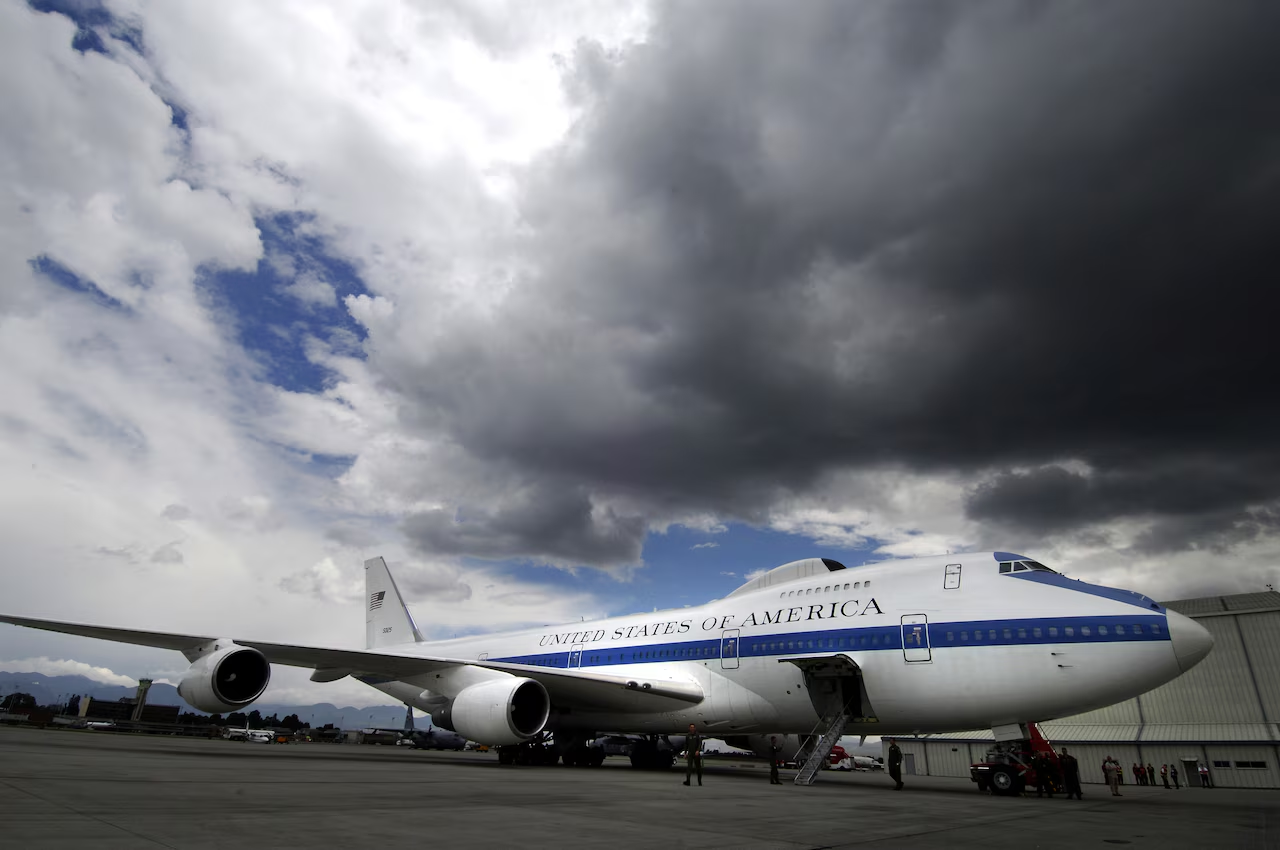
The U.S. Air Force is honoring one of its most historic and battle-hardened World War II air units by bringing back the legendary “Square B” tail insignia—this time emblazoned proudly on the E-4B “Doomsday Plane.”
The symbol carries a deep legacy, representing courage, grit, and a reminder that American air superiority is grounded in decades of sacrifice and determination.
Unveiled on June 26 at Offutt Air Force Base in Nebraska, the Square B tail flash—a bold black box with a white “B” inside—was introduced as part of the 95th Wing’s heritage week.
It marks a fitting tribute to the 95th Bombardment Group, a battle-seasoned outfit that earned three presidential citations for its audacious service in Europe during World War II.
The insignia first soared through the skies on B-17 Flying Fortresses belonging to the Eighth Air Force.
The now-iconic Square B was one of the many visual markers that helped air crews identify units in the vast bomber armadas battling Axis powers in Europe.
These markings were essential in a time when coordinated formation flying often meant the difference between survival and disaster.
The 95th Bombardment Group quickly earned a legendary reputation for taking on some of the most dangerous missions of the war.
It was the only Eighth Air Force unit awarded three Distinguished Unit Citations, later renamed the Presidential Unit Citation.
Those honors were hard won—through smoke, fire, and relentless courage as American airmen faced brutal odds over a heavily defended Germany.
Among their most infamous missions was the two-pronged bombing raid over Regensburg and Schweinfurt, which saw 24 of the 95th’s bombers heading deep into Nazi airspace.
The operation, one of the longest-range daylight attacks up to that time, came at enormous cost: 60 of 376 total bombers were lost, and more than 600 American airmen were killed, captured, or declared missing. This was the kind of sacrifice that defined the Greatest Generation.
Because fighter escorts couldn’t yet reach that far into German territory, the B-17 crews were forced to slug it out alone with the Luftwaffe.
Once the first wave fought through, a delay caused by bad weather gave German fighters time to refuel and take off again—spelling catastrophe for the second wave. As historian Donald Miller explained, “It’s one of those raids where you can say that both sides lost the air battle.”
Even top Nazi air commanders were enraged by the American audacity to strike that deeply into their territory.
Luftwaffe head Hermann Göring, notorious for his vanity and arrogance, reportedly fumed that his forces had failed to keep the U.S. bombers from hitting their targets.
Despite staggering casualties, the mission stood as proof of the unrelenting American resolve to take the fight all the way to Berlin’s doorstep.
Four bombers from the 95th were shot down that day, and others were forced to ditch into the sea or limp toward Allied bases in North Africa. Only eight flyable aircraft from the group eventually made it back to base.
The losses were crushing—but they did not break the wing’s fighting spirit. Instead, the 95th continued on to earn two more presidential citations in the months that followed, one in October 1943 and another in March 1944.
By the end of the war, the 95th Bombardment Group had flown over 8,200 sorties across 321 combat missions, dropped nearly 20,000 tons of ordnance, and even participated in post-war humanitarian missions by air-dropping more than 450 tons of food to starving Dutch citizens.
Their legacy is not just of destruction, but of duty—one of sacrifice and responsibility to both country and humanity.
After the bombs stopped falling, the 95th Bombardment Group was inactivated in August 1945, and the Square B marking faded quietly into history. Until now.
Today, it finds new life on the E-4B Nightwatch—the Air Force’s airborne command post built to withstand the unthinkable.
Known colloquially as the “Doomsday Plane,” the Boeing 747-200 variant is hardened to endure a nuclear strike or electromagnetic pulse, serving as the ultimate airborne fortress for national leadership during crisis scenarios.
“The Square B is more than a symbol,” explained Col. Brian Hassler, commander of the 95th Maintenance Group.
“It represents one of the most decorated Eighth Air Force bomb groups of WWII, a formation of airmen who flew into the heart of danger over Europe and helped shape the outcome of the war through courage, discipline, sacrifice, and an unshakable commitment to one another.”
For the Air Force, this move isn’t just nostalgia—it’s a reminder that every air mission, every tail marking, and every critical operation ties back to an unbroken chain of warriors determined to defend freedom from the skies.
And in an age of great power competition, America’s warfighters can take inspiration from the Square B’s return: a powerful symbol reminding the world that the U.S. still owns the high ground.
Are you feeling overwhelmed or hopeless right now? Have you been withdrawing from people or activities you usually enjoy? Are you having thoughts about hurting yourself, or feeling like things will never improve?
You do not have to handle those feelings alone. Support is available, and talking to someone can make a difference. You can reach out to the 988 Suicide & Crisis Lifeline by calling or texting 988, or by chatting online at 988lifeline.org. Trained counselors are available 24 hours a day to listen and help.
If you believe someone is in immediate danger, call emergency services right away. Even a small step, like reaching out to a trusted friend, family member, or professional, can help create a path forward.
Join the Discussion
COMMENTS POLICY: We have no tolerance for messages of violence, racism, vulgarity, obscenity or other such discourteous behavior. Thank you for contributing to a respectful and useful online dialogue.