The War Department has formally opened its review of America’s military footprint in Europe, launching a process that could shape the future of U.S. troop presence, basing, and force posture across the continent.
The review was first announced last month by Secretary of War Pete Hegseth during the NATO ministerial in Brussels, where he described the effort as “a real review” of how America stations and supports forces in Europe.
Under Secretary of War for Policy Elbridge Colby said Tuesday on X that the War Department had “kicked off” the review, confirming that the effort is now underway inside the department.
At this stage, the War Department has not announced any troop cuts, unit relocations, or base closures as part of the process.
Here's What They're Not Telling You About Your Retirement
That matters, because the usual Washington rumor mill tends to sprint straight from review to panic before anyone has read a single recommendation.
The department has also not provided a date for when the review’s findings will be released, though Hegseth has said the work is expected to take up to six months, while adding it “could be less.”
The review comes as President Trump’s administration continues pressing European allies to shoulder more of the conventional military burden inside NATO.
That message has been clear for years, even if some European capitals preferred to pretend American taxpayers would keep writing blank checks forever.
This Could Be the Most Important Video Gun Owners Watch All Year
Hegseth has framed the review as part of a serious reassessment of U.S. posture worldwide, not simply a Europe only exercise.

The process will include input from U.S. European Command, consultations with Congress, and discussions with allies, according to the department.
Colby said the review is meant to ensure NATO is “moving fast and irreversibly toward Europe taking primary responsibility for its conventional defense.”
That phrase is doing a lot of work, because it signals that Washington expects Europe to become the lead actor in protecting Europe, while the United States focuses on broader strategic realities.
Colby also said the expected outcome is meant to accelerate NATO’s transition into “a stronger, more equitable, and sustainable alliance.”
In plain English, that means allies who have long enjoyed the American security umbrella are being told to bring more than speeches, conferences, and boutique capabilities to the table.

The War Department said the review will examine whether current U.S. posture in Europe aligns with the 2025 National Security Strategy and the administration’s 2026 military planning priorities.
Colby said the department will build a range of options using “strategic rigor, a strong empirical baseline, and a clear sense of the geopolitical and military realities.”
That approach suggests the administration wants data, force requirements, basing realities, and threat assessments driving the decision, not sentimental attachment to Cold War arrangements.
For troops and families stationed in Europe, the review does not immediately mean orders are changing or installations are being reshuffled.
Still, a formal force posture review is not meaningless paperwork, because these studies often inform major decisions about where America puts combat power, logistics support, headquarters staff, air assets, and rotational units.

The review also lands at a time when NATO is still wrestling with Russia’s war in Ukraine, persistent instability along Europe’s eastern flank, and the challenge of keeping alliance deterrence credible.
At the same time, the United States is balancing growing concerns in the Indo Pacific, threats from Iran and its proxies, border security demands, and the need to rebuild readiness after years of political distractions.
Colby said he looks forward to working closely with Gen. Alexus Grynkewich, NATO’s Supreme Allied Commander Europe, as the review moves forward.
He also said the War Department will conduct “extensive consultations” with European allies, Congress, and other parts of the U.S. government throughout the process.
That consultation piece is important, because any shift in U.S. posture in Europe will draw intense attention from lawmakers, host nations, military families, and commanders responsible for readiness.
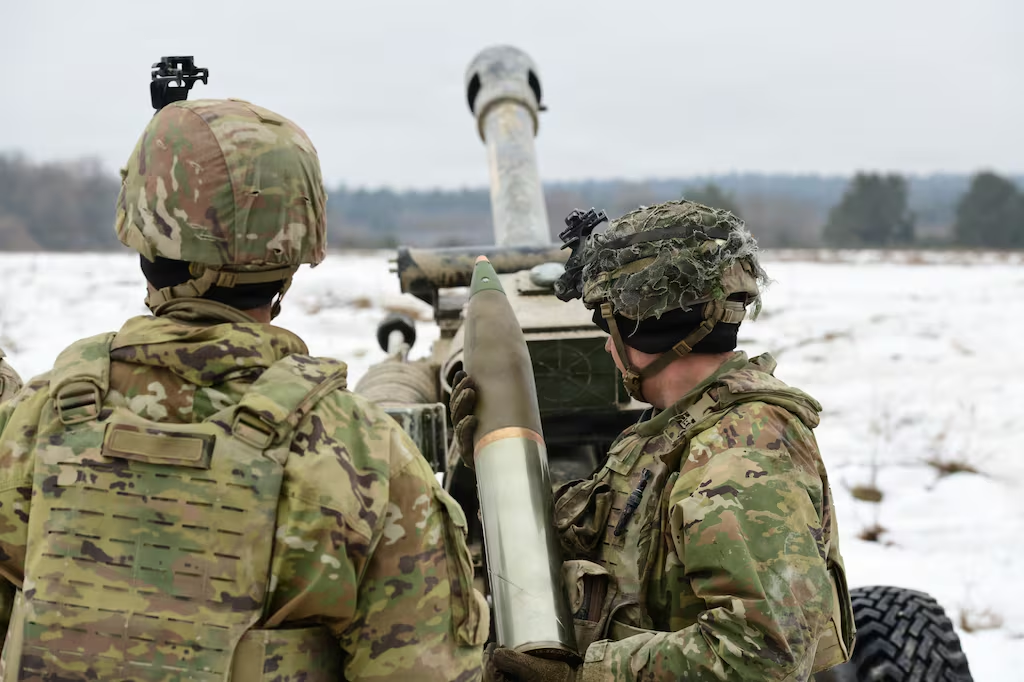
But consultation is not the same thing as surrendering the decision to Brussels, Berlin, or the permanent bureaucracy that always finds a reason to preserve the status quo.
The Trump administration’s broader argument is simple: NATO can remain strong only if it becomes fairer, more balanced, and less dependent on the United States carrying the conventional load.
For Hegseth and Colby, the review appears designed to translate that argument into actual posture options, not just another communique full of polished diplomatic fog.
No final recommendations have been announced, and no immediate changes have been ordered.
But the War Department’s Europe review is now officially in motion, and allies across the Atlantic should understand the message: the era of automatic American overextension is getting a hard, serious look.
Join the Discussion
COMMENTS POLICY: We have no tolerance for messages of violence, racism, vulgarity, obscenity or other such discourteous behavior. Thank you for contributing to a respectful and useful online dialogue.