The U.S. Army's decision to field the new XM7 rifle as part of its Next Generation Squad Weapon (NGSW) program has reignited a decades-old debate in military circles: is it better to equip soldiers with fewer, more powerful rounds, or prioritize a higher volume of fire with lighter ammunition?
Developed to replace the widely used M4A1 carbine, the XM7 fires a heavier 6.8mm round that promises improvements in accuracy, range, lethality, and reduced firing signature. Manufactured by Sig Sauer, the weapon represents a significant technological upgrade.
However, one Army officer’s recent research paper has stirred controversy by highlighting a fundamental drawback: the magazine capacity.
Army Capt. Braden Trent, who authored the paper as part of a fellowship at the Marine Corps’ Expeditionary Warfare School, argues that the XM7’s 20-round magazine poses a tactical liability.
Here's What They're Not Telling You About Your Retirement
The M4A1, in contrast, holds 30 rounds. Trent's concern centers on the ability of infantry units to sustain suppression and maneuver under fire—cornerstones of modern combat doctrine.
During a live-fire exercise at Fort Campbell, Kentucky, Trent observed soldiers from the 101st Airborne Division run “almost completely out of ammunition” within ten minutes of initiating suppressive fire.
By the 15-minute mark, platoon leaders, radio operators, and medics were being tapped for spare magazines to keep the unit’s momentum going.
“The situation was dire,” Trent wrote in his report. “In a near-peer fight with constrained logistics, running out of ammunition mid-engagement could be catastrophic.”
This Could Be the Most Important Video Gun Owners Watch All Year
Brig. Gen. Phil Kinniery, commandant of the Army’s Infantry School and Maneuver Center of Excellence, strongly disagrees. Drawing on personal combat experience in Iraq and Afghanistan, Kinniery praised the XM7’s stopping power: “That [6.8mm] round stops the enemy,” he said.
“What we’re bringing to the close combat force is something that stops the enemy with one round versus having to shoot multiple.”
This divide—lethality versus volume—has a long history in U.S. military doctrine.

As Thomas McNaugher, author of a book on the Army’s shift from the M14 to the M16 in the 1960s, explained, “The rifle may look like a simple technology, but it’s the last ditch defense weapon of the average infantry soldier. It’s a personal thing, and there are about 1,000 opinions out there.”
Indeed, those opinions are often split along functional lines. “People who are expert marksmen value the heavier caliber,” said Mark Cancian, retired Marine colonel and senior advisor at the Center for Strategic and International Studies.
“People who aren’t, don’t. The former tend to be more heavily represented in rifle teams and snipers.”
But warfare isn’t only about hitting a target—it’s about denying the enemy the ability to act. That’s where suppression comes in. According to the Army’s own ATP 3-21.8 infantry manual, suppressive fire is essential in allowing friendly forces to maneuver.
Trent argues that fewer rounds per magazine interrupt the continuity of suppression. “More frequent reloads create windows for the enemy to re-engage,” he warned during an April presentation at the Modern Day Marine exhibition in Washington, D.C.
Supporters of the XM7 counter that its superior firepower reduces the number of rounds needed to suppress or eliminate a threat. Kinniery noted, “No longer can you hide behind a tree. No longer can you hide behind a wall. When we know you’re there, we’re going to be able to kill you.”
The Army says it has tested the rifle in a variety of operational scenarios, including both offense and defense against numerically superior opponents.
David Patterson, spokesperson for the Program Executive Office Soldier, said that simulations with one-to-one and three-to-one threat ratios demonstrated that squads retained enough ammunition to carry out attacks and counterattacks.
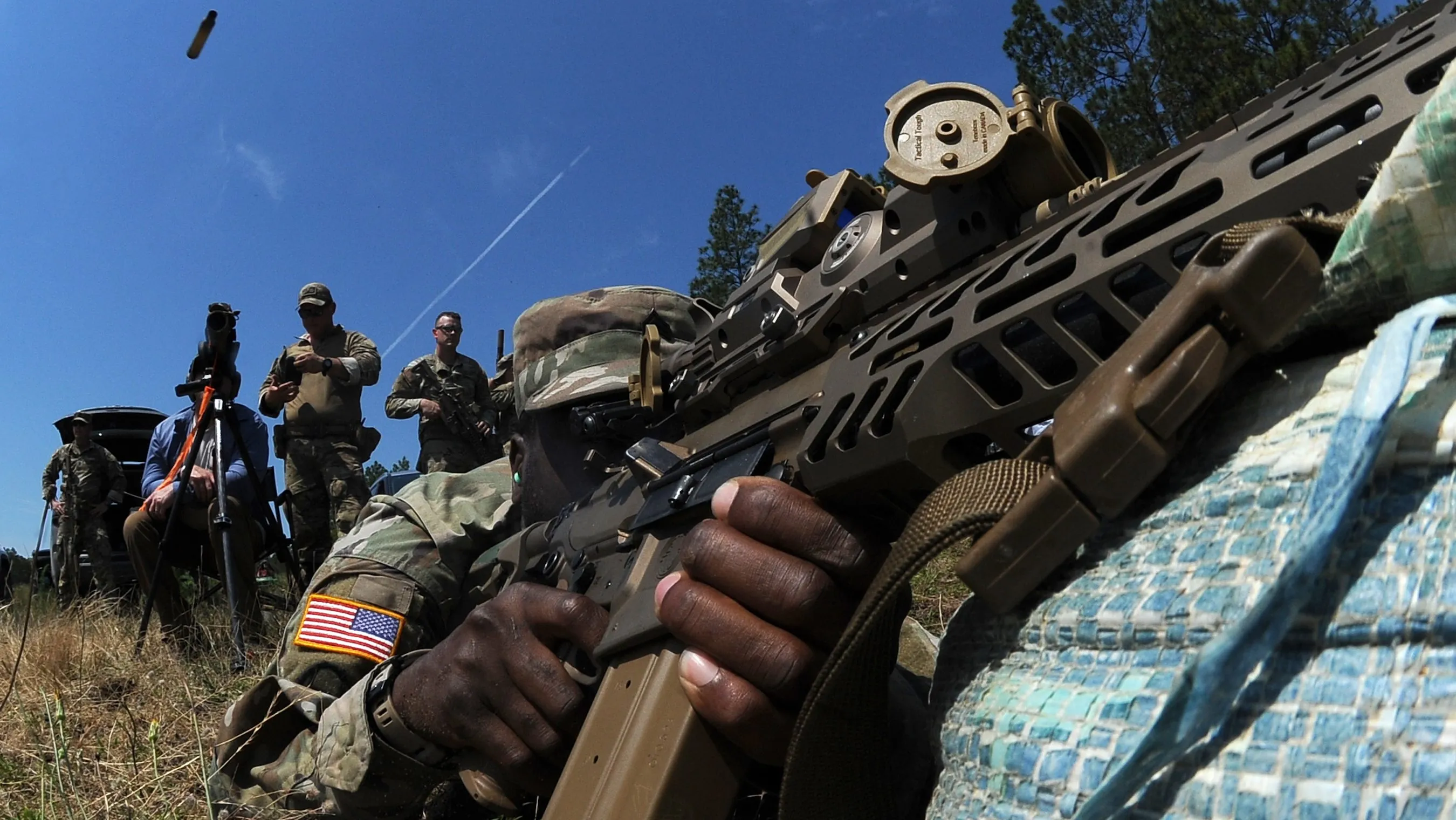
Still, the trade-off is real. A soldier with an M4A1 typically carries seven 30-round magazines—210 rounds total. That same loadout with XM7 magazines equates to just 140 rounds.
To match the old volume, soldiers would need to carry more magazines, each filled with heavier 6.8mm ammunition.
There’s also the issue of weight. The XM7 itself weighs 8.18 pounds unloaded, compared to the M4A1’s 6.54 pounds. Add a suppressor, optics, and ammunition, and the weight burden climbs steeply.
“Walking up and down the mountains of Afghanistan, if I had to carry a full combat load of this and it weighs X amount more, that would suck,” said one Army marksmanship instructor, who requested anonymity due to media restrictions. “I’m literally just carrying too much weight.”
The Army has acknowledged the challenge and is reportedly working to reduce soldier load in other ways, including minimizing battery and equipment redundancies. But Kinniery also suggested reevaluating long-standing assumptions about basic combat loads.
“One of the first questions I asked when I took the job over is, where did the science come from for having 210 rounds?” he said. “I have searched for the science on this, and I’m still looking for it.”
Retired Marine Col. J.D. Williams, now with the RAND Corporation, highlighted that exercise results may vary depending on the scenario. While larger magazines might encourage indiscriminate fire, smaller ones could create deadly pauses in suppressive capability. “The structure of the exercise will impact outcome,” Williams wrote in an email.
Ultimately, the debate over the XM7 is not just about ballistics or gear specs—it’s about how the Army envisions future combat. Is the next fight a battle of attrition, or one of precision? Will soldiers have reliable logistics, or be forced to stretch limited supplies?
As McNaugher reflected on his time in Vietnam, the question felt deeply personal. “I really wished I could have carried a 13-round pistol instead of the nine-round .45. In the end, it didn’t matter—I never got ambushed—but that question of how many rounds you can fire before you have to reload is an important one.”
In the high-stakes, close-quarters world of infantry combat, that question remains as urgent as ever.
Join the Discussion
COMMENTS POLICY: We have no tolerance for messages of violence, racism, vulgarity, obscenity or other such discourteous behavior. Thank you for contributing to a respectful and useful online dialogue.