In a bold shift aimed at adapting to the modern battlefield, the U.S. Army’s 25th Infantry Division is trading in most of its traditional cannon artillery for rocket systems.
This transition, part of a broader push to increase mobility and lethality, places the division at the forefront of the Army’s modernization strategy.
Maj. Gen. Marcus Evans, commander of the 25th Infantry Division, announced the move during a call with reporters on Tuesday.
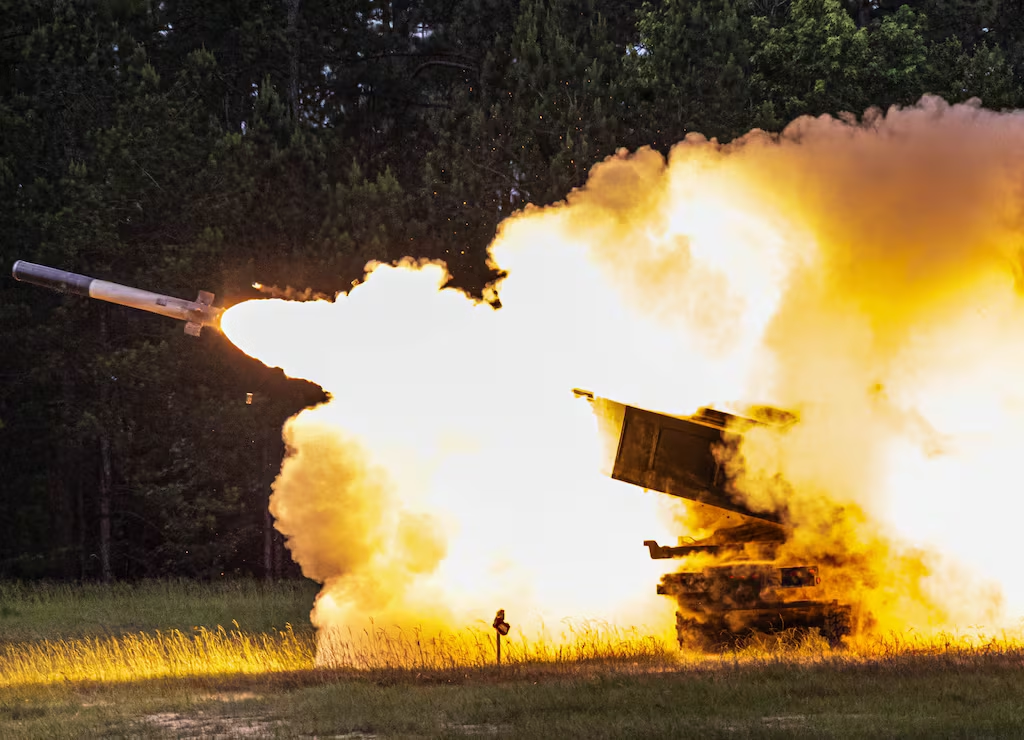
He confirmed that the division has already begun fielding 16 High Mobility Artillery Rocket Systems (HIMARS), a process set to unfold over the next six weeks. These rocket systems will replace a substantial portion of the division’s conventional cannon artillery.
Here's What They're Not Telling You About Your Retirement
However, the transformation is not a total abandonment of cannon artillery. Instead, officials explained that the division has consolidated its remaining firepower into a single battalion, composed of two batteries of 105mm howitzers and one battery of 155mm howitzers.
As part of the shift, cannon crew members will undergo a rigorous three-week training course to prepare for their new roles operating the HIMARS.
The unit is expected to validate its proficiency with the new systems during a major training event at the Joint Pacific Multinational Center later this fall.
This Could Be the Most Important Video Gun Owners Watch All Year
The strategic shift to HIMARS significantly extends the reach of the division’s firepower. HIMARS has a current operational range of up to 186 miles, dwarfing the approximate 43-mile maximum range of traditional 155mm cannon artillery using specialized rounds.
Even more impressive, future iterations under development through the Precision Strike Missile (PrSM) program are expected to extend that range to as far as 300 miles.
This enhanced range allows for greater operational standoff and the ability to strike targets with increased precision and safety. “It creates increased survivability,” Evans said in June.
“It enhances their ability to protect themselves with greater standoff and strike with loitering munitions or weaponized drones.”
The switch to rocket artillery is just one piece of the division’s sweeping modernization efforts. The 25th Infantry Division was selected as one of the Army’s “transformation in contact” units, a designation that signals a deliberate effort to field new capabilities while actively training and operating.
Over the past year, the division’s 2nd Brigade has undergone a significant overhaul and now bears the name 2nd Mobile Brigade Combat Team.
This restructured unit has received a suite of advanced technologies including drones, electronic warfare systems, counter-drone tools, and Infantry Squad Vehicles (ISVs).
The result is a faster, more agile force capable of responding to threats across diverse terrains and mission profiles.

Evans emphasized the operational impact of these upgrades during training exercises conducted earlier this summer with the Philippine Army’s 7th Infantry Division.
Where drones used last year had a scouting range of only about three kilometers, improved drone technology now allows the brigade to “see, sense and strike” targets up to 30 kilometers away.
This increase in reconnaissance and targeting range dramatically changes how soldiers engage with the enemy.
The ability to detect threats at greater distances and deliver precision fires without exposing troops to unnecessary risk is a game-changer for ground combat operations.
All these improvements underscore the Army’s ongoing shift from legacy systems to integrated, multi-domain capabilities that match the complexity of today’s threats.
For the 25th Infantry Division, that means embracing innovation while maintaining readiness.

As HIMARS rolls into formation and crews prepare for a new era of warfare, the division remains committed to leading the charge in Army transformation.
With greater range, faster mobility, and smarter targeting tools, the Tropic Lightning Division is poised to strike faster, farther, and more decisively than ever before.
Join the Discussion
COMMENTS POLICY: We have no tolerance for messages of violence, racism, vulgarity, obscenity or other such discourteous behavior. Thank you for contributing to a respectful and useful online dialogue.