The House Armed Services Committee is set to embark on its annual markup of the National Defense Authorization Act (NDAA) this week, continuing a long-standing tradition of shaping U.S. defense policy and budgeting priorities through an exhaustive daylong session.
The markup process, often marked by intense debate and partisan sparring, will set the tone for the House's vision for the Pentagon in fiscal year 2026.
The House effort comes on the heels of the Senate Armed Services Committee’s passage of its own draft version of the NDAA.
In stark contrast to the Senate’s closed-door approval process, House members will deliberate on a wide range of contentious issues in a public forum.
Here's What They're Not Telling You About Your Retirement

Topics up for discussion include politically charged social policies and detailed fiscal provisions that impact nearly every facet of the Department of War.
Despite the open nature of the markup, major policy shifts led by Democratic members are unlikely to gain traction due to the Republican majority on the committee.
The partisan divide suggests that while the debate may be spirited, the final House draft will hew closely to GOP preferences.
This Could Be the Most Important Video Gun Owners Watch All Year
One of the clearest distinctions between the House and Senate versions of the bill lies in the overall defense spending levels.
The Senate draft supports a $879 billion base budget for the Department of War, exceeding the White House’s request by roughly $32 billion.
The House version, at least for now, aligns with the Biden administration’s $847 billion proposal.
While funding levels may differ, both chambers share several key priorities.
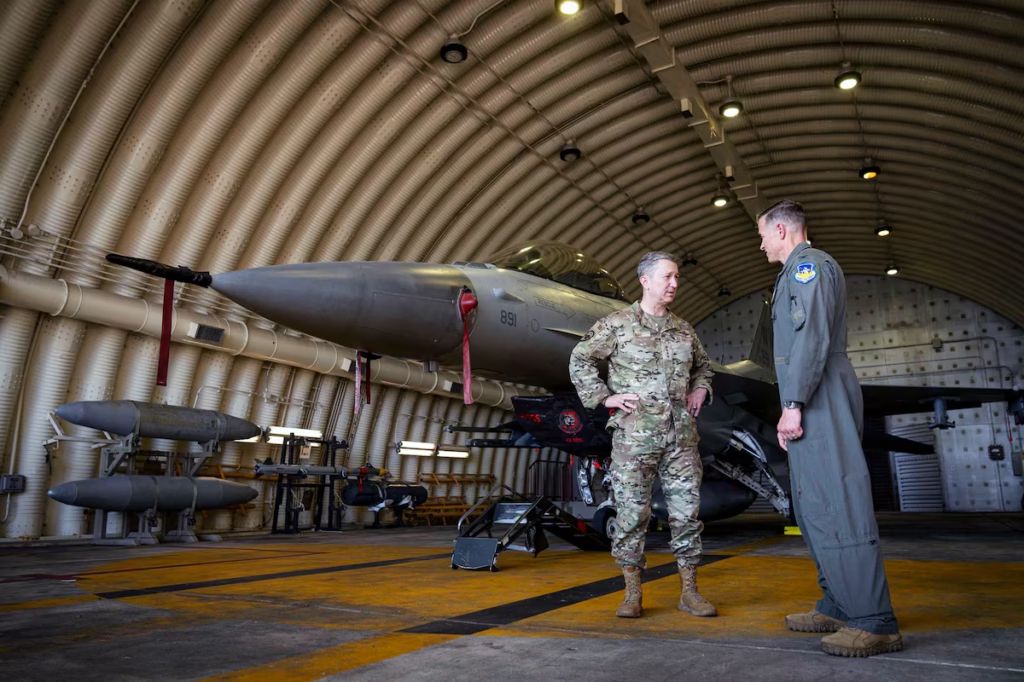
Each draft includes provisions for a 3.8% pay raise for military personnel, a move aimed at improving recruitment and retention across the armed services.
The bills also propose increases in end strength, reflecting a broader bipartisan concern over force readiness amid rising global threats.
Over the coming weeks, lawmakers from both chambers will begin the complex task of reconciling the two versions of the bill.
This negotiation process, which typically stretches through the summer, is critical to ensuring the NDAA can pass both the House and Senate and ultimately be signed into law before the end of the fiscal year.
In addition to the NDAA markup, a slate of other key congressional hearings and markups will take place this week, further signaling the start of a busy legislative session on Capitol Hill.

On Monday, the House Veterans’ Affairs Committee will hear testimony from Department of Veterans Affairs officials at 3 p.m. in Room 360 of the Cannon House Office Building.
The focus will be on reforms to the VA’s Office of Information and Technology.
Tuesday brings a packed agenda across multiple committees:
- At 10 a.m., the House Homeland Security Committee will convene in Room 310 Cannon to hear from outside experts on the threat of drone attacks against both military and civilian targets within the U.S.
- Also at 10 a.m., the Senate Foreign Relations Committee will meet in Room 419 Dirksen to consider several nominations, including that of Rep. Michael Waltz to serve as the U.S. Representative to the United Nations.
- The House Transportation and Infrastructure Committee will mark up its draft of the annual Coast Guard authorization bill at 10 a.m. in Room 2167 Rayburn.
- At 11 a.m., the House Appropriations Committee will mark up its version of the State Department’s appropriations bill in Room 2358-A Rayburn.
- At 12 p.m., the House Armed Services Committee will meet in Room 2118 Rayburn to formally begin the NDAA markup.
- Finally, at 2:15 p.m., the House Veterans' Affairs Committee will hold a hearing in Room 360 Cannon on the Department of Veterans Affairs’ community care programs.
On Wednesday, July 16, the Senate Foreign Relations Committee will again convene at 10 a.m. to discuss reforms within the State Department.
Later in the afternoon, the House Veterans’ Affairs Committee will meet at 2:30 p.m. to examine updates to veteran employment assistance programs.
At 4 p.m., the Senate Veterans’ Affairs Committee will consider additional pending nominations.
The week wraps up on Thursday, July 17, when the Senate Appropriations Committee marks up its draft of the Veterans Affairs and Military Construction appropriations bill at 9:30 a.m. in Room 106 Dirksen.
This flurry of legislative activity comes at a time of growing concern over military readiness, cyber threats, veteran support systems, and international diplomacy.
As lawmakers work to finalize next year’s defense and foreign policy frameworks, the NDAA markup remains one of the most consequential steps in setting national security priorities for the year ahead.
Join the Discussion
COMMENTS POLICY: We have no tolerance for messages of violence, racism, vulgarity, obscenity or other such discourteous behavior. Thank you for contributing to a respectful and useful online dialogue.