The U.S. Army and Marine Corps are about to take a massive leap forward in battlefield speed and accuracy with the unveiling of the Scorpion Light 81mm mobile mortar system, a GPS-guided, semi-automated weapon designed to revolutionize the age-old call-for-fire process.
The system, built by Global Military Products, is bringing frontline mortar technology into the digital era where sensor-to-shooter times are slashed and precision is tighter than ever.
Traditionally, mortar crews have had to rely on shouted commands and manual adjustments to dial in the right deflection, charge, and elevation before firing.
It’s a process that works, but it’s slow, reliant on human coordination under stress, and vulnerable to error. The Scorpion Light system changes all of that by automating almost every step except dropping the round down the tube.
According to James Knight, director of business development for Global Military Products and a former Army indirect fire infantryman, the Scorpion allows mortar teams to input their target data digitally.
Once entered on a map-style tablet, the system automatically sets the tube’s angle and direction without a crew member touching it. The only thing soldiers must still do by hand is charge and load the round. That’s it.
Knight, speaking during SOF Week in Tampa, explained that the breakthrough system was carefully designed with combat realities in mind.
“The only thing that’s manually not really going to change is that you have to grab the round from a ready rack or the ammo storage point, implement the correct charges, and drop it down the tube,” he said. Everything else is fully streamlined and automated.
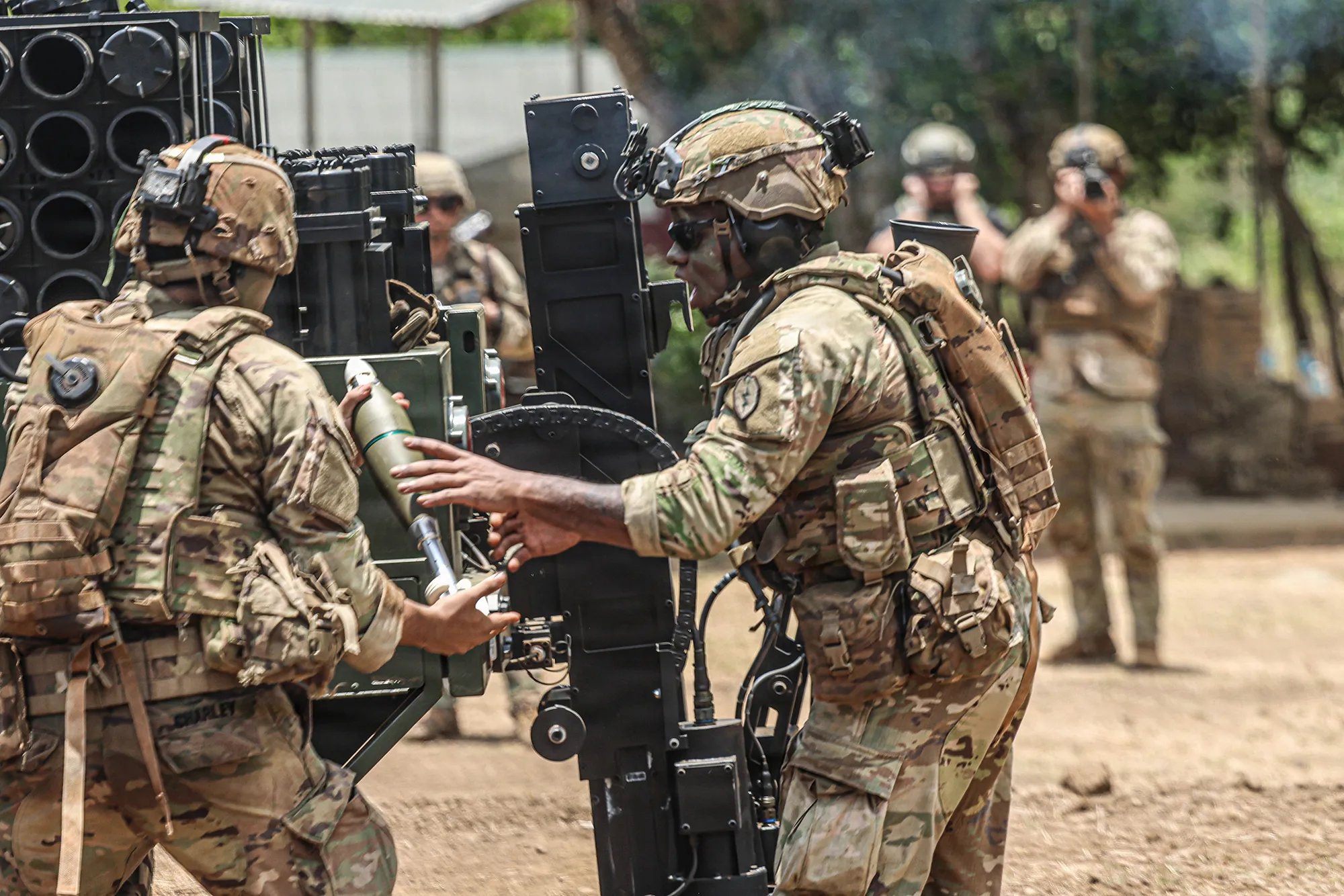
The Scorpion Light wasn’t built just for convenience—it’s about speed and survival. Its digital architecture reduces auditory commands, meaning mortar teams won’t have to bellow instructions like they’re on a World War II battlefield.
“There’ll be some auditory commands, like ‘hang it,’ but the way that they receive those fire missions will all be digitally sent messages that increase the sensor-to-shooter capability,” Knight said.
Faster missions, fewer mistakes, and greater lethality.
Using dual GPS receivers and a sophisticated inertial navigation system, the Scorpion Light can pinpoint its exact location down to millimeter-level precision.
It also features an inclinometer that guarantees dead-on aim and elevation accuracy. The result: rounds hit where they’re supposed to, even when the pressure is on.
At 940 pounds, the Scorpion Light isn’t lightweight, but its mobility is no issue. It’s built to be mounted onto a range of tactical vehicles.
Recent live-fire trials saw it integrated with the Army’s Infantry Squad Vehicle, while the Marine Corps is preparing to test its compatibility with the Polaris MRZR Alpha 6×6 platform. Both services are looking for an edge in rapid-fire mobility operations—and this system delivers.
Performance-wise, Knight said the Scorpion Light can fire eight rounds in under two minutes before repositioning to a different firing location, keeping mortar teams safe from counter-battery fire.
That kind of hit-and-move timing is exactly what modern battlefields demand where survivability often depends on speed.
Even better, the Scorpion requires no trench digging or soft soil for setup. Current mortar systems need crews to dig in the base plate before they can fire. Scorpion Light’s engineering wipes that problem away.
“With this, you don’t have to dig any base plate in,” Knight explained proudly. “You can shoot on soft ground, hard surfaces, urban terrain—basically anywhere you need to.”
For troops moving through cities, mountains, or deserts, that’s a game-changer.
From Knight’s perspective, this innovation isn’t just about efficiency; it’s about protecting the men and women who actually pull the trigger.
“It’s very personal to me to ensure that future 11 Charlies and mortarmen have the best capability possible,” he said. As someone who’s seen mortar work firsthand, Knight’s excitement is more than justified.
The Army’s field tests reportedly showed that even under combat simulation, the Scorpion Light’s digital targeting produced faster mission responses than conventional tube mortars.
And in a world where seconds can decide who comes home, that’s no small thing.
This new tech fits squarely into the broader push for more connected, adaptive, and digital warfighting systems across the U.S. military—a mission backed strongly by the War Department under Secretary Pete Hegseth.
This is the kind of innovation that aligns directly with President Trump’s agenda to rebuild and modernize America’s warfighting edge.
As far as battlefield upgrades go, this one isn’t theoretical. It’s here, it’s operational, and it’s designed to give U.S. troops a decisive upper hand over any adversary that dares to test them.
Precision, mobility, automation—Scorpion Light brings it all together. If you want to know what the future of indirect fire looks like, this is it. And it’s proudly American made.
Join the Discussion
COMMENTS POLICY: We have no tolerance for messages of violence, racism, vulgarity, obscenity or other such discourteous behavior. Thank you for contributing to a respectful and useful online dialogue.