The Marine Corps is making it clear: to meet the demands of modern warfare and maintain a truly global presence, the United States needs roughly 40 amphibious warfare ships.
That number would allow three Marine Expeditionary Units, or MEUs, to remain deployed and ready at all times—a crucial requirement if the nation expects to deter threats from adversaries like China, Russia, and Iran.
Lt. Gen. Jay Bargeron, deputy commandant for plans, policies, and operations, spelled it out during the Modern Day Marine exhibition in Washington, D.C. “The number is probably going to be around 40,” he said.
“It could be a little more.” That understated assessment highlights a growing acknowledgment among military leaders that the Navy’s current fleet of 32 amphibious ships simply isn’t enough to meet combat and crisis-response missions across the globe.
To put it plainly, America’s amphibious capability has been running on fumes. Bargeron confirmed the Marines’ goal aligns with Commandant Gen. Eric Smith’s “3.0 presence” initiative—keeping three Amphibious Ready Groups and three MEUs forward-deployed at all times.
That posture ensures the United States can strike, assist, or deter anywhere on the planet, even with little warning.
Smith’s own words to Congress in May 2025 painted the strategic picture vividly. He wrote that three simultaneously deployed MEUs “provide lethal response options, create dilemmas for our adversaries, forward-posture forces to deny adversaries decision space, and support campaigning alongside our allies and partners.”
In other words, the 3.0 presence isn’t just about having ships in the water—it’s about keeping America unpredictable and powerful offshore.
Yet the Navy’s readiness numbers tell a troubling story. Out of 32 amphibious warfare ships, fewer than half are deployment-ready. That’s barely enough to cover two MEUs, let alone sustain three globally-distributed formations for extended periods. “The Navy and the Marine Corps are aligned on this: 31 is not the right number,” Bargeron said. “It’s a floor.”
The lack of readiness isn’t theoretical—it’s already affected operations. In early 2022, the 22nd MEU at Camp Lejeune was supposed to deploy to Europe as Russia threatened Ukraine. But maintenance failures across its assigned ships kept it stuck at port. That’s not just a scheduling inconvenience—it’s a national security failure. When Marines can’t sail, American deterrence fades.
At an April 15 hearing before the House Armed Services Committee, Navy Adm. James Kilby, the vice chief of naval operations, admitted the obvious: only 45% of amphibious ships qualify as "combat surge ready." Compare that to 63% of surface ships and 65% of submarines. The disparity speaks volumes about neglect and misplaced priorities at the shipyard and budget level.
Bargeron also revealed that global demand from combatant commanders is even greater than the target 3.0 presence. “There is a demand signal that is in excess of 3.0,” he said.
“If you look at the raw data that comes into the Global Force Management process, it’s been somewhere around six [in the] last few years.” That number underscores the reality that hotspots are multiplying faster than America is building ships. From the Red Sea to the Taiwan Strait, the calls for amphibious capability are stacking up.
Navy Vice Adm. John Skillman echoed Bargeron’s assessment. “We’re aligned,” Skillman said. “It’s more than 31. We actually don’t know the numbers yet.” That honesty is refreshing, but it’s also damning. Washington has known for years that the amphibious fleet was running too small—and now, crisis after crisis is proving the point.
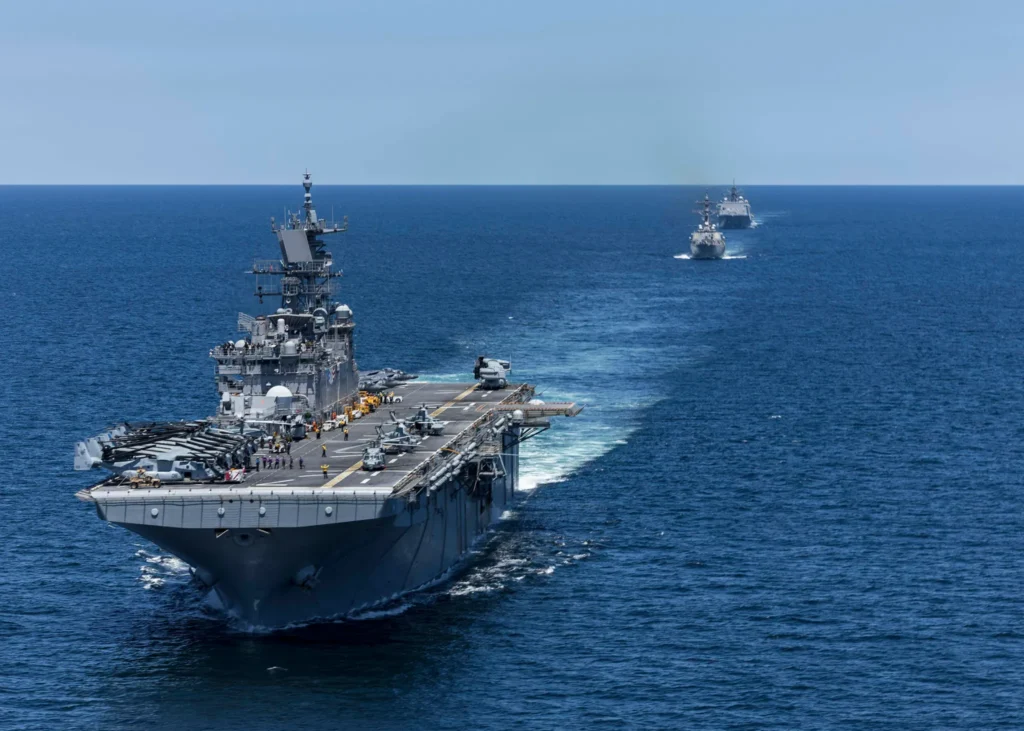
The requirement for 40 ships isn’t just bureaucratic talk. Every component of a 3-ship Amphibious Ready Group is vital. Big-deck amphibious assault ships carry vertical lift aircraft like the MV-22 Osprey and F-35 fighters.
Amphibious transport docks—like the USS John P. Murtha, which recently recovered Artemis II astronauts—deliver Marines and heavy equipment ashore. Dock landing ships bring armored vehicles, Landing Craft Air Cushion (LCAC) systems, and other assets to fight inland.
This fleet is America’s on-call strike force, the spearhead of our global presence. Without enough ships, it’s like sending a firefighter without a hose. The Marines have learned this lesson the hard way over the last decade.
Of course, building and maintaining 40 amphibious warfare ships won’t come cheap. But if America expects to project power across oceans, counter threats before they hit our shores, and give the War Department the flexibility it needs, it’s an investment worth making.
President Trump and War Secretary Pete Hegseth have both stressed that peace through strength begins at sea—exactly where the United States used to dominate without question.
If the Pentagon is serious about meeting global mission loads and deterring adversaries, then 40 ships should be a starting point, not an end goal. The Marine Corps is ready. It’s time for shipbuilders and Congress to catch up.
America cannot afford another year of pretending that 31 ships will keep the peace.
Because when the Marines say they’re short on ships, they’re not talking about convenience. They’re talking about warfighting reality.
Join the Discussion
COMMENTS POLICY: We have no tolerance for messages of violence, racism, vulgarity, obscenity or other such discourteous behavior. Thank you for contributing to a respectful and useful online dialogue.