U.S. Marines are grinding through mountains of collapsed concrete and rebar in northern Venezuela, working shoulder to shoulder with local rescue teams to find survivors of last week’s devastating earthquakes.
The work is grueling, hazardous, and urgent. “We’re racing against the clock,” said U.S. Southern Command, which oversees the mission.
The back-to-back quakes struck on June 24, pounding Yaracuy state west of Caracas with staggering magnitudes of 7.2 and 7.5. Within seconds, whole blocks were flattened, leaving more than 1,450 people confirmed dead and thousands still unaccounted for.
The devastation is severe enough that U.S. forces deployed immediately, with Marines, sailors, and airmen forming the core of an expanding international effort to search the wreckage.
MORE NEWS: Pentagon Confirms First Military Execution in Over 60 Years Will Be Publicly Livestreamed
The Marines are operating in coordination with Venezuelan emergency responders, who have publicly thanked the U.S. teams for their speed and toughness.
Working day and night, American and allied personnel are crawling through unstable debris, using thermal imaging and acoustic sensors to detect faint signs of life.
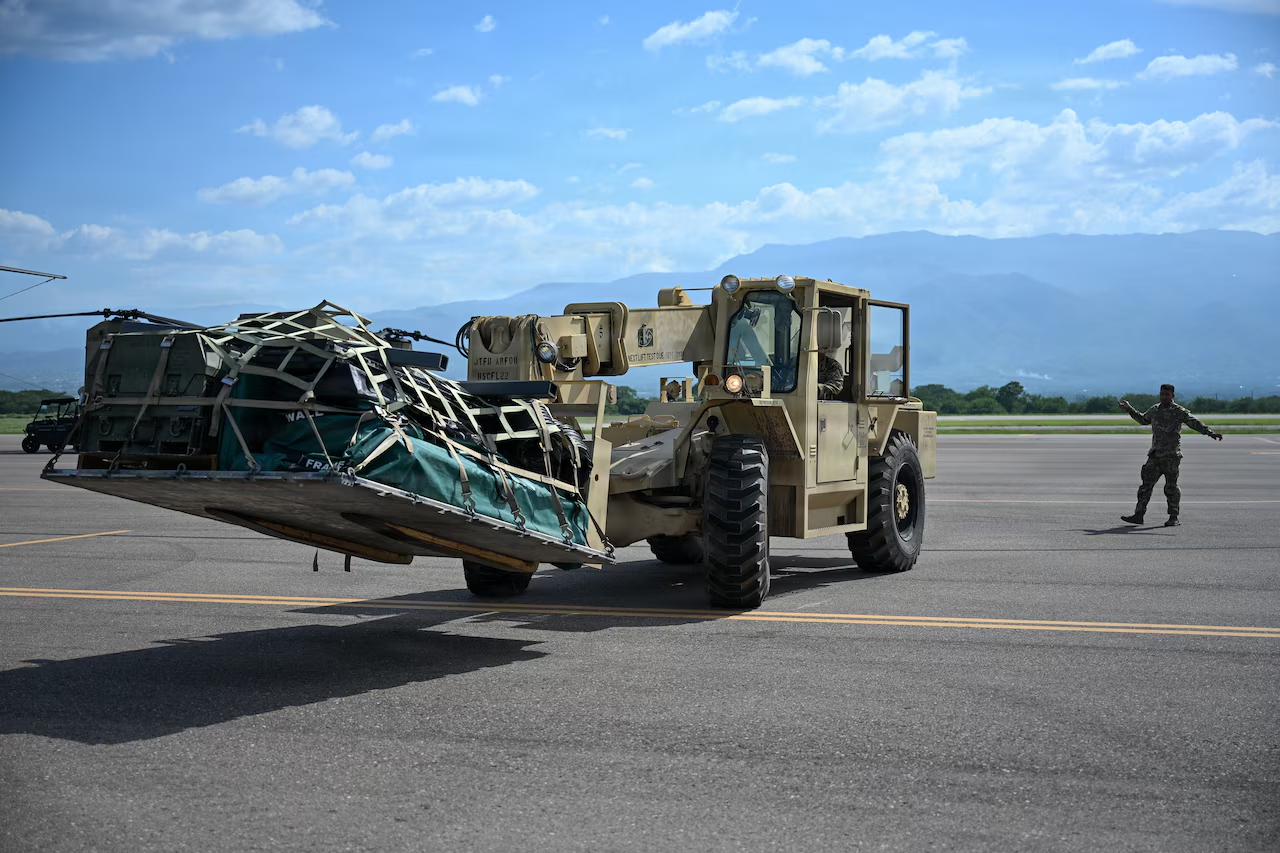
U.S. Air Force C-17 and C-130 transport aircraft have been ferrying in supplies and personnel, while Marine MV-22 Ospreys shuttle teams between impact zones. Meanwhile, Army CH-47 Chinooks and U.S. Navy ships stationed off the coast provide additional lift and logistics.
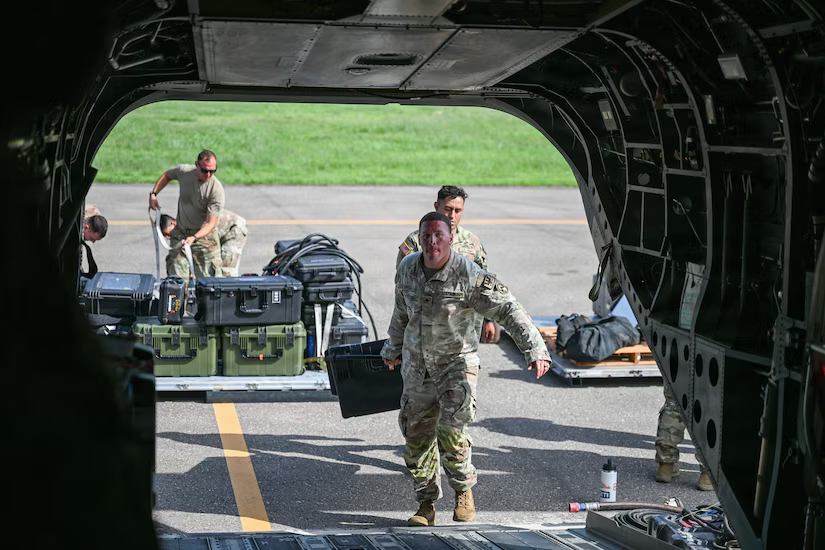
Joint Task Force Bravo members load equipment into a CH-47 Chinook helicopter in preparation for potential support to Venezuela's disaster relief response at Soto Cano Air Base, Honduras, June 25, 2026.
The War Department stressed that the operation is entirely self-sustaining, with troops relying on their own food, fuel, and medical resources.
Images released by U.S. Southern Command show Marines covered in gray dust beside Venezuelan police officers, pausing briefly between shifts before digging again.
One photo shows a Venezuelan rescuer gripping a U.S. Marine’s hand as they push through a narrow gap in the rubble—a powerful reminder of how disaster strips away politics when lives hang in the balance.
Major General Kevin Jarrard of the U.S. Marine Corps arrived on site soon after the earthquakes to guide the American response.
According to SOUTHCOM, Jarrard and his forward team are coordinating directly with Venezuela’s interim government led by Delcy Rodriguez, who requested U.S. assistance after years of strained relations under former dictator Nicolas Maduro.
That cooperation itself is a major shift. In January, U.S. special operations forces successfully captured Maduro and his wife during a daring nighttime raid, ending his long tenure of socialist misrule.
Since that mission, Venezuela has been tentatively rebuilding institutional stability—and this earthquake has become the first major test of the new leadership’s willingness to work with Washington.
So far, the coordination has been remarkably smooth. The Marines’ arrival was met with visible gratitude from civilians and overwhelmed first responders who had been digging with shovels and bare hands. One Venezuelan volunteer described the Marines’ effort simply: “They don’t stop.”
The mission has also become a striking demonstration of what American might looks like when used for good. The same precision, logistics, and discipline that dominate the battlefield have been redirected toward saving lives in one of the worst natural disasters in South American history.
Despite that humanitarian focus, safety remains a challenge. The terrain is unstable, aftershocks continue, and temperatures soar during the day.
“Every move we make has to be deliberate,” one Marine engineer officer said. “There are whole sections of collapsed structures that could shift at any second.”
Military analysts have noted that operations like this highlight why a robust American military presence matters far beyond conflict zones.
Without the airlift capacity, logistics, and command coordination that the War Department can mobilize, such large-scale rescues would be nearly impossible. When crisis strikes, humanitarian rhetoric doesn’t save lives—boots, muscle, and organization do.
As Marines pull back debris piece by piece, the broader mission continues to grow. U.S. Navy divers are expected to assist in coastal regions where fishing towns were washed out by quake-triggered waves.
Medical teams are setting up mobile field hospitals, and combat engineers are beginning to assess long-term rebuilding needs.
For now, though, the mission remains singular. The search continues through shattered buildings and broken neighborhoods as U.S. Marines, Venezuelan responders, and international volunteers fight exhaustion and fading hope.
In the chaos, America’s warriors once again prove they’re not just the best at fighting wars—they’re the best at saving lives when the world collapses.
Join the Discussion
COMMENTS POLICY: We have no tolerance for messages of violence, racism, vulgarity, obscenity or other such discourteous behavior. Thank you for contributing to a respectful and useful online dialogue.