WHAT YOU NEED TO KNOW
- Congressional researchers questioned whether Marine Corps ACVs can survive drones and guided munitions during amphibious and land combat operations.
- The Marines plan to buy 608 ACVs, down from an initial vision of 1,122 vehicles, with each costing about $6 million.
- Anduril received a contract for a counter-UAS system designed to protect ACVs from small Group 1 and 2 drones.
- Weight, saltwater corrosion and past surf incidents remain concerns as the Navy requests $237 million for fiscal 2027 upgrades.
The Marine Corps’ new Amphibious Combat Vehicle is facing congressional scrutiny over battlefield vulnerability, future costs, weight, corrosion and possible expansion of the service. A Congressional Research Service report released Tuesday raised questions about whether the ACV can survive modern threats while supporting Marines ashore.
The report pointed specifically to the war in Ukraine, where unmanned aerial vehicles and guided munitions have largely pushed armored vehicles from the battlefield. That experience is prompting researchers to examine whether the ACV is sufficiently protected during amphibious operations and subsequent combat missions on land.
“As ACVs are intended to provide organic, direct fire support to dismounted Marines in the attack, how vulnerable to these threat systems are ACVs during amphibious operations and when operating ashore to support combat operations?” the research service asked in its report.
The report followed with another pointed question about the Marine Corps’ response to battlefield developments. “Are the Marines considering additional ACV survivability modifications based on lessons learned in Ukraine?”
The Marine Corps awarded Anduril a contract last month for a counter-UAS system intended to protect the ACV from small drones. The company’s Pulsar-L system combines sensors and jamming equipment designed to stop small Group 1 and 2 radio-frequency drones.

“The system is currently in use by the Special Operations Command due to the system’s low weight, proven performance in engaging multiple UASs, and simultaneous execution of the full kill-chain while static or on the move,” the Marine contract award stated.
Congressional researchers also questioned whether a potential expansion of the Marine Corps would require the service to buy more ACVs. Each vehicle costs about $6 million, although the precise price depends on the variant selected.
A Force Structure Review released last month proposed adding more than 6,500 personnel by 2032. The plan included additional positions across 19 infantry battalions and two Littoral Combat Teams, potentially affecting how many vehicles Marine infantry formations would need.
“If the plan is implemented, would additional ACVs be required to accommodate growth in Marine infantry units?” the Congressional Research Service asked. The question places the vehicle program’s planned fleet size alongside the service’s proposed personnel growth.
The ACV family includes several specialized versions. They are the ACV-P troop carrier, ACV-C command vehicle, ACV-30 fire support model equipped with a 30mm cannon and ACV-R armored recovery vehicle.
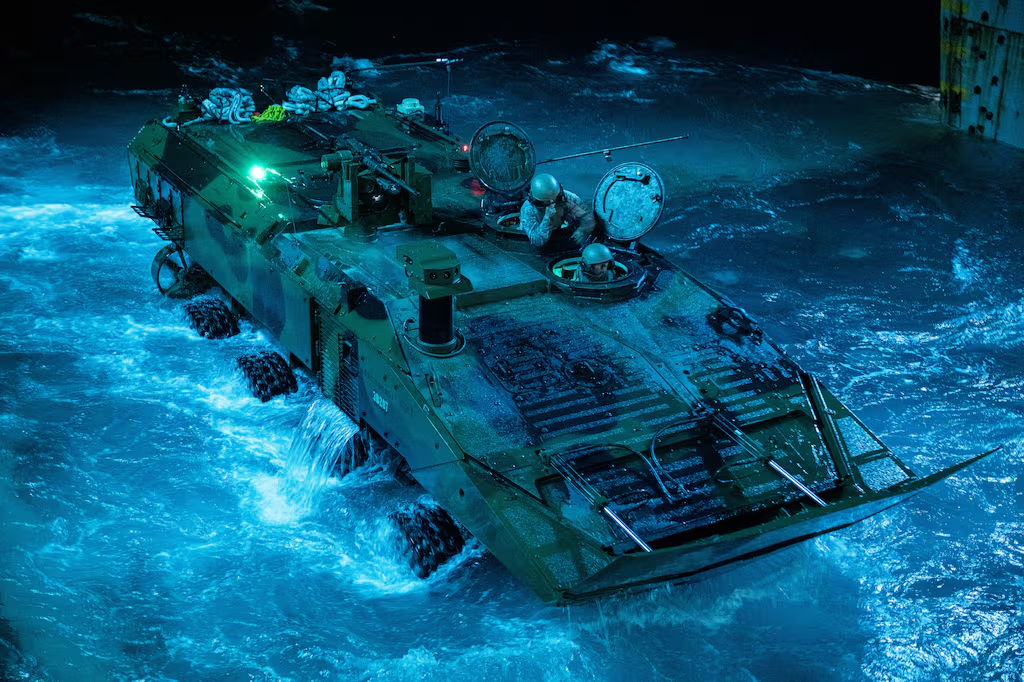
The Marines initially envisioned purchasing 1,122 ACVs, but the current plan calls for 608. Marine Corps officials told the Congressional Research Service that the planned fleet includes 389 ACV-P vehicles, 33 ACV-C vehicles, 152 ACV-30 vehicles and 34 ACV-R vehicles.
BAE recently received a $230 million contract modification for 32 ACV-Rs, the final ACV variant. The order is scheduled for completion by November 2028, while the Navy is requesting $237 million for ACV upgrades in fiscal 2027.
The program has already encountered operational problems. Two ACVs tipped over in 2022 while operating in surf as high as 10 feet, after which the Marines briefly suspended open ocean operations as long as significant breaker height does not exceed four feet.
Weight remains another concern because the ACV now weighs around 35 tons. A 2025 Navy Small Business Innovation Research solicitation sought ways to reduce weight across every ACV variant, particularly the heavier ACV-30 and ACV-R, with a target reduction of at least 2,000 pounds per vehicle.
“Components identified as having potential for weight reduction include engine access covers, drive shafts, ramp door, ramp, hatches, external fuel tanks, external metallic and metallic/composite add-on-armor components, suspension, turret exterior panels, and bow plane,” the 2025 solicitation stated.
Saltwater corrosion has created additional trouble for ACV struts. A January 2026 Sources Sought notice seeking more than 5,000 corrosion resistant struts said the Marine Corps’ deployment and training schedules expose the vehicle to an unusually corrosive operating environment.
The weight reduction solicitation also required any proposed solution to address corrosion associated with operations in and around salt water. It stated that lowering the vehicle’s weight would improve fuel efficiency and could lower its Center of Gravity and Center of Buoyancy.
Join the Discussion
COMMENTS POLICY: We have no tolerance for messages of violence, racism, vulgarity, obscenity or other such discourteous behavior. Thank you for contributing to a respectful and useful online dialogue.