WHAT YOU NEED TO KNOW
- Iran threatened U.S. forces and shipping as the USS Theodore Roosevelt joined two American carriers in the Gulf region.
- A tanker caught fire after an unidentified projectile struck it in the Strait of Hormuz.
- The White House said no credible homeland threat existed despite reported Iranian planning against senior Trump administration officials.
- Trump said the war could end fairly soon while warning that strikes could resume if negotiations fail.
Iran has intensified threats against American forces and commercial shipping as a third U.S. aircraft carrier arrived in the Gulf. The mounting pressure has fueled fears of renewed escalation in the conflict that began in late February.
Iran's Revolutionary Guards Navy warned shipping companies not to use the southern route through the Strait of Hormuz that is backed by the United States. Regional media outlets cited a force statement describing the route as fully closed and a "minefield of fire."
Brig. Gen. Mohammad Akrami-Nia, a spokesperson for the Iranian Army, tied any reopening of the critical passage to Tehran's demands. He said the Strait of Hormuz would not reopen until "the enemy accepts Iran's conditions."
The maritime warning came as CNN reported Monday that new U.S. intelligence indicated Iran was developing plans that could target senior Trump administration officials. The reported options included using a dirty bomb or chemical weapon in Washington, D.C., though CNBC could not immediately verify the report.
CNN characterized the intelligence as Iranian work to develop options, not evidence that an attack was imminent. U.S. officials have held several meetings during the past week to consider how to respond to the potential threat.
Iranian threats had already prompted Treasury Secretary Scott Bessent to move into military housing last week. Despite the heightened concern, the White House said no credible homeland threat had been identified.
"We remain vigilant, monitoring any and all potential threats, but at this time there are no credible threats to the homeland," a White House spokesperson said in a statement to CNBC.
Tensions also remained high at sea Tuesday after the U.K. Maritime Trade Operations reported that a tanker had been struck by an unidentified projectile in the Strait of Hormuz. The tanker subsequently caught fire, and the agency urged vessels to use caution and report suspicious activity.
The agency did not identify who was responsible for striking the tanker. Separately, the Iranian navy said four oil tankers had hit mines and caught fire in the eastern Strait of Hormuz during the previous 24 hours.
Oil prices moved slightly lower during Asian trading Tuesday. International benchmark Brent crude futures fell 0.7% to $91.8 a barrel, while U.S. West Texas Intermediate futures also dropped 0.7% to $85.1 a barrel.
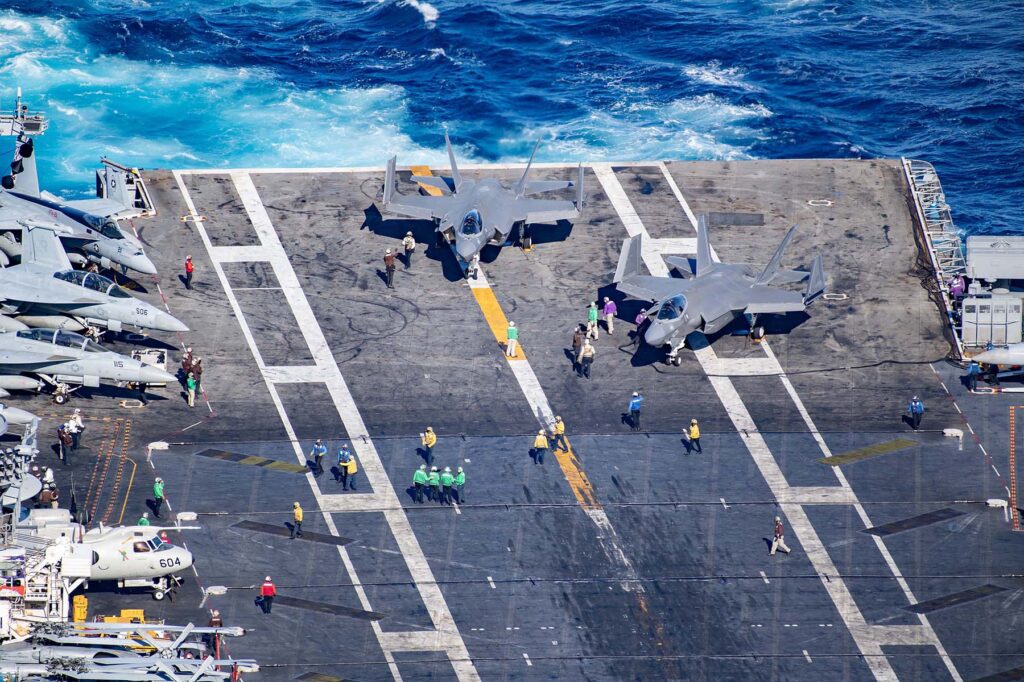
The escalation in Tehran's rhetoric coincided with the USS Theodore Roosevelt arriving in the Gulf region on Sunday. The carrier joined the USS George H.W. Bush and USS George Washington, adding to American firepower positioned near Iran.
President Donald Trump has alternated between saying the conflict could soon end and warning that large scale strikes could resume if efforts to secure a deal fail. After meeting Qatari Prime Minister Sheikh Mohammed bin Abdulrahman Al Thani last week, Trump said the war could end "fairly soon," adding that it "militarily is effectively over."
Tehran said Sunday that it launched six drones against a U.S. air defense radar at Bahrain's Riffa air base. It was the second attack Iran claimed against the kingdom in three days, while Bahrain's military said it intercepted and destroyed several Iranian aerial attacks.
Secretary of State Marco Rubio condemned the attacks during a Monday call with Bahraini Foreign Minister Abdullatif bin Rashid Al Zayani. Rubio also reaffirmed Washington's commitment to the security of Bahrain and other Gulf partners.
The conflict began in late February when the United States and Israel attacked Iran, prompting Tehran to retaliate against Israel and Gulf states hosting American military bases. Indirect talks conducted through Qatar have since appeared to reach a stalemate as the parties disagreed over terms for a lasting peace deal.
Washington appears unwilling to accept several Iranian demands, including the lifting of sanctions and the U.S. naval blockade on Iran's southern ports. The United States has also stressed that Iran cannot possess a nuclear weapon.
Ian Bremmer, president and founder of Eurasia Group, said Iran is likely to keep escalating attacks against tankers and container ships while occasionally striking U.S. military targets to pressure Washington for concessions. He said Washington would likely respond by expanding its blockade of Iran's maritime and inland trade routes.
"The presumption is that eventually Iran can't handle the economic pressure and will accept better terms," Bremmer said, calling that view a "misread of the Iranian leadership and their capacity to resist." He also said Iran is likely to intensify efforts to disrupt Strait of Hormuz shipping over the coming year.
Join the Discussion
COMMENTS POLICY: We have no tolerance for messages of violence, racism, vulgarity, obscenity or other such discourteous behavior. Thank you for contributing to a respectful and useful online dialogue.