After years of experimentation and debate, the U.S. Marine Corps has officially decided to retain its traditional 13-Marine rifle squad configuration, while incorporating modern battlefield innovations to bolster its lethality and adaptability.
Speaking at the Navy League Sea-Air-Space 2025 conference at National Harbor, Maryland, Marine Corps Commandant Gen. Eric Smith announced the finalized structure and a significant new addition: the integration of a precision fires specialist.
“This includes a school-trained squad leader sergeant and three fire teams,” Smith stated. “While this structure sounds familiar, it now includes an organic precision fires specialist.”

Here's What They're Not Telling You About Your Retirement
The precision fires role reflects the Corps’ evolving battlefield doctrine and acknowledges the growing importance of beyond-line-of-sight engagement tools, such as loitering munitions, drones, and other precision-guided weaponry.
These weapons systems allow Marine squads to engage enemies from significantly greater distances than before, enhancing both survivability and offensive capability.
Over the past several years, the Marine Corps has continuously tested new configurations in pursuit of a more flexible and capable rifle squad.
According to Lt. Col. Eric Flanagan, a spokesman for Combat Development and Integration, the Corps experimented with squad sizes ranging from 12 to 15 Marines.
This Could Be the Most Important Video Gun Owners Watch All Year

“Starting in 2018, the Marines experimented with adding an assistant squad leader and squad systems operator to rifle squads, but this was limited to experimental battalions,” Flanagan explained.
Other tests involved a 14-Marine squad divided into two fire teams and augmented with a Navy corpsman, which brought the total number to 15. These variations were all part of a larger effort known as the Infantry Battalion Experimentation (IBX) initiative, aimed at evaluating new ideas for future warfare.
Ultimately, the Marines chose to maintain the 13-Marine squad, reorganized into three fire teams of four Marines each, with a school-trained sergeant as squad leader, a corporal as assistant squad leader, and corporals leading each fire team. The final structure, while preserving tradition, integrates modern capability.
“Recent Fleet Marine Force feedback and in-stride reading of IBX efforts make the case for maintaining the 13-Marine Rifle Squad and reorganizing it into three teams of four Marines,” Flanagan wrote.
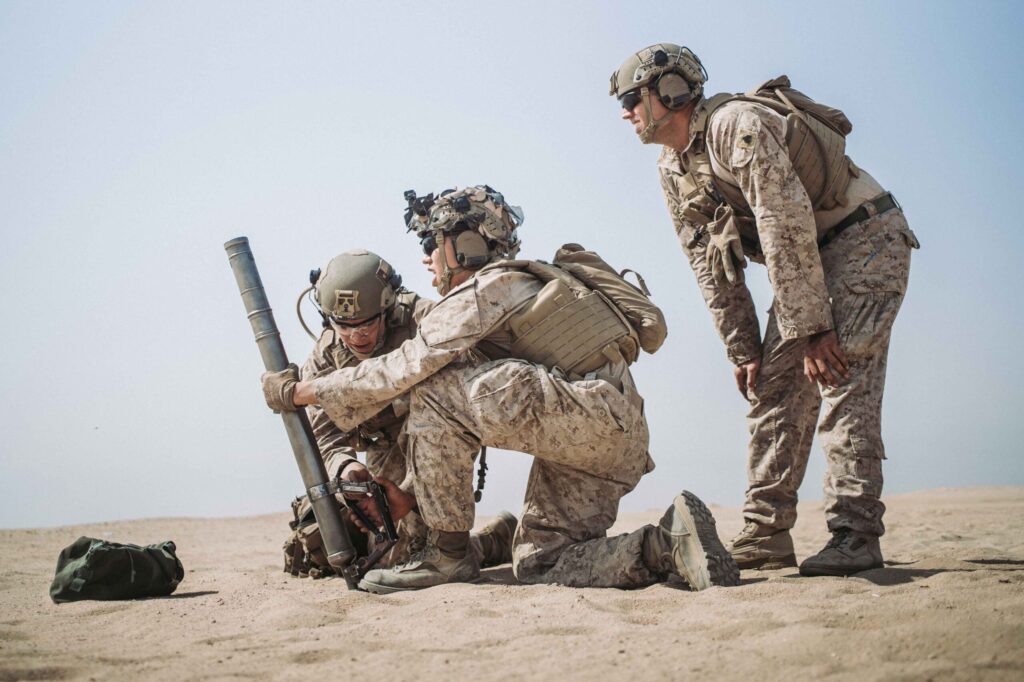
“With a school-trained sergeant squad leader, corporal assistant squad leader, and corporals assigned as fireteam leaders.”
One of the most significant influences behind the decision to incorporate a precision fires specialist has been the ongoing war in Ukraine. As Flanagan noted, loitering munitions—essentially drones capable of hovering and striking targets—have proven to be game-changers.
These weapons provide real-time intelligence, surveillance, and reconnaissance, in addition to striking power, all of which have a tangible psychological effect on enemy forces.
“Over the last few years, we experimented with our Organic Precision Fires (OPF) capability to provide multiple echelons of the FMF [Fleet Marine Force] with an organic, loitering, beyond line-of-sight precision strike capability,” Flanagan said.
“This extends the range and increases the lethality of our Marine infantry squads and platoons.”
The Marine Corps’ decision to institutionalize the precision fires role underscores a broader shift in how warfare is conducted.
Close-quarters combat is no longer the only focus. Instead, battlefield dominance is increasingly achieved through the integration of technology, range, and precision.
General Smith emphasized that the new structure is not just the result of top-down reform but comes directly from feedback and frontline experience.
“It is part of a campaign of learning,” Smith said, referring to insights drawn from battalion commanders and ongoing experimentation.

The move illustrates a balance between tradition and innovation, maintaining the foundational squad model while adapting to the demands of modern warfare.
Smith also revealed another significant organizational change within the Marine infantry battalion: the creation of a dedicated fires and reconnaissance company. This new unit will be formed by reallocating resources from headquarters and services companies.
“By consolidating our 81mm mortars, our organic precision fires, and a scout platoon into a single unit, we’re better postured to integrate intelligence, precision fires, and reconnaissance at greater ranges – it’s all about range – to better enable battalion maneuver,” Smith said. “And it is all about range.”
This reorganization is designed to increase operational effectiveness by combining capabilities that were previously spread across different units, ensuring that intelligence and long-range firepower are more tightly integrated and more rapidly deployed.
The Marine Corps’ decision to retain the 13-Marine rifle squad while adding a precision fires specialist reflects a careful balance between legacy structure and modern necessity.
Informed by real-world conflict and rigorous testing, the Corps is adapting to new realities of war where information, reach, and precision play pivotal roles.
By doing so, the Marines ensure that their infantry units remain not only relevant but also dominant in future battles—prepared to outmaneuver and outgun adversaries across a spectrum of operational environments.
Join the Discussion
COMMENTS POLICY: We have no tolerance for messages of violence, racism, vulgarity, obscenity or other such discourteous behavior. Thank you for contributing to a respectful and useful online dialogue.