The U.S. Marine Corps is entering a new era of coastal defense and naval warfare with the fielding of its first modern ship-killing missile, a crucial step in the Corps’ strategy to operate in dispersed, island-based formations alongside the Navy.
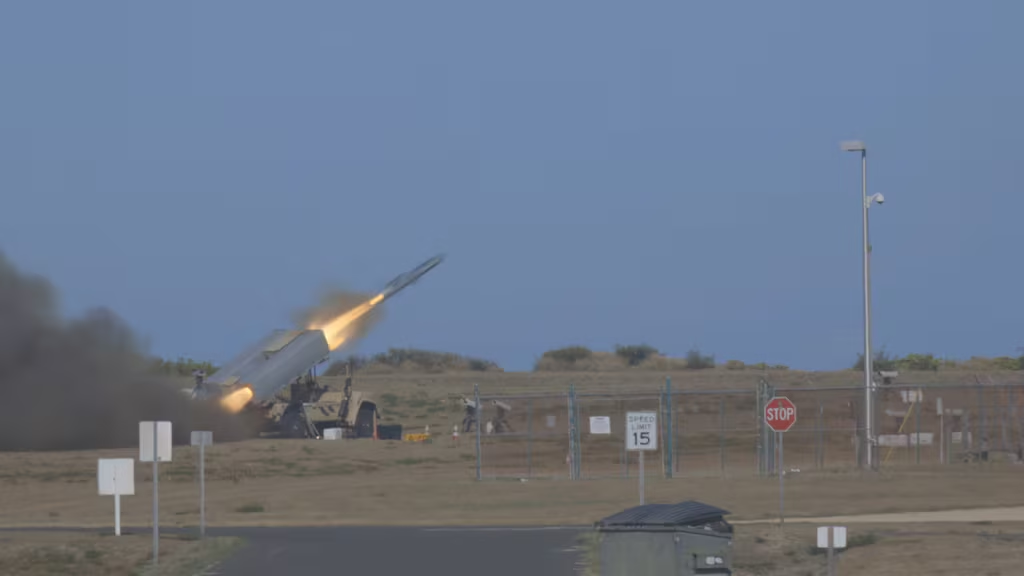
Central to this transformation is the Navy-Marine Expeditionary Ship Interdiction System, or NMESIS—a cutting-edge missile platform designed to bring greater precision, flexibility, and lethality to littoral operations.
Between now and March 2026, the Corps will steadily receive several batches of the NMESIS, totaling four dozen systems. This mobile fires and missile capability is built around the Naval Strike Missile, mounted on a Joint Light Tactical Vehicle (JLTV) chassis.
The launch system is semi-autonomous and can operate remotely, enabling Marines to strike enemy naval targets from concealed coastal locations without placing operators directly in harm’s way.
MORE NEWS: Pentagon Confirms First Military Execution in Over 60 Years Will Be Publicly Livestreamed
“The system provides coverage for Navy and partner vessels from coastal positions and gives joint forces combined land and sea targeting options,” said Nick Pierce, product manager for NMESIS at Marine Corps Systems Command. “It’s the Corps’ first modern ship-killing missile.”
The first six NMESIS systems were delivered to the Hawaii-based 3rd Marine Littoral Regiment (MLR) in November 2023. This regiment, activated in 2021, is the first of its kind in the Corps—a streamlined, technologically enhanced force designed specifically for the modern maritime fight.
The 3rd MLR combines a leaner infantry battalion structure with advanced radar, sensors, reconnaissance units, and mobile precision fires to support joint force commanders in contested littoral zones.
“Third MLR has an enhanced sea denial capability and is positioned at the forefront of strategic transformation,” said Lt. Col. Timothy Love, 3rd Littoral Combat Team commander, in a November statement.
The arrival of NMESIS at the 3rd MLR marks a pivotal moment in the Marine Corps' Force Design 2030 vision, which reimagines the service as a fast, lethal, and adaptable force capable of supporting the Navy in high-end maritime conflict.
This vision includes a strong emphasis on stand-in forces that can persist within an enemy’s weapons engagement zone and deliver decisive effects.
Following the 3rd MLR’s example, the newly activated 12th MLR, based in Okinawa, Japan, will begin fielding its own NMESIS systems in March 2026.
Additionally, a rotational third littoral regiment is planned for Guam, further extending the Corps’ reach across the Indo-Pacific.
In support of the growing missile program, the Marine artillery school at Fort Sill, Oklahoma, will also receive a NMESIS unit to train Marines on its operation and tactics.
These training efforts will ensure that operators across the fleet are proficient in deploying and maintaining the new system.
The initial batch of NMESIS platforms, known as “block 0,” represents the baseline capability.
These will soon be replaced by “block I” versions, beginning in 2026, which feature significant technological enhancements. Among the most notable improvements is the elimination of “swivel chair fires”—a term describing the outdated method of manually relaying data between systems.
The block I model will incorporate a fully digital fires system, allowing for quicker, more precise targeting and engagement of threats.
As the Corps continues to evolve, it has set an ambitious goal: to acquire a total of 261 NMESIS systems by 2033, according to Pierce.
This large-scale procurement underscores the importance the Marine Corps places on its new role as a mobile, ship-hunting force operating within contested maritime spaces.
Supporting this initiative, Oshkosh Defense recently unveiled the Remotely Operated Ground Unit for Expeditionary Fires (ROGUE Fires) system, which also integrates the NMESIS onto a JLTV platform.
This was introduced at the Association of the U.S. Army’s Global Force Symposium in Huntsville, Alabama, in March.
The ROGUE Fires system offers remote controls and a consolidated missile launch package, enhancing both mobility and survivability on the modern battlefield.
The combination of NMESIS and ROGUE Fires represents a significant shift in U.S. military strategy. These technologies enable distributed operations, allowing Marines to strike enemy ships before they can threaten larger U.S. naval formations.
This approach reflects a broader strategic shift toward “island hopping” tactics reminiscent of World War II, but with the benefit of 21st-century precision fires and autonomous platforms.
As the Marine Corps integrates these systems into its operating forces, the service is not only enhancing its lethality but also reinforcing its commitment to support the Navy in maritime dominance.
With the Indo-Pacific region increasingly viewed as a potential flashpoint, these capabilities ensure that the Marines remain ready to deter or defeat naval threats across any theater.
With digital integration, mobility, and advanced strike capabilities at their fingertips, the next generation of Marines will be equipped to operate at the leading edge of sea denial—securing the littorals and shaping the future of naval warfare.
Join the Discussion
COMMENTS POLICY: We have no tolerance for messages of violence, racism, vulgarity, obscenity or other such discourteous behavior. Thank you for contributing to a respectful and useful online dialogue.