As global tensions simmer in the Pacific, the United States Marine Corps and Navy are quietly testing a bold new way to project power across the vast maritime expanse: the Lightning Carrier.
This innovative concept turns traditional amphibious assault ships into nimble, heavily armed aircraft carriers, capable of launching advanced fighter jets and supporting forward-deployed Marine units in some of the most remote and contested areas of the world.
The Lightning Carrier idea began taking shape in 2016, when the Marine Corps first started experimenting with repurposing ships like the America-class USS America.
These vessels, which are just over 800 feet long and displace 45,000 tons, are traditionally used to carry helicopters and tiltrotor aircraft like the MV-22B Osprey and CH-53 Sea Stallion.
Here's What They're Not Telling You About Your Retirement
But under this concept, they’re transformed into smaller, more agile versions of the Navy’s massive supercarriers—outfitted with as many as 20 F-35B Lightning II aircraft and about 1,800 Marines.

Thanks to the F-35B’s short takeoff and vertical landing capabilities, the ship’s flight deck doesn’t require the massive catapult and arresting gear systems that are standard on traditional aircraft carriers.
This makes it possible for amphibious ships to act as a mobile launchpad for fifth-generation fighters while also serving as a hub for Marine operations ashore.
This Could Be the Most Important Video Gun Owners Watch All Year
In 2022, the USS Tripoli was used to put the Lightning Carrier concept to the test. Instead of the usual mix of helicopters and Ospreys, its flight deck was loaded with 16 F-35Bs.
Marines and sailors maintained a demanding operational tempo to assess whether these mid-sized ships could serve as effective floating forward-operating bases.
The results were promising, and the experiment marked a major step in the Marine Corps’ evolving doctrine under Force Design 2030.
This broader strategic initiative has led to a number of radical shifts in how the Corps operates, including the elimination of legacy platforms like the Abrams tank and the creation of new, more agile units.
At the heart of this redesign is the push for distributed operations—deploying small, well-equipped teams across a wide area.
In a potential Pacific conflict, where U.S. forces would be spread across thousands of miles of ocean and hundreds of islands, this model could be key.
The People’s Republic of China remains the primary strategic concern in the region.
In the event of a conflict, the Marine Corps anticipates that large, vulnerable ships such as the $13 billion USS Gerald R. Ford may not be able to operate close enough to the fight to be effective.
Lightning Carriers, on the other hand, offer speed, flexibility, and a much smaller footprint. They can operate from shallower waters, use smaller ports, and require far fewer supporting vessels.
While a full Carrier Strike Group might include up to 10 ships, an Amphibious Ready Group (ARG) that houses a Lightning Carrier typically consists of just three.
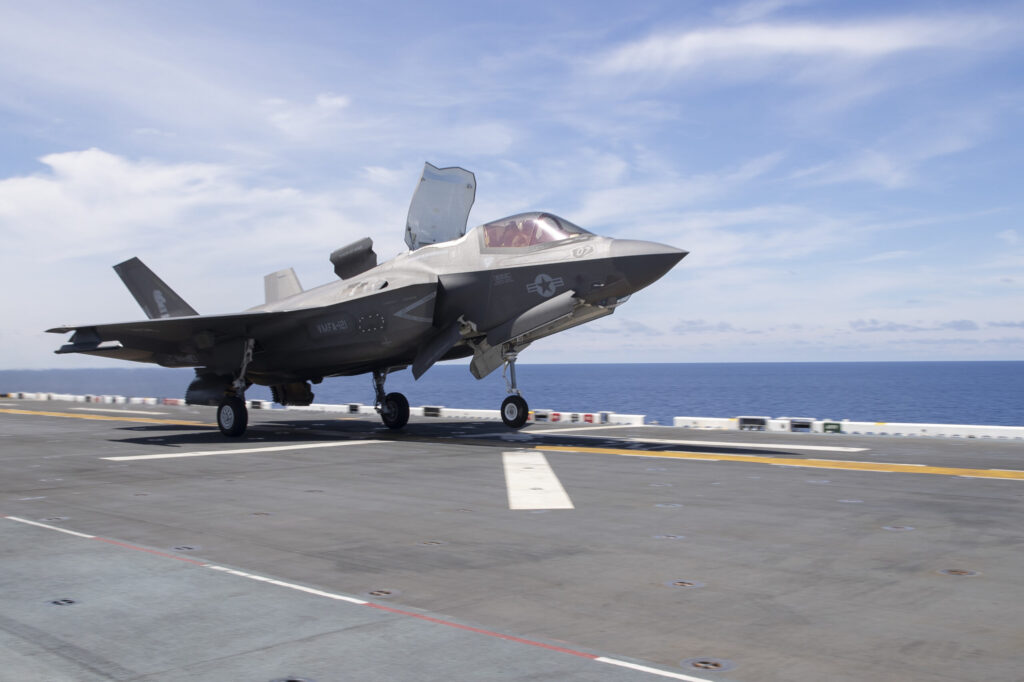
The F-35B is perfectly suited for this kind of deployment. It doesn’t need the infrastructure of a traditional carrier to operate, and its suite of onboard sensors, electronic warfare tools, and weapons enables it to perform a wide variety of missions.
These range from intelligence gathering and surveillance to close air support and suppression of enemy air defenses.
Importantly, the Lightning Carrier concept doesn't just focus on airpower. It’s also about delivering a powerful, self-contained ground force.
Each ship, along with the rest of its ARG, carries a full Marine Expeditionary Unit (MEU)—about 1,800 Marines and all their gear.
This allows for rapid deployment by air or sea, giving commanders the ability to quickly reinforce remote islands, respond to emerging threats, or seize strategic outposts. When paired with the F-35B’s capabilities, the MEU becomes a formidable force projection tool.
However, the Lightning Carrier is not without its drawbacks. These ships lack the layered defenses and survivability of larger supercarriers, making them more susceptible to anti-ship missiles and other threats.
Their smaller size also means they can’t maintain flight operations as continuously, nor can they carry the same volume of munitions, spare parts, or fuel. This creates logistical challenges that will require frequent resupply and careful coordination.

There are also operational limitations to the F-35B itself.
Without catapults and arresting gear, the aircraft have shorter ranges and reduced payloads compared to their Navy (F-35C) and Air Force (F-35A) counterparts. Additionally, no other fixed-wing aircraft can operate from these decks, limiting flexibility in some scenarios.
Despite these challenges, military leaders are optimistic about the future of Lightning Carriers.
Vice Adm. Karl Thomas, who led the 7th Fleet during the 2022 tests, summed up the concept’s versatility: “One day you can have F-35Bs on the flight deck, the next day you could have MV-22s and you can be putting Marines ashore.”
His comment reflects the adaptability that makes this concept so compelling in today’s dynamic threat environment.
As the U.S. continues to pivot toward the Pacific and modernize its force structure, the Lightning Carrier may prove to be a vital piece of the puzzle—offering a fast, flexible, and forward-leaning capability to meet tomorrow’s challenges head-on.
Join the Discussion
COMMENTS POLICY: We have no tolerance for messages of violence, racism, vulgarity, obscenity or other such discourteous behavior. Thank you for contributing to a respectful and useful online dialogue.