U.S. Navy warships operating in the Eastern Mediterranean Sea have successfully intercepted multiple Iranian ballistic missile attacks, according to a Sunday press release from the U.S. Navy’s 6th Fleet.
The move comes amid escalating military action between Iran and Israel, with U.S. forces stepping in to provide crucial defensive support in a rapidly intensifying regional conflict.
Since June 14, five Arleigh Burke-class guided-missile destroyers—USS Thomas Hudner, USS Arleigh Burke, USS The Sullivans, USS Oscar Austin, and USS Paul Ignatius—have been on high alert in the region.
Equipped with the Aegis Weapon System, an advanced naval defense network that uses high-powered radar and missiles to detect and neutralize aerial threats, the destroyers successfully “intercepted multiple Iranian ballistic missiles,” the Navy confirmed.
Here's What They're Not Telling You About Your Retirement
Specific details regarding the targets or trajectories of the intercepted missiles were not disclosed.
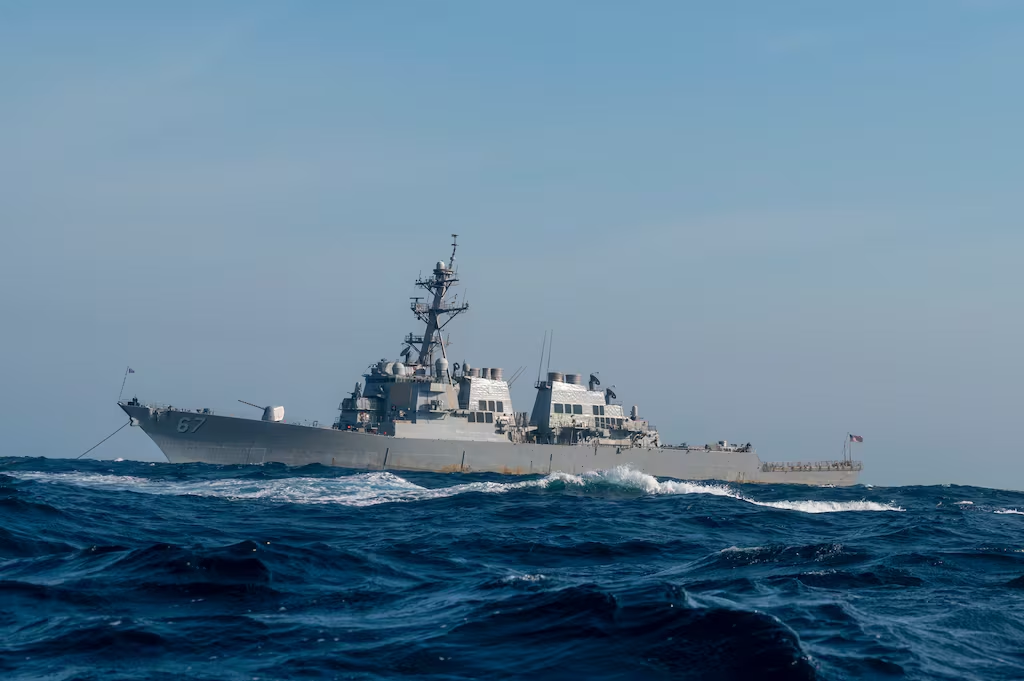
This deployment marks a significant show of force and commitment by the United States to protect regional allies, particularly Israel, as tensions with Iran reach a boiling point.
The destroyers, while typically stationed in Rota, Spain (Arleigh Burke, Paul Ignatius, and Oscar Austin) or Mayport, Florida (The Sullivans and Thomas Hudner), were strategically positioned to respond rapidly to any threats arising from Iranian retaliation.
This Could Be the Most Important Video Gun Owners Watch All Year
On Sunday, Air Force Gen. Dan Caine, chairman of the Joint Chiefs of Staff, and Adm. Stuart B. Munsch, commander of U.S. Naval Forces Europe-Africa, visited the crew of the Thomas Hudner during a port call in Souda Bay, Greece.
The visit served as both a morale boost and a recognition of the destroyer's key role in protecting regional stability.
“Thomas Hudner represents the best and the highest standard of our Navy,” said Adm. Munsch.
“Deploying from our homeland and operating forward to defend our nation and our interests abroad has been a hallmark of our Navy for over two centuries. The naval forces operating in the European theater and beyond have shown that our Navy is prepared, postured, and ready for the challenges we face.”

The U.S. Navy’s interception operations were triggered by a sharp escalation in hostilities between Israel and Iran.
On June 13, Israel launched coordinated airstrikes against Iranian nuclear facilities, reportedly killing several nuclear scientists and senior military leaders.
Iran quickly retaliated, launching ballistic missiles toward Israel and striking a hospital in a move that garnered international condemnation.
Iran’s Supreme Leader, Ayatollah Ali Khamenei, warned Washington that U.S. intervention would bring “irreparable damage” to the United States. Nonetheless, the Trump administration responded with overwhelming force.
On June 21, President Donald Trump ordered Operation Midnight Hammer, a large-scale U.S. airstrike targeting three major Iranian nuclear sites—Fordo, Natanz, and Isfahan.
The operation involved 125 U.S. aircraft, 75 precision-guided weapons, and over a dozen 30,000-pound bunker-buster bombs, marking one of the most significant American military strikes in the Middle East in recent years.
Initial reports from the Trump administration touted the operation as a resounding success, with claims that it had “completely obliterated” Iran’s nuclear infrastructure.
However, that narrative was challenged by an early assessment from the Defense Intelligence Agency (DIA), which stated the strikes had only delayed Iran’s nuclear program by a matter of months.

Defense Secretary Pete Hegseth pushed back against this characterization during a press conference held on Thursday. “The agency’s assessment is preliminary and low-confidence,” Hegseth said.
“The strike resulted in severe damage to Iran’s nuclear sites,” he added, dismissing media claims of a mismatch between official statements and intelligence assessments.
The conflict continued to escalate when, on June 23, Iran launched another wave of missile attacks—this time targeting U.S. forces stationed at the Al Udeid Air Base in Qatar.
Fortunately, the attack was intercepted by Qatari defense systems before any damage occurred.
The series of events underscores the fragile nature of Middle Eastern security and highlights the increasing role of the U.S. Navy in maintaining strategic deterrence.
As tensions remain high, the presence of U.S. destroyers equipped with Aegis defense systems sends a clear message to adversaries and allies alike: the United States remains committed to defending its interests and those of its partners in the region.
Join the Discussion
COMMENTS POLICY: We have no tolerance for messages of violence, racism, vulgarity, obscenity or other such discourteous behavior. Thank you for contributing to a respectful and useful online dialogue.