A major legal battle is underway in San Francisco as a trial begins over President Donald Trump’s decision to deploy National Guard soldiers and U.S. Marines to Los Angeles during a wave of unrest following federal immigration enforcement actions.
The proceedings are poised to shape the limits of presidential authority to protect federal interests and maintain order in situations where state leadership refuses to cooperate.
Maj. Gen. Scott Sherman, a deputy commanding general, testified on Monday that military forces assigned to domestic operations are allowed to protect federal property and assist federal agents in their duties.
He explained that they may also take certain law enforcement actions, such as establishing a security perimeter outside federal facilities, if commanders believe the safety of personnel is at risk.
Here's What They're Not Telling You About Your Retirement
Sherman’s testimony underscored that these actions are permitted under long-standing federal guidelines and are essential when federal agents face potentially dangerous conditions.
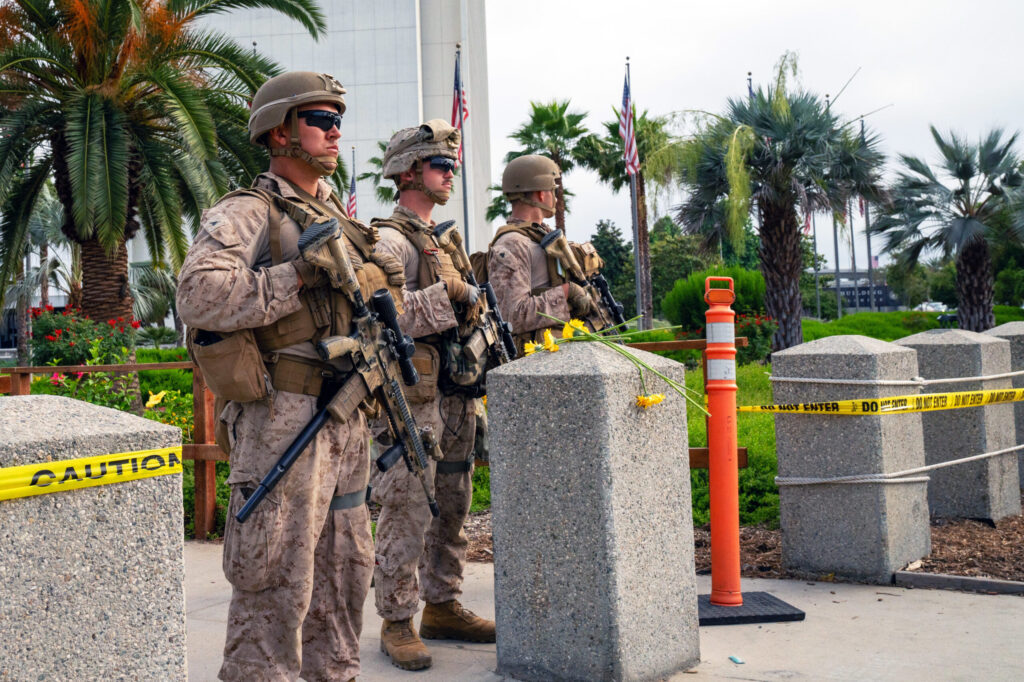
The Trump administration ordered the deployment of roughly 4,000 California National Guard members and 700 Marines to Los Angeles in early June, following large protests sparked by Immigration and Customs Enforcement arrests at several locations across the city.
The decision came after California’s Democratic leadership, including Governor Gavin Newsom, refused to support additional security measures and criticized federal immigration enforcement efforts.

This Could Be the Most Important Video Gun Owners Watch All Year
President Trump acted under his constitutional authority and federal law that allows the president to federalize National Guard units during times of invasion, rebellion, or when there is a clear danger that prevents the federal government from executing the law.
Trump’s move was designed to ensure public safety, safeguard federal facilities, and protect law enforcement officers carrying out lawful duties.
Following the deployment, National Guard members worked alongside immigration officers during certain operations, including at two marijuana farms in Ventura County, while Marines primarily provided security around a key federal building in downtown Los Angeles that houses a detention center.
This building had become a focal point for protests, and the additional protection helped prevent violence and damage.
California officials, led by Governor Newsom, have asked Judge Charles Breyer to order the removal of the remaining 250 National Guard members and to prevent federal use of military forces for any law enforcement activity in the state.

They argue that the deployment violates the 1878 Posse Comitatus Act, which generally restricts the use of federal military forces for domestic law enforcement.
Earlier in the case, Judge Breyer ruled that the Trump administration overstepped its authority and violated the Tenth Amendment, which outlines the division of powers between federal and state governments.
However, the administration quickly appealed, insisting that courts cannot override the president’s national security and public safety decisions. The appeal was successful in temporarily keeping the troops under federal control while the lawsuit proceeds.
President Trump has maintained that his actions were necessary because local authorities were unwilling or unable to respond effectively to volatile and dangerous situations.
Ernesto Santacruz Jr., the Department of Homeland Security’s field office director in Los Angeles, backed this position in court documents, explaining that local law enforcement was slow to react when a crowd gathered outside the federal building on June 7.
Santacruz stated that “the presence of the National Guard and Marines has played an essential role in protecting federal property and personnel from the violent mobs.”
The president’s decision to intervene reflects his broader commitment to upholding the rule of law, ensuring that immigration laws are enforced, and defending federal officers from hostility.
His administration has argued that when public safety is at stake, the president must have the authority to act swiftly and decisively.
This is especially true when federal agents face coordinated disruptions and state leadership refuses to provide adequate support.
While opponents frame the move as an overreach, supporters see it as an example of strong leadership in the face of resistance.
The deployment of the National Guard and Marines was not about replacing local police, but about reinforcing security at critical federal sites and allowing immigration enforcement to proceed without interference or risk of harm.
The outcome of this trial could have long-term implications for how future presidents, including Trump if reelected, can respond to similar challenges in California and across the nation.
A ruling in favor of the Trump administration would affirm the president’s authority to take decisive measures to protect federal interests and maintain order, even when doing so conflicts with the political preferences of state leaders.
As the case unfolds, one fact remains clear: President Trump acted out of a commitment to protecting American citizens, federal officers, and the nation’s laws.
His actions in Los Angeles demonstrate a readiness to confront unrest head-on, even when political opponents seek to stand in the way.
Join the Discussion
COMMENTS POLICY: We have no tolerance for messages of violence, racism, vulgarity, obscenity or other such discourteous behavior. Thank you for contributing to a respectful and useful online dialogue.