In the early hours of July 24, the calm waters of the Coral Sea gave way to the roar of engines as Japanese and American amphibious vehicles surged onto the sands of central Queensland, Australia.
Simultaneously, two hours to the east, forces from Australia and South Korea stormed Freshwater Beach.
These coordinated beach landings represented the climactic moment of Exercise Talisman Sabre 2025, held from July 13–27, and marked the most sophisticated amphibious operations in the exercise’s 11-year history.
Rear Adm. Tom Shultz, commander of Expeditionary Strike Group Seven (ESG-7) and leader of the U.S. amphibious forces, emphasized the demanding nature of this year’s exercise.
Here's What They're Not Telling You About Your Retirement
“We maintained a high operational tempo during Exercise Talisman Sabre 25, which was designed to provide intense training to ensure our forces are capable, interoperable, deployable on short notice and combat ready,” he said.
Shultz also praised the emphasis on international collaboration, stating the Navy “embraced cooperation and interoperability,” with 14 ships and expeditionary units from six nations participating in joint operations.
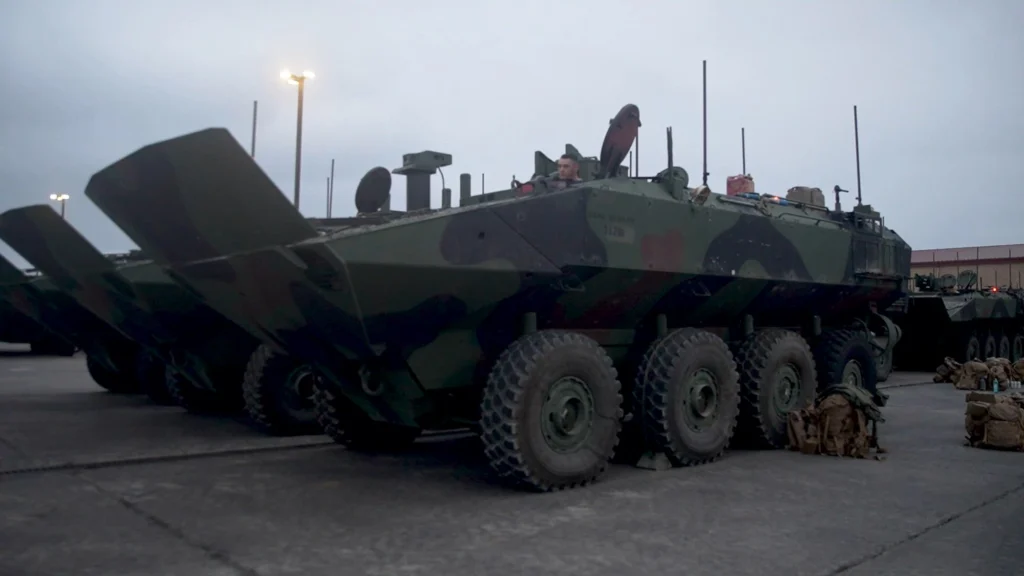
Among the standout features of this year’s drills was the debut of the U.S. Marine Corps’ new Amphibious Combat Vehicle (ACV) in Australian waters.
This marked the first time the cutting-edge 8x8 ACVs had deployed to the Indo-Pacific region—a significant milestone following the retirement of the aging AAV7A1 series, which had been in service for half a century.
This Could Be the Most Important Video Gun Owners Watch All Year
The older vehicles were withdrawn from amphibious use following a tragic accident off the coast of California in 2020.

Courtesy photo by Cpl. Nicole Dorrett, Australian Defence Force
Now, with the ACV in action, the Marines are bringing armored amphibious capability back to the Pacific theater.
1st Lt. Brooks Wright, the ACV platoon commander, reported that his unit deployed five ACVs ashore during the landings.
Wright praised the ACV as a “fabulous vehicle” that delivers both increased firepower and versatility.
“It adds a lot of combat power for the Marine Corps, and allows us to do a lot of things we haven’t been able to do the last couple of years without the AAV around,” he explained. “It does everything that we advertise that we’re able to do – the ship-to-shore movement, getting troops to shore, and then pushing inland to objectives.”
The 31st Marine Expeditionary Unit (MEU), based in Okinawa, Japan, played a central role in the exercise, led by Lt. Col. Andy Hornfeck, commanding officer of the 1st Battalion, 7th Marines. Acting as the battalion landing team for the 31st MEU, Hornfeck laid out four key lines of effort for his formation during Talisman Sabre.
The first was a full-spectrum live-fire assault on Townshend Island, showcasing the MEU’s combined arms capability with assets like F-35B stealth fighters, AH-1Z Viper helicopters, and M777 howitzers.
Next came force integration with coalition partners, which Hornfeck described as a vital exchange of tactics and skills through “cross-pollination.”
The MEU’s third mission focused on assaults in the Bowen region of Queensland. These included an aerial assault as well as a small-boat raid, highlighting the flexibility of Marine forces across domains.
The final phase was the large-scale combined joint forcible entry operation—the beach landings with Japanese forces. British and Dutch troops also joined the MEU’s pre-landing reconnaissance teams, emphasizing the multinational nature of the drill.
Hornfeck acknowledged the complexities of such integration, stating, “Fighting as a coalition is challenging.” Nonetheless, he emphasized that the deliberate pace taken to maintain synchronization with Japanese partners added realism and depth to the training.
“Talisman Sabre,” he said, “was a realistic experience.”
Meanwhile, further inland, the U.S. Marine Corps’ Marine Rotational Force–Darwin (MRF-D), comprising about 2,500 Marines, executed a series of rapid-deployment exercises reminiscent of World War II’s island-hopping campaign.
Their movements began with the seizure of an airstrip at Timber Creek, located 375 miles south of Darwin. From there, the force moved on to Nackeroo and ultimately captured an airfield at Cloncurry.
These land grabs across the Australian Outback served a strategic training purpose.
In a potential conflict with China, the U.S. military envisions employing similar tactics to navigate and dominate the First Island Chain—a natural geographic barrier stretching from Japan, through Taiwan and the Philippines, to Indonesia.
Laced with forward-deployed troops and missile systems, this island chain would serve as a key defensive line to constrain Chinese military movements.
Exercise Talisman Sabre 2025 not only reaffirmed the United States’ commitment to allied cooperation in the Indo-Pacific but also demonstrated that the Marine Corps is adapting to modern warfare with new technology, revitalized tactics, and international partnerships.
With the successful deployment of ACVs, integrated multinational operations, and Pacific-style island seizures, the Marines showed they are ready for the challenges of a future fight in one of the world’s most strategically contested regions.
Join the Discussion
COMMENTS POLICY: We have no tolerance for messages of violence, racism, vulgarity, obscenity or other such discourteous behavior. Thank you for contributing to a respectful and useful online dialogue.