In 1775, even before the birth of the United States, General George Washington made a declaration that would leave a lasting imprint on the nation’s military structure: “We need chaplains.”
This statement, delivered just six weeks after the formation of the Continental Army, prompted the Continental Congress to establish what would become one of the oldest continuous ministries in the nation — the U.S. military chaplaincy.
This year marks the 250th anniversary of that sacred mission.
Celebrations across the country, including a golf tournament at Fort Jackson and a sold-out commemorative ball in Columbia, South Carolina, reflect both the history and ongoing legacy of military chaplains.
Here's What They're Not Telling You About Your Retirement
MORE NEWS: U.S. Hits Iran with Punishing New Strikes After Oil Sanctions Snapback Over Tanker Attacks
As America’s armed forces also celebrate their 250th birthday, the chaplain corps remains deeply embedded in the military fabric — offering comfort, guidance, and spiritual support to service members around the globe.
Retired Chaplain (Major General) Doug Carver, a former Army Chief of Chaplains and now head of the Southern Baptist Convention’s chaplaincy ministries, summarized the significance of their role during the SBC’s annual meeting in Dallas:
“In times of peace and war, our chaplains have held fast as beacons of hope and resilience for our troops, whether enduring the brutal winter of Valley Forge, comforting the wounded and dying on the battlefields during the Civil War, braving trench warfare in World War I, storming the beaches of Normandy during World War II, marching the frozen mountains during the Korean War, slogging through the rice paddies and jungle battlefields of Vietnam or traveling the bomb-filled roads of Iraq and Afghanistan.”
Chaplains like Navy Chaplain J.M. Smith continue this legacy today.
This Could Be the Most Important Video Gun Owners Watch All Year
At the Progressive National Baptist Convention in Chicago, Smith detailed his recent tour in Okinawa, Japan, where he served as a Marine Corps command chaplain.
“My team and I have ministered to thousands of Marines, sailors, civilians and Japanese,” he said. “We increased our chapel’s membership from eight to 100. We incorporated spiritual readiness into our base’s core curriculum.’’

Unlike civilian chaplains in hospitals or factories, military chaplains operate in environments that often include combat zones and ethical dilemmas under pressure.
One of the most defining examples of chaplain bravery came in 1943, when four chaplains — two Protestant, one Catholic, and one Jewish — gave up their life jackets to fellow soldiers aboard a sinking World War II ship.
“It was a real defining moment,” said retired Gen. Steve Schaick, former chief of chaplains for both the Air Force and Space Force. “The stories that came from that really kind of highlighted chaplains at their best.”
Military chaplaincy today is more diverse than ever. Initially limited to Protestant ministers, the corps has grown to include Catholic, Jewish, Muslim, Buddhist, Hindu, and other faith leaders.
The first Catholic chaplains joined during the Mexican-American War in 1846, the first rabbi in 1862, and the first Muslim, Buddhist, and Hindu chaplains in 1993, 2008, and 2011, respectively.
As of now, the Army has 1,500 active-duty chaplains, down from 9,117 during World War II. The Navy, whose Chaplain Corps began in 1775, currently employs 898 chaplains, a decrease from its peak of 1,158 in 1990.
To reflect modern military demographics, the Corps is actively recruiting more women and representatives of underrepresented faith groups.
Chaplain Margaret Kibben, acting chaplain of the U.S. House of Representatives and former Navy Chief of Chaplains — notably the first woman in that role — described how the confidentiality and immediacy of chaplaincy set it apart.
“It’s the one place that people can go where there’s essentially a sanctuary around them, wherever they find themselves... a safe place to have somebody to talk to about a whole host of issues,” she said. Topics range from family troubles to the burdens of combat.
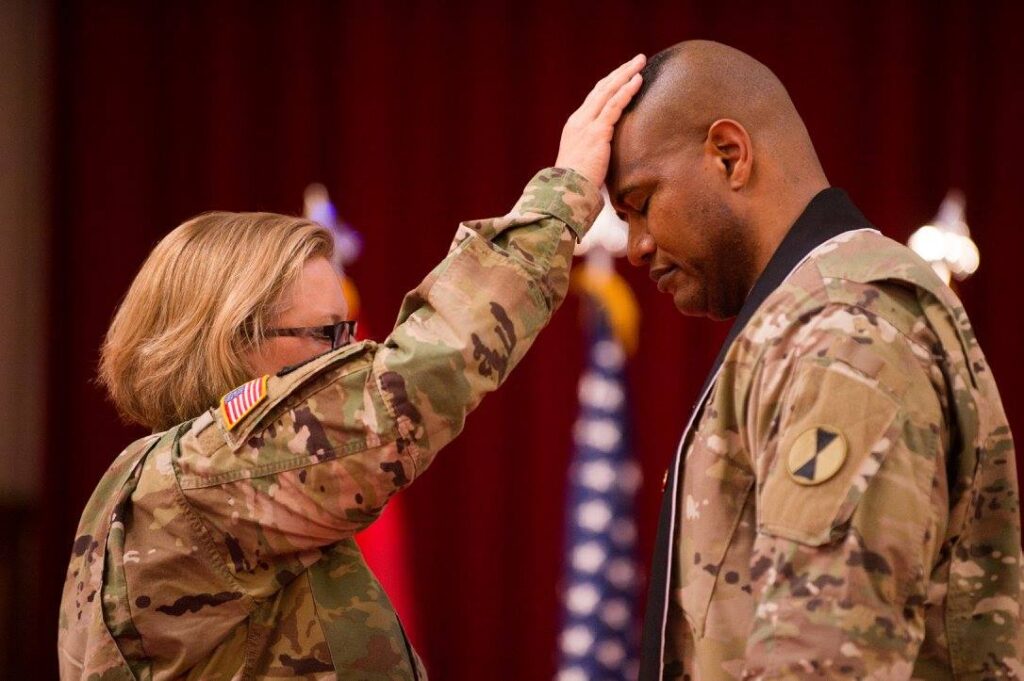
Kibben emphasized that many soldiers today are unfamiliar with traditional religious vocabulary.
“What I realized later, 20, 30 years later, was that many service members have never learned the language of faith,” she explained.
“So as a chaplain, we had to figure out our way around the lack of a lexicon of faith. How do you speak about grace to someone who doesn’t have a clue how powerful grace is?”
The chaplain’s role has also influenced military procedures.
After the Vietnam War, Julie Moore — the wife of a commanding officer — advocated for a more compassionate method of notifying families about battlefield deaths.
As a result, chaplains began accompanying uniformed officers in delivering this solemn news, replacing the impersonal telegrams once delivered by cab drivers.
The military chaplaincy hasn't been without controversy.
Groups like the Military Religious Freedom Foundation have raised concerns about proselytization, while conservative organizations argue that Christian voices face growing opposition. But regardless of these debates, the core mission remains clear.
Karen Diefendorf, a former Army chaplain and current board member of the U.S. Army Chaplain Corps Regimental Association, put it succinctly:
“The primary goal for chaplains is to provide for the free exercise rights of every soldier, sailor, airman, Marine, Coast Guardsman.”
She recounted how she once helped a Wiccan soldier in Korea find a way to practice his faith.
“My job was to help that young soldier find where his particular group of folks met and where he could practice his faith.”
Ultimately, the chaplain’s duty transcends creed. Schaick reflected on the enduring essence of their calling:
“It’s ‘How’re you doing today?’ and ‘I’d love to hear what’s on your heart’ and ‘How can I be able to help you today?’ Those kind of questions, quite frankly, are impervious to religious distinctions.”
As the U.S. military chaplaincy steps into its next 250 years, it continues to serve not just as a spiritual anchor, but as a symbol of compassion, courage, and constitutional commitment to religious freedom.
Join the Discussion
COMMENTS POLICY: We have no tolerance for messages of violence, racism, vulgarity, obscenity or other such discourteous behavior. Thank you for contributing to a respectful and useful online dialogue.