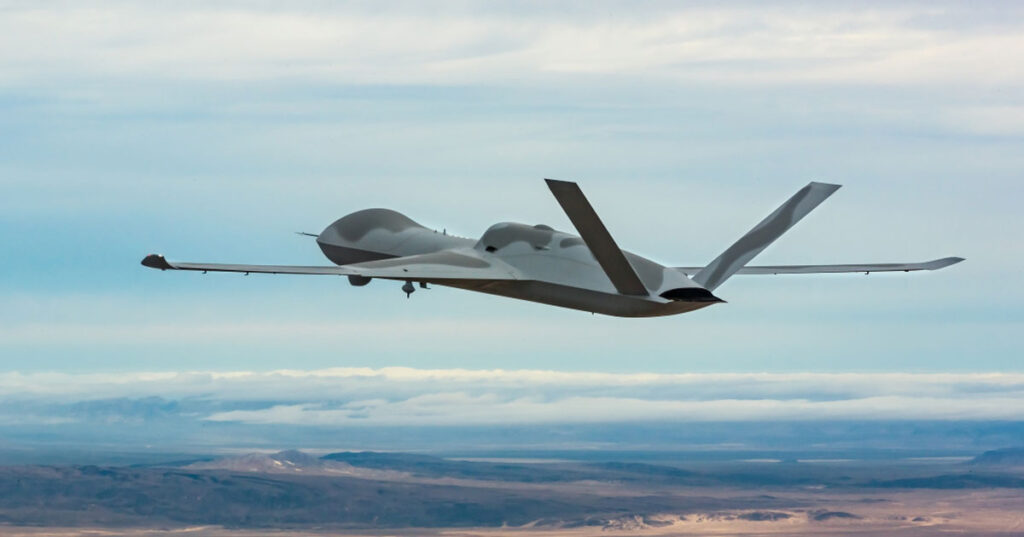
A pivotal demonstration at Edwards Air Force Base showcased a manned F-22 Raptor teaming with an MQ-20 Avenger unmanned aircraft, signaling a major shift in how tactics will be fought in contested skies.
The live-flight exercise was conducted under a program that aims to fuse human judgment with autonomous systems for greater lethality and survivability.
The event featured a human-piloted F-22 issuing real time commands to the MQ-20 via advanced autonomy software and a tactical data link.
The Avenger drone responded by executing a range of mission tasks, including waypoint navigation, combat air patrol patterns and simulated engagement of airborne threats, functioning as a direct force extender for the manned platform.
MORE NEWS: Pentagon Confirms First Military Execution in Over 60 Years Will Be Publicly Livestreamed
Because this was a controlled demonstration, the two aircraft operated in a seamless loop that highlighted how autonomous systems can extend the pilot’s reach without replacing human decision making.
Onboard sensors enabled the unmanned aircraft to process information independently, coordinate maneuvers and exchange tactical messages with the Raptor in a continuous command loop between the two aircraft.
“We appreciate the flawless execution of this mission using the government’s advanced autonomous systems,” said General Atomics President David R. Alexander. “This demo featured the integration of mission elements and the ability of autonomy to utilize onboard sensors to make independent decisions and execute commands from the F-22.”
The demonstration builds on General Atomics’ accelerating timeline for the Collaborative Combat Aircraft program. This progress comes as the Air Force validates new autonomy architectures and software frameworks across multiple vendors. On Feb. 12, the Air Force announced validation of the Autonomy Government Reference Architecture, or A-GRA, across multiple vendors. This included successful integration of Collins Aerospace’s Sidekick software on the General Atomics YFQ-42A CCA for its first semi-autonomous airborne mission.
The YFQ-42A, officially nicknamed “Dark Merlin” in a separate press release on Feb. 23, executed precise commands for more than four hours under ground operator control, validating reliable data exchange and autonomy execution that support advanced manned-unmanned teaming, such as the recent MQ-20/F-22 demo.
Edwards demonstrated that autonomy can complement fifth generation fighters by handling routine or dangerous tasks, thereby preserving pilot attention for complex decisions.
The Edwards demonstration is the latest in a series of tests underscoring the Air Force’s priority on pairing fifth-generation fighters with autonomous unmanned aircraft.
Such teaming concepts aim to boost lethality, extend sensor reach and enhance survivability in contested environments by enabling pilots to delegate tactical tasks to drones while retaining command authority for critical decisions. The results reinforce a vision of air power where manned and unmanned platforms operate as a unified system rather than as isolated assets.
From a policy perspective, this is exactly the kind of modernization President Trump has consistently championed.
The objective is clear: empower the bravest pilots to wage precision warfare with superior information and speed, while ensuring that cutting edge autonomy amplifies their effectiveness in high-threat environments.
Secretary of War Pete Hegseth has argued that a robust, agile defense industrial base is essential to deliver this capability on time and within budget. Therefore, continued investments in autonomy and manned-unmanned teaming are not optional, but imperative for keeping America ahead of near peer competitors.
Because the mission demonstrates a tangible path to greater battlefield resilience, supporters say the demonstrated integration of autonomy within existing fighters matters for deterrence.
At the same time, critics might ask how far this capability can go before humans cede too much control. Proponents respond that pilots will always retain decision authority for dire, high-stakes choices, while autonomous systems handle the repetitive, dangerous or data-heavy tasks that reduce risk to service members.
In this view, the technology acts as a force multiplier rather than a replacement for skilled aviators.
The demonstration also sends a message beyond the hangar doors. It shows that America’s defense leadership remains committed to pushing the envelope on modernization, even as adversaries monitor every step.
If the Raptor and Avenger can operate in lockstep today, the logic applies to future fighters, sensors and munitions that will define air superiority for decades to come.
And in that forward gaze, the collaboration between government researchers, contractors and the services continues to be the backbone of strategic strength.
Join the Discussion
COMMENTS POLICY: We have no tolerance for messages of violence, racism, vulgarity, obscenity or other such discourteous behavior. Thank you for contributing to a respectful and useful online dialogue.